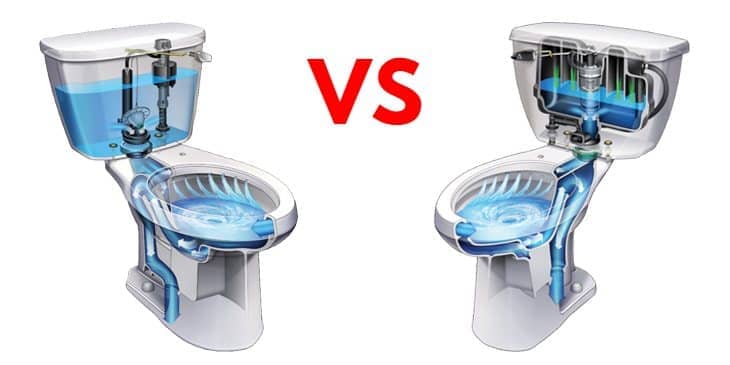
The siphonic jet vs gravity fed toilet debate trips up more buyers than any other toilet decision — not because the technology is complicated, but because most guides get the comparison backwards.
Siphonic jet toilets dominate the North American market and are often called the superior flush system, but drop one into a low-pressure building or a home on a private well below 20 PSI and it will underperform a basic gravity-fed model every single time. Choosing the wrong flush system means years of weak flushes, partial clears, or maintenance calls that never fully fix the problem.
This guide resolves that decision with specific, condition-based answers. It is written for homeowners replacing an existing toilet, builders spec’ing fixtures for new construction, and landlords managing multi-unit properties where flush reliability and maintenance cost matter. After reading, you will know exactly which flush system fits your home’s water pressure, household size, budget, and plumbing type — and you will know the one scenario where the conventional wisdom completely reverses.
⚠️ Common Mistake: Choosing a Flush System Without Checking PSI First
The single most common error I see is homeowners selecting a siphonic jet toilet because it “flushes better” — without ever checking their home’s water supply pressure. Siphonic flush systems require a minimum of 20 PSI to activate the siphon reliably. Homes on private wells, older apartment buildings, and top-floor units in multi-story buildings frequently run at 15–18 PSI. At that pressure, a gravity-fed toilet outperforms a siphonic model in every measurable way. Check PSI first. Every time.
What Is a Siphonic Jet Toilet?
A siphonic jet toilet uses a large, exposed flush valve — typically 3 or 4 inches in diameter — to release the full tank volume rapidly into the bowl through a directed jet port at the base of the trapway. That surge of water creates a siphon effect inside the trapway: water is literally pulled out of the bowl by the negative pressure generated as the trapway fills completely and seals off the air supply.
The siphon sustains itself until the trapway empties and air breaks the seal.
The trapway on a siphonic toilet is typically narrow — 2 to 2⅜ inches — and fully glazed. The narrow diameter is intentional: it forces the water column to fill and seal faster, which generates a stronger, more sustained siphon. Most siphonic toilets flush at 1.28 GPF or 1.6 GPF. High-efficiency siphonic models like the TOTO Drake II and American Standard Champion 4 achieve 1,000g+ MaP scores — meaning they clear over 1,000 grams of solid waste per flush at 1.28 GPF.
Siphonic jet toilets are the standard in the United States and Canada. Walk into any Home Depot or Lowe’s and roughly 85–90% of the toilets on the floor use siphonic flush technology. The elongated bowl shape, quiet fill cycle, and powerful single flush are all characteristics the American market has come to expect — and they all trace back to the siphonic system.
What Is a Gravity Fed Toilet?
A gravity fed toilet — also called a washdown or gravity-flush toilet — moves waste by using the weight and momentum of the water column falling from the tank. There is no siphon. The flush valve opens, water drops directly into the bowl, and the hydrostatic pressure of the falling water pushes waste over the rim of the trapway and down the drain. Once the tank empties, the flush is complete.
The trapway on a gravity-fed toilet is typically wider — 2½ to 3 inches — and positioned at the front of the bowl rather than the back. This wider, shorter trapway is far less susceptible to clogging because waste doesn’t have to travel as far or through as narrow a passage. Gravity-fed models dominate in Europe, Australia, and most of Asia, where water supply pressures and building drainage configurations differ from the North American standard.
In the USA, gravity-fed toilets appear most often in older homes (pre-1950s), low-pressure rural properties, and some commercial applications. They are also the flush mechanism behind many wall-mounted toilet systems, where the cistern is concealed inside the wall and relies on gravity drop rather than a siphon jet to flush.
Gravity-fed toilets are mechanically simpler: fewer moving parts, easier repair, and no dependency on a minimum supply pressure to function correctly. A gravity-fed toilet will perform identically at 10 PSI or 80 PSI. That pressure independence is their defining advantage — and the reason they remain the right answer for specific home types.
Siphonic Jet vs Gravity Fed Toilet: 5 Conditions That Change the Answer
The right choice between a siphonic jet and gravity fed toilet is never absolute — it depends on five specific conditions in your home. Most guides skip these conditions entirely and default to “siphonic is better.” That advice fails roughly 20–25% of American households where at least one of these conditions points the other direction.
The 5 Conditions:
- Water supply pressure (PSI) — siphonic requires 20+ PSI to function reliably
- Household size and flush frequency — impacts clog risk by flush system type
- Budget: upfront vs. long-term maintenance cost — they differ significantly
- Building type and plumbing configuration — high-rise, rural, or old stack systems
- DIY repair access and part availability — critical for landlords and remote properties
Branch 1: Water Supply Pressure — The Deciding Factor Most Buyers Ignore
If your home’s water supply pressure is consistently above 25 PSI, a siphonic jet toilet will outperform a gravity-fed model in flush power, bowl wash (the water coverage during the flush cycle), and waste clearance per gallon. At 30–60 PSI — the range most municipal-water homes operate in — siphonic jets achieve MaP scores of 800–1,000g+ at 1.28 GPF. That is genuinely more efficient than any gravity-fed model at the same volume.
If your home’s water supply pressure falls below 20 PSI, the calculus reverses completely. A siphonic jet toilet at 15 PSI will flush weakly, fail to fully activate the siphon on heavier loads, and leave the bowl incompletely washed. The jet port — which depends on a surge of high-velocity water — cannot generate enough force to initiate a proper siphon at low pressure. The result is double-flushing, partial clears, and accelerated staining of the vitreous china bowl surface.
A gravity-fed toilet at 15 PSI flushes just as reliably as it does at 60 PSI. The mechanism depends on tank volume and gravity — not supply pressure. For homes on private wells, top-floor apartments, aging municipal systems in rural areas, or any property where PSI fluctuates below 20, a gravity-fed toilet is the correct choice by a wide margin.
How to Check Your PSI
Attach a pressure gauge (available at any hardware store, $10–$18) to an outdoor hose bib or laundry connection. Check in the morning before peak usage. If you consistently read below 20 PSI, a gravity-fed toilet is the right flush system for your property. Between 20–25 PSI, either system will work, but gravity-fed offers a safety margin.
The conditional answer: If your supply pressure is 25+ PSI → choose a siphonic jet toilet. If your supply pressure is below 20 PSI → choose a gravity fed toilet. If you’re between 20–25 PSI and pressure fluctuates → gravity fed is the safer, more consistent performer.
Branch 2: Clog Frequency and Household Size
Siphonic jet toilets have a narrower trapway — 2 to 2⅜ inches — compared to the 2½ to 3-inch trapway on most gravity-fed models. That difference in trapway diameter directly affects clog susceptibility. For a single-person household or a couple, the difference is minimal. For a family of four or more with children in the house, the difference becomes measurable over a twelve-month period.
If your household uses thick toilet paper, flushes feminine hygiene products, or has young children who over-use paper, a gravity-fed toilet with a wider trapway will clog less frequently.
The wider opening requires more mass to obstruct. That said, a high-performance siphonic jet toilet like the American Standard Champion 4 — which uses a 4-inch flush valve and a larger-than-average trapway of 2⅜ inches — dramatically reduces clog risk compared to standard siphonic models. Many best-flushing toilets in the siphonic category are engineered specifically to minimize clogs through wider trapways and stronger jet velocity.
The conditional answer: If your household has 4+ people and frequent heavy use → a gravity-fed toilet’s wider trapway or a high-performance siphonic model with a 4-inch valve offers the best clog resistance. If your household is 1–3 adults using standard toilet paper → a standard siphonic jet toilet carries negligible clog risk compared to gravity-fed at adequate PSI.
Branch 3: Budget — Upfront Cost vs. Long-Term Maintenance
At the entry price point, gravity-fed and siphonic jet toilets overlap significantly: both types are available from $120–$280 for reliable residential-grade models. The difference emerges at the high end and in long-term ownership cost. Premium siphonic toilets — TOTO Drake II at $350–$430, Kohler Cimarron at $280–$360 — carry higher upfront costs because the engineering behind a high-MaP siphonic flush system is more complex than a gravity-fed mechanism.
Long-term maintenance cost favors gravity-fed models clearly. Gravity-fed flush mechanisms use fewer components: a simple flush valve, a fill valve, and a flapper. Replacement parts for standard gravity-fed systems cost $8–$22 at any hardware store and require no special tools. Siphonic jet systems — particularly models with tower-style flush valves or dual-flush mechanisms — use proprietary components that cost $25–$65 to replace and sometimes require the toilet-specific part rather than a universal fit.
The conditional answer: If you are spec’ing a rental property or a vacation home where long-term serviceability matters more than peak flush performance → gravity-fed is the lower-cost ownership choice. If you are installing a primary bathroom in a home with adequate PSI and want maximum flush performance over 10–15 years → a quality siphonic jet toilet ($300–$450) is cost-competitive when factoring in water efficiency and reduced double-flushing.
Branch 4: Building Type and Plumbing Configuration
Your building’s drain stack configuration affects which flush system performs more reliably. In a standard single-family home with a direct vertical drop to the main drain line, both siphonic and gravity-fed toilets perform as designed. In high-rise apartment buildings, the answer depends on which floor you’re on and how the building’s water pressure is managed.
Buildings taller than six stories typically use pressure-reducing valves at multiple floor levels to control supply pressure. Top-floor units in older buildings frequently experience PSI below 20, which creates the low-pressure problem described in Branch 1. In these buildings, a gravity-fed toilet is the correct specification — and many older high-rises were originally plumbed with gravity-fed fixtures for exactly this reason.
Rural homes on private well systems face a different version of the same problem. Well pumps cycle between a cut-in and cut-out pressure — commonly 30 PSI on, 50 PSI off on a standard pressure tank setting. During the low end of that cycle, PSI can drop to 25–28 PSI.
That is functional for a siphonic toilet, but homes with aging pump systems, undersized pressure tanks, or long supply lines to the bathroom may see consistent PSI below 20. A dual-flush toilet with a gravity-fed mechanism is a common and smart specification for rural properties.
The conditional answer: If you are in a multi-story building above the 6th floor or on a private well with PSI below 25 → gravity-fed is the lower-risk choice. If you are in a standard single-family home with municipal water at 30+ PSI → siphonic jet is the appropriate and better-performing specification.
Branch 5: Maintenance Access and Part Availability
For a homeowner in a major metro area with a hardware store nearby and a plumber available within 24 hours, part availability between siphonic and gravity-fed is a non-issue. For a landlord managing a remote vacation rental, a property manager overseeing a 20-unit building across town, or a homeowner in a rural area with limited service access, part availability becomes a genuine decision factor.
Gravity-fed fill valves and flush valves are universal. A Fluidmaster 400A fill valve ($11 at Walmart or Amazon) fits virtually every gravity-fed toilet sold in the last 40 years. A replacement flapper is a $4 item. Troubleshooting a gravity-fed toilet — running water, weak flush, phantom flush — is a 15-minute job for any handyman. These repairs require no specialized knowledge and no brand-specific parts.
Siphonic jet toilets — particularly TOTO models using the G-Max or Tornado flush system, or Kohler models with the Class Five canister valve — use proprietary flush tower assemblies that require the correct brand-specific replacement. A TOTO flush valve assembly runs $35–$55 and must be ordered online if not stocked locally.
For landlords, consider whether your maintenance staff can diagnose and repair a tower flush valve at 10pm on a Saturday. If the answer is no → gravity-fed is the lower-risk long-term specification for that property.
The conditional answer: If maintenance access is limited or staff are not plumbing-trained → gravity-fed toilets with universal parts reduce service cost and downtime. If you are a homeowner with reasonable access to parts and service → siphonic jet parts from major brands are widely stocked and this is not a meaningful differentiator.
What Most Comparison Guides Get Wrong About Siphonic Jet vs Gravity Fed Toilets
The standard framing in most siphonic jet vs gravity fed toilet comparisons is: siphonic = more powerful, gravity = simpler and cheaper. That framing is useful as far as it goes — but it leaves out three factors that matter significantly in real purchasing decisions.
What Most Guides Miss #1: Bowl Water Surface Area
Siphonic toilets have a larger water surface in the bowl — typically 9–10 inches front to back. Gravity-fed toilets have a smaller water surface — 6–7 inches — because the front-entry trapway position reduces the bowl depth available for standing water. A larger water surface means less bowl staining, less odor exposure, and less cleaning frequency. For buyers focused on hygiene and maintenance, this is a real, measurable advantage of the siphonic design that most comparison guides never mention.
What Most Guides Miss #2: Flush Noise Profile
Siphonic flush systems are louder during the flush cycle — the siphon break at the end of the flush produces a distinctive gurgle that can register at 65–72 dB in a tiled bathroom.
Gravity-fed flushes are generally quieter — 55–62 dB — because there is no siphon break. For a bathroom adjacent to a bedroom, or a half-bath near a home office, the noise difference is worth weighing. High-end siphonic models like the TOTO UltraMax II use a larger water channel to quiet the siphon break, but they still exceed the noise floor of a standard gravity-fed flush.
What Most Guides Miss #3: The WaterSense / GPF Efficiency Gap Has Closed
In 2010, siphonic jet toilets held a clear advantage in water efficiency at 1.28 GPF vs. the 1.6 GPF common in gravity-fed models. Today, WaterSense-certified gravity-fed toilets — particularly European-style washdown models — flush at 1.28 GPF with comparable waste clearance to mid-range siphonic models. The efficiency argument that historically favored siphonic designs is now model-specific, not system-specific. A modern gravity-fed dual-flush toilet at 0.8 GPF / 1.28 GPF uses less water than the majority of siphonic toilets on the US market.
⚡ When the Answer Flips — When a Gravity Fed Toilet Is the Correct Choice in a “Siphonic-Default” Home
The conventional default in US construction is siphonic jet. Most new homes are spec’d with siphonic toilets without ever measuring supply pressure.
The answer flips to gravity-fed when: (1) supply pressure tests below 20 PSI at the fixture location;
(2) the toilet serves a detached ADU, garage bathroom, or outbuilding fed from a pressure-reduced sub-line, (3) the building uses a greywater recirculation system that delivers water at non-standard pressure, or (4) the installation is a concealed-tank wall-hung toilet where tank height is limited and gravity drop replaces jet pressure as the primary flush force. In these four scenarios, defaulting to siphonic because “it’s what we always use” produces a chronically underperforming toilet.
Siphonic Jet vs Gravity Fed Toilet: Decision Matrix
The table below applies each of the five conditions directly to the siphonic jet vs gravity fed toilet comparison. Use your home’s actual measurements — not general assumptions — against each row.
| Condition | Siphonic Jet | Gravity Fed | Winner | Why |
|---|---|---|---|---|
| PSI above 25 | 800–1,000g MaP at 1.28 GPF | 500–700g MaP at 1.28–1.6 GPF | Siphonic Jet ✅ | Significantly stronger waste clearance per gallon |
| PSI below 20 | Siphon fails to activate reliably; double-flushing | Performs identically at any PSI | Gravity Fed ✅ | Pressure-independent — gravity does the work |
| Household 4+ people | Higher clog risk with standard 2–2⅜” trapway | 2½–3″ trapway resists clogs better | Gravity Fed ✅ | Wider trapway requires more mass to obstruct |
| Remote/rental property | Brand-specific parts, $35–$55, online ordering | Universal parts, $8–$22, any hardware store | Gravity Fed ✅ | Any handyman can service it with universal parts |
| Primary home, city water | Superior flush performance; larger bowl water surface | Adequate flush; quieter; simpler repair | Siphonic Jet ✅ | Higher MaP, larger water surface, better bowl wash |
| Wall-hung toilet | Less common; requires full pressure at carrier frame | In-wall cistern + gravity drop is standard design | Gravity Fed ✅ | Most wall-mounted systems are gravity-fed by design |
| Noise-sensitive location | 65–72 dB; distinct siphon break at cycle end | 55–62 dB; no siphon break | Gravity Fed ✅ | Meaningfully quieter flush cycle |
Frequently Asked Questions: Siphonic Jet vs Gravity Fed Toilet
Siphonic Jet vs Gravity Fed Toilet: What Is the Core Difference?
The core difference between a siphonic jet and a gravity fed toilet is the mechanism used to remove waste from the bowl. A siphonic jet toilet uses a jet of high-velocity water to initiate a siphon inside the trapway, pulling waste out by suction. A gravity fed toilet pushes waste out using the weight and momentum of falling water from the tank, with no suction involved.
Siphonic models require adequate supply pressure (20+ PSI) to function correctly. Gravity-fed models work at any supply pressure. In the US, siphonic jet toilets are the dominant design and generally offer higher MaP scores at 1.28 GPF when supply pressure is adequate.
Why do siphonic jet toilets flush better than gravity fed toilets?
Siphonic jet toilets flush more powerfully than gravity fed toilets in adequate-pressure conditions because the siphon effect generates significantly more force than gravity alone. When the jet port releases a surge of water into the base of the trapway, the trapway fills completely, seals off the air supply, and the resulting negative pressure pulls waste through with sustained force.
At 30–60 PSI supply pressure, top-rated siphonic toilets like the TOTO Drake II achieve MaP scores of 1,000g at 1.28 GPF — meaning 1,000 grams of solid waste cleared per flush. A comparable gravity-fed model at 1.28 GPF typically scores 500–700g on the same MaP test. The advantage disappears below 20 PSI, where the jet cannot generate enough velocity to initiate a proper siphon.
Are gravity fed toilets more likely to clog than siphonic jet toilets?
The relationship between siphonic jet toilet clogging and gravity fed toilet clogging is more nuanced than a simple yes/no. Gravity-fed toilets have wider trapways (2½ to 3 inches) that are geometrically harder to obstruct. Siphonic jet toilets typically have narrower trapways (2 to 2⅜ inches) that concentrate the siphon force but provide less clearance for bulky waste. In high-use households with 4+ people or heavy paper usage, gravity-fed toilets clog less frequently.
However, a high-performance siphonic model with a 4-inch flush valve — like the American Standard Champion 4 — pushes waste through its narrower trapway with enough velocity to make real-world clog frequency comparable to a gravity-fed model. For most households at adequate PSI, siphonic jet clogging risk is minimal with a quality model.
Can I upgrade from a gravity fed toilet to a siphonic jet toilet?
Upgrading from a gravity fed toilet to a siphonic jet toilet is straightforward in most homes — it is a standard toilet replacement and requires no plumbing modifications. The critical step before upgrading is measuring your supply pressure. Attach a gauge to a nearby hose bib and confirm you consistently read above 20 PSI, preferably 25+ PSI. If your home meets that threshold, any standard siphonic jet toilet with a 12-inch rough-in will install directly in place of your existing gravity-fed model.
The rough-in distance (floor drain center to wall) must match — 12 inches is standard in most US homes, with 10-inch and 14-inch variants for older construction. Verify your rough-in before purchasing. See our guide to standard toilet rough-in size before ordering.
What are the common problems with gravity fed toilets?
The most common gravity fed toilet problems are: (1) a running toilet caused by a worn flapper that no longer seals against the flush valve seat — a $4–$8 repair; (2) a slow or weak flush caused by a clogged rim jet or worn fill valve that doesn’t refill the tank to the correct level — a $12–$22 fill valve replacement fixes this in most cases;
(3) phantom flushing (the toilet runs briefly on its own) caused by a slow internal flapper leak — replaced in 15 minutes with a universal flapper; (4) a loose handle that fails to lift the flush lever reliably — a $5–$10 handle replacement. All gravity-fed toilet problems are DIY-serviceable with universal parts at any hardware store. This is a core advantage over proprietary siphonic flush mechanisms.
Which flush system lasts longer — siphonic jet or gravity fed?
The vitreous china bowl on both siphonic jet and gravity-fed toilets lasts 25–50 years with normal use. The meaningful lifespan difference is in the tank mechanism.
A gravity-fed tank mechanism — fill valve, flapper, flush valve — has 3–5 moving parts and replacement costs of $15–$35 for a complete rebuild kit. Gravity-fed mechanisms routinely last 10–15 years between major service.
A siphonic jet tank mechanism with a tower-style or canister flush valve has more components, proprietary parts, and replacement costs of $35–$75. With proper maintenance, both systems last the life of the toilet — but gravity-fed mechanisms require less technical knowledge and less cost to maintain over a 20-year ownership period. For a one-piece toilet where tank access is integrated into the bowl housing, siphonic jet models from major brands like TOTO and Kohler offer excellent long-term reliability with periodic seal replacement.
⚖️ Verdict: Which Flush System Is Right for You?
If your supply pressure is 25+ PSI and you are in a standard home with city water → Choose a siphonic jet toilet. You get higher MaP performance, a larger bowl water surface, and better waste clearance at 1.28 GPF. Start with a best-flushing toilet in the siphonic category.
If your supply pressure is below 20 PSI, or you are on a private well, in a high-rise above the 6th floor, or plumbing a wall-hung toilet → Choose a gravity fed toilet. Pressure independence and mechanical simplicity make gravity-fed the right system for these conditions. A dual-flush gravity model at 0.8/1.28 GPF covers both efficiency and reliability.
If you are spec’ing a rental property, remote vacation home, or any installation where long-term serviceability matters more than peak flush performance → Choose gravity fed. Universal parts, $8–$22 repairs, and zero proprietary components make gravity-fed the lower-cost ownership choice for hands-off installations. See our best two-piece toilets for durable gravity-fed options that are easy to service.
How Does a Siphonic Jet Toilet Work?
A siphonic jet toilet works by using a large-diameter flush valve — typically 3 or 4 inches — to release the tank’s full water volume rapidly through a jet port at the base of the trapway. That surge of high-velocity water fills the trapway completely in less than 1 second, sealing off the air supply.
The sealed trapway creates a negative pressure zone — the siphon — that actively pulls water and waste out of the bowl by suction. The siphon self-sustains until the trapway empties and air re-enters the system, breaking the seal with the characteristic gurgle at the end of the flush cycle.
The fill valve then refills the tank to the pre-set water line — typically 1 inch below the overflow tube — in 45–90 seconds depending on supply pressure and valve design.
The watersense-compliant refill cycle uses 1.28 GPF on all modern siphonic models certified under EPA WaterSense standards. The jet port location at the base of the trapway, rather than distributed around the rim, is what distinguishes a siphonic jet from a standard siphon-action toilet — the directed jet is what initiates the siphon faster and with more force.
For buyers researching specific siphonic jet models, the best-flushing toilets guide reviews the top-performing siphonic jet models by MaP score, GPF, and flush valve size. The TOTO lineup and the American Standard Champion series represent the two strongest siphonic jet systems in the US residential market by measurable flush performance.
Common Gravity Fed Toilet Problems and Solutions
Gravity fed toilet problems are well-documented and almost always DIY-fixable without a plumber. The four most common issues — running continuously, flushing weakly, phantom flushing, and a slow fill cycle — each have a specific mechanical cause and an inexpensive solution. Understanding these failure modes is also useful for anyone evaluating whether to repair an existing gravity-fed toilet or replace it with a siphonic jet model.
Continuous running: The flapper is not sealing against the flush valve seat. Either the flapper rubber has hardened or warped, or mineral deposits on the seat prevent a clean seal. Fix: replace the flapper ($4–$8, universal fit) or clean the seat with a plastic scrubbing pad. If replacing the flapper doesn’t stop the running within 24 hours, the flush valve seat itself is damaged and the entire flush valve assembly ($18–$28) needs replacement.
Weak or slow flush: Two causes: (1) the fill valve is not refilling the tank to the correct water level — the float arm or float cup needs adjustment or the valve needs replacement ($12–$22 for a Fluidmaster 400A); (2) the rim jets around the bowl are clogged with mineral scale, reducing rim wash coverage. For rim jets, insert a wire hanger into each jet hole or use a bottle of CLR poured into the overflow tube and left for 4 hours before flushing.
Phantom flushing: The tank is slowly losing water through the flapper, dropping the water level until the fill valve activates to refill. The toilet appears to “flush itself.” Adding a few drops of food dye to the tank and checking the bowl for color after 15 minutes confirms a flapper leak. Replace the flapper — this is a 10-minute repair.
All of the above repairs apply to any two-piece toilet with a standard gravity-fed tank. For a complete guide to gravity-fed and siphonic toilet models currently available, see the best toilets to buy comparison covering both flush types across all price ranges.
How to Choose Between a Siphonic Jet and Gravity Fed Toilet
Choosing between a siphonic jet and a gravity fed toilet comes down to three measurements and one property profile question. Take these four steps before you look at a single model:
Step 1 — Measure supply pressure: Use a gauge on the nearest hose bib. If you read 25+ PSI consistently, a siphonic jet toilet is the right flush system. Below 20 PSI → gravity fed. Between 20–25 PSI with fluctuations → gravity fed is the safer specification.
Step 2 — Measure your rough-in: Floor drain center to finished wall. 12 inches is standard. 10 inches and 14 inches exist in older homes. This measurement applies to both flush types — get it right before ordering any toilet. Refer to our rough-in size guide for measurement instructions.
Step 3 — Confirm household size and use profile: 4+ people with heavy paper use → prioritize a wider trapway (gravity-fed or a siphonic model with a 4-inch flush valve). 1–3 adults with standard paper → trapway diameter is not a meaningful differentiator.
Step 4 — Confirm installation type: Standard floor-mount → both options are available. Wall-hung → gravity-fed is the standard specification.
Rental or remote property → gravity-fed for serviceability. Primary home with full service access → siphonic jet offers the better long-term performance profile at adequate PSI. Once your flush system is selected, the comfort height vs standard height and one-piece vs two-piece decisions determine the final model. Both decisions are independent of flush system type — siphonic jet and gravity-fed toilets are available in every configuration across both dimensions.
