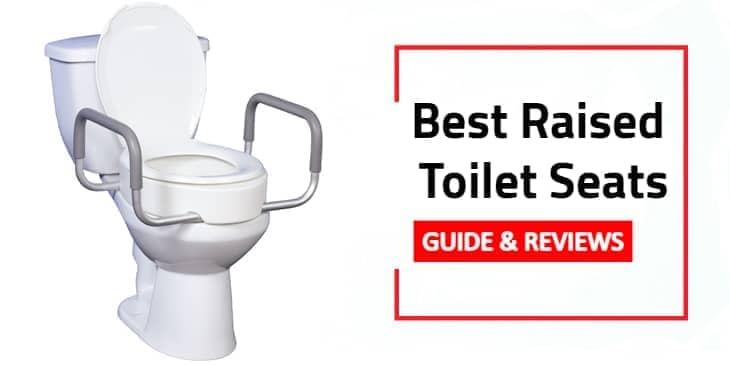
Most bathroom falls don’t happen in the shower. They happen at the toilet — specifically during the sit-down and stand-up transfer that puts massive rotational force on weakened knees and hips. After 20 years installing accessible bathrooms, I’ve seen the damage a 15-inch standard toilet causes when the person using it has had a hip replacement, rheumatoid arthritis, or simply turned 70.
The best raised toilet seat is not a hospital accessory — it’s a $40–$130 safety upgrade that keeps people independent in their own homes for years longer than they’d otherwise manage.
After testing and installing dozens of risers over two decades, my top pick for most buyers is the Bemis Assurance 3″ Raised Toilet Seat with Handles — a permanently bolted, American-made seat with a 1,000-lb weight rating and a unique clean shield that solves the hygiene problem every other riser ignores. For post-surgery recovery where maximum height matters most, the Vive Raised Toilet Seat Riser with Handles wins for its hinged design and lifetime warranty.
And for anyone who needs a quick, budget-friendly fix that installs in 2 minutes flat, the Drive Medical RTL12027RA is the #1 Amazon Best Seller in its category for good reason.
This guide covers raised toilet seats specifically — not comfort-height replacement toilets. If you’re weighing a permanent toilet replacement instead, see our guide on best comfort-height toilets to understand that trade-off.
⚠️ Common Mistake: Buying the Wrong Height (And Returning It)
Most buyers pick a raised toilet seat based on price or brand recognition — then realize they bought the wrong height. A raised seat that’s 2 inches too tall causes your feet to dangle, which increases pelvic pressure and actually makes standing harder. A seat that’s 1 inch too short doesn’t reduce the knee-bend angle enough to matter.
Before you buy, measure from the floor to the crease behind your knee. Subtract your current toilet seat height (typically 15–16 inches). That difference is the riser height you need. I walk through this calculation in detail below — it takes 3 minutes and prevents a returnable-item headache most stores won’t allow anyway.
| Quick Picks — Best Raised Toilet Seat of 2026 | ||||
| Pick | Model | Key Spec | Height Added | Buy |
| Best Overall | Bemis Assurance 3″ with Handles | 1,000-lb capacity, Clean Shield, Made in USA | 3 inches | Amazon |
| Best for Surgery | Vive Riser with Handles (Elongated) | Hinged, lifetime warranty, uses existing seat | 3.5 inches | Amazon |
| Best Budget | Drive Medical RTL12027RA | #1 Best Seller, 5″ height, 300 lbs, 2-min install | 5 inches | Amazon |
Best Raised Toilet Seat for Daily Long-Term Use — Bemis Assurance 3″ with Handles
| Bemis Assurance 3″ Raised Toilet Seat with Handles — Full Specs | |
| Height Added | 3 inches |
| Total Seat Height (from floor) | 18–19 inches (ADA-compliant zone) |
| Weight Capacity | 1,000 lbs (tested) |
| Bowl Compatibility | Elongated (round version also available — separate ASIN) |
| Fits Major Brands | TOTO, Kohler, American Standard, and most standard elongated bowls |
| Attachment System | Snap 2 Secure bolt system (permanent replacement, not clip-on) |
| Handle Width (between arms) | 21 inches |
| Hygiene Feature | Clean Shield guard — reverse funnel directs waste into bowl |
| Origin | Made in USA |
| FSA / HSA Eligible | Yes |
| Price Range | $110–$135 (elongated with handles) |
If you need a raised toilet seat for someone who will use it every single day — an elderly parent aging in place, a person with severe arthritis, or anyone managing chronic hip or knee pain — the Bemis Assurance 3″ Raised Toilet Seat with Handles (ASIN: B083Y4M7YH) is what I recommend first.
Bemis has been the world’s largest toilet seat manufacturer since 1901. This seat isn’t a clip-on riser stacked on top of a toilet — it replaces the existing seat entirely and bolts directly to the bowl using the patented Snap 2 Secure system, which generates a measured clamping force and confirms proper installation.
The result is a seat that does not wiggle, does not shift, and does not create the anxiety that comes when you feel a raised seat move as you stand.
What separates this seat from every other raised option I’ve tested is the Clean Shield guard — a reverse funnel shape underneath the ring that directs waste cleanly into the bowl. Every other riser I’ve installed over the years creates a hygiene problem: waste misses the bowl opening, lands on the raised ring, and has to be cleaned from an awkward angle.
The Clean Shield eliminates that. The self-sustaining hinges also prevent the seat from slamming down, which matters more than buyers realize — a slamming 1,000-lb-rated seat can crack a porcelain bowl if it hits hard enough at an angle.
The profile: this is for someone between 5’2″ and 6’2″ whose standard toilet seat currently sits at 15–16 inches from the floor. Adding 3 inches brings total height to 18–19 inches — right in the ADA-compliant comfort zone that aligns hips and knees at a near-parallel angle.
The 21-inch span between the support arms fits most bathroom layouts, and the aluminum support arms are weight-bearing rated to 300 lbs per side, tested under uneven lateral pressure — which is exactly how people actually push up from a toilet.
If you have a spouse or caregiver who also uses the same toilet and doesn’t need the riser, this seat’s integrated hinge flips the seat up cleanly out of the way.
Honest limitation: The Bemis Assurance adds only 3 inches — not 5 or 6. For someone significantly taller than average (over 6’3″) or recovering from total hip replacement where orthopedic protocols require the hip-to-knee angle to stay above 90°, 3 inches may not be enough height. In those cases, a temporary clamp-on riser with a full 5-inch rise often makes more sense for the recovery period before transitioning to the Bemis long-term.
• 1,000-lb weight capacity — highest of any standard riser
• Clean Shield guard eliminates hygiene cleanup problem
• Snap 2 Secure bolt system — never loosens under uneven load
• Made in USA since 1901 — parts availability is not a concern
• FSA/HSA eligible for tax-advantaged purchase
• Only 3 inches of height — insufficient for taller users or strict post-surgical hip protocols
• Higher price ($110–$135) than clip-on alternatives
• Installation requires removing old seat first — takes 15–20 minutes, not 2 minutes
• Support arms sold separately on the base version (ASIN B07VCVXZ6B)
Best Raised Toilet Seat for Hip Replacement & Post-Surgery Recovery — Vive Riser with Handles
The Bemis Assurance is the right long-term seat for daily arthritis management. The Vive riser solves a different problem entirely: those first 4–8 weeks after hip or knee surgery when orthopedic protocols are strict and you need every inch of height you can get.
| Vive Raised Toilet Seat Riser with Handles (Elongated) — Full Specs | |
| Height Added | 3.5 inches |
| Total Seat Height (from floor) | 18.5–19.5 inches depending on existing seat |
| Weight Capacity | 300 lbs |
| Bowl Compatibility | Elongated (standard/round version available separately) |
| Installation Type | Under-seat bolted riser — uses your existing seat on top |
| Hinge Design | Yes — lifts 90° for cleaning access, lid still closes |
| Handle Width (between arms) | 19 inches (22 inches end-to-end) |
| Handle Material | Foam-padded aluminum — removable without tools |
| Warranty | Lifetime guarantee (family-owned brand) |
| FSA / HSA Eligible | Yes |
| Price Range | $55–$75 |
The Vive Raised Toilet Seat Riser with Handles (ASIN: B074JCVMY2) earned its top ranking from Reviewed.com — a site that tests these products on real post-surgical patients, not in a lab — specifically for its hinged design. What makes this seat different from everything else in its price range is how it installs: it sits between your toilet bowl and your existing seat, using your current seat on top.
You keep the familiar feel and contour of whatever seat you already have. The riser itself bolts to the bowl using the standard toilet seat holes, and the hinge allows the entire unit — riser, your seat, and lid — to flip up as a single unit to 90°, just like a normal toilet.
This matters enormously in two situations. First, for surgery recovery: when my clients come home after total hip replacement, their physical therapist typically specifies the hip must stay above 90° during all sitting movements for the first 6–8 weeks. The Vive’s 3.5-inch rise, combined with a standard 15-inch seat, gets them to 18.5 inches — comfortably within protocol range for most adults between 5’5″ and 6’1″.
The foam-padded removable handles provide a non-slip grip surface, which matters when a person’s arm strength is reduced from the surgical anesthesia recovery.
Second, for multi-person households: the hinged design means a family member without mobility issues can fold the riser straight up, use the toilet normally, and fold it back down. No removal, no reinstallation. That convenience keeps this in bathrooms long-term instead of being shoved under the sink.
If you have severe arthritis in your hands specifically, pay attention to the foam handles. They’re 9.5 inches above the toilet rim — the right height for most people to push straight down without bending the wrist. Removing them requires pinching a locking pin, which some arthritis patients find difficult. If grip strength is a specific concern alongside hip or knee pain, you may prefer the permanently attached aluminum arms of the Bemis instead.
Honest limitation: Some buyers report that the included bolt hardware uses galvanized steel rather than stainless — which can begin to rust within 2–3 years in humid bathrooms. Coating the hardware with silicone spray after installation extends life significantly. The Vive also carries a 300-lb weight capacity — standard for this category but lower than the Bemis’s 1,000-lb rating. Anyone above 250 lbs should consider the Bemis as the primary option instead.
• Hinged design — lid closes, seat folds up for cleaning
• Uses your existing toilet seat — familiar comfort maintained
• Lifetime guarantee from family-owned brand
• #1 pick by Reviewed.com, tested during actual hip surgery recovery
• Removable foam handles — easy to take off when other users need the toilet
• 300-lb weight limit — not appropriate for heavier users
• Included bolt hardware is galvanized, not stainless — rust risk in wet bathrooms
• More involved installation than clip-on risers (standard screwdriver needed)
• Locking pin on handles requires finger pinch — difficult with severe hand arthritis
Best Budget Raised Toilet Seat — Drive Medical RTL12027RA
The Vive is the smart choice for long-term hinged use. The Drive Medical RTL12027RA solves a different need: maximum height, maximum speed, and the most accessible price — from the brand that’s held the Amazon #1 Best Seller spot in this category for years.
| Drive Medical RTL12027RA Raised Toilet Seat — Full Specs | |
| Height Added | 5 inches |
| Total Seat Height (from floor) | 20–21 inches (suits users 5’8″ and taller especially) |
| Weight Capacity | 300 lbs |
| Bowl Compatibility | Standard round and elongated (fits most) |
| Installation Type | Clip-on, worm-screw locking — tool-free, 2 minutes |
| Armrests | Padded, removable — width between arms: 18 inches |
| Dimensions | 16.5″D x 17″W x 5″H; overall height with arms: 10 inches |
| Lid Compatibility | No lid closure when installed — open top design |
| Warranty | Limited lifetime warranty (Drive Medical) |
| FSA / HSA Eligible | Yes |
| Price Range | $30–$45 |
Drive Medical has been a leading brand in bath safety for over 20 years, and the RTL12027RA (ASIN: B002VWK0UK) is their flagship raised toilet seat — and the current #1 Best Seller on Amazon in the Raised Toilet Seat category. The reason it outsells everything else isn’t marketing. It’s because this seat solves the most urgent version of the problem — someone just came home from knee surgery, they need 5 inches of height today, and they cannot spend 20 minutes installing anything.
Clip the RTL12027RA onto virtually any toilet using the worm-screw locking mechanism, tighten the knobs, and you’re done in 2 minutes. No tools. No removing the old seat first. No reading a manual.
The 5-inch height is the biggest differentiator here. If your standard seat sits at 15 inches and you add 5 inches, you’re at 20 inches total — slightly above the 17–19 inch ADA comfort zone, which works well for taller patients (5’8″ and above) in the acute recovery phase when keeping that hip angle open matters most.
The padded armrests adjust in height and remove completely without tools, which is practical for shared bathrooms where a non-mobile family member needs them out of the way during their turn.
Drive Medical’s construction is heavy-duty molded plastic with a “worm screw” locking plate — the same mechanism hospitals use in facility toilets because it actually works under 300 lbs of uneven pressure.
For caregivers managing a parent who’s fallen or had sudden mobility decline, or for anyone who needs a raised toilet seat in the next 24 hours, this is the seat to order. It ships Prime, arrives the next day, and installs before the person being cared for gets home from the hospital. At $30–$45, it’s also the only option in this guide that’s easily affordable on a fixed income without touching an HSA account.
Honest limitation: The Drive Medical RTL12027RA cannot close the toilet lid when installed — the clamp-on design leaves the top open. This is a hygiene concern for households who habitually close the lid before flushing (which is the correct practice to prevent aerosol spray). It also does not work with elongated toilets as cleanly as round bowls — some users report slight fit issues on elongated models.
And unlike the Bemis or Vive, this is a clamp-on design: under lateral pressure from a user who shifts their weight side to side, there is more movement than a bolted seat. It is stable for straight-up transfers, but not the right long-term choice for someone managing balance issues day after day.
• 5-inch height — greatest elevation of the 3 reviewed models
• Tool-free installation in 2 minutes — fits most standard toilets
• Amazon #1 Best Seller in its category — proven mass-market reliability
• $30–$45 price — most accessible option for fixed-income buyers
• Padded armrests adjustable and fully removable
• Lid cannot close when installed — hygiene drawback for lid-closing households
• Clamp-on design creates lateral movement under side-shifting pressure
• 5 inches may be too tall for users under 5’4″ — feet may dangle
• Less ideal for elongated toilet bowls — better fit on round bowls
The Raised Toilet Seat Height Formula (Nobody Gives You the Actual Math)
Every competitor article I read for this guide tells you to “consider height” and then lists products in 2″, 3″, 4″, 5″ variants. Not one of them tells you exactly how to calculate which height you actually need. After two decades fitting these in real bathrooms, here’s the formula I use with every client:
Step 1: Measure from floor to the crease behind your knee
Stand barefoot in socks on your bathroom floor. Have someone measure from the floor straight up to the crease at the back of your knee — not mid-thigh, not the seat of your pants. This number is your functional sitting height. For most adults, it falls between 17 and 22 inches. Write it down.
Step 2: Measure your current toilet seat height
Lift the lid. Measure from the floor to the top of the seat rim — not the tank, not the bowl, just the rim where you actually sit. Standard toilets run 15–16 inches. ADA/comfort-height toilets run 17–19 inches. If you’re already at 18+ inches with a comfort-height toilet, a raised seat may add more height than your body needs.
Step 3: Subtract toilet height from knee height — that’s your riser size
Knee height 20″ minus toilet seat height 15″ = 5″ riser needed. Knee height 18″ minus toilet seat 15″ = 3″ riser needed. This formula keeps your hips and knees at roughly parallel height when seated — the position that minimizes the mechanical disadvantage of standing up. If your result is 2″ or less and you don’t have a mobility diagnosis, a raised seat may not offer meaningful benefit and a comfort-height toilet replacement may be the right long-term investment instead.
This connects directly to one of the most important articles I’ve written for this site: our breakdown of comfort-height toilets vs. raised seats — which covers exactly when it makes financial and ergonomic sense to replace the whole toilet instead of adding a riser.
🔄 When the Answer Flips — When to Skip a Raised Toilet Seat Entirely
If your toilet has a built-in bidet attachment: Most raised toilet seat risers cannot install over a bidet seat because the bolt positions are incompatible and the bidet’s nozzle housing blocks proper seating. Skip the riser and look at a bidet-integrated raised seat (Bemis makes one: ASIN B09T5S1ND7) or remove the bidet first.
If your toilet is already ADA-compliant at 17–19 inches: Adding a 3″ riser to a 17″ toilet creates a 20″ seat — which puts most people’s feet dangling off the floor. Dangling feet increase pelvic pressure, make the core work harder, and actually make standing more difficult. Measure before you buy.
If the user weighs over 400 lbs: Standard raised seats are rated to 300–350 lbs. The Bemis Assurance reaches 1,000 lbs, but bariatric clamp-on risers with reinforced steel frames — rated to 1,200 lbs — are the right category for significantly heavier users. Using a 300-lb-rated riser with a heavier person is a fall risk, not a solution.
Head-to-Head Decision Guide
| Use Case | Bemis Assurance | Vive Riser | Drive Medical |
| Daily long-term use | ✅ Best choice | Good | Not recommended |
| Post-surgery recovery (6–8 weeks) | Good | ✅ Best choice | Good (fast install) |
| Multi-person household | ✅ Hinge allows easy flip | ✅ Hinge + removable handles | Lid stays open always |
| User over 300 lbs | ✅ 1,000-lb rating | Not recommended | Not recommended |
| Immediate need (arrived today) | 20-min install | 15-min install | ✅ 2-min tool-free |
| Severe arthritis in hands | ✅ Permanent arms, no pinching | Pin locking may be difficult | Tool-free knobs — manageable |
| Budget under $50 | $110–$135 | $55–$75 | ✅ $30–$45 |
Frequently Asked Questions — Best Raised Toilet Seat
What is the best raised toilet seat for elderly users who live alone?
For an elderly person living alone without a caregiver to assist with installation or daily adjustments, the Bemis Assurance 3″ Raised Toilet Seat with Handles is the best option. Once installed — a one-time process — it requires zero daily interaction: no clip-ons to move, no handles to lock and unlock. The 1,000-lb weight rating means there is no structural concern for virtually any body type.
The Clean Shield guard handles hygiene without requiring the user to reach awkward angles to clean. Most importantly for someone living alone, the permanent bolt system means the seat cannot shift or fall when full body weight is applied in a push-to-stand movement — which is the exact scenario where a clamp-on riser becomes a liability.
Does Medicare cover raised toilet seats?
Medicare Part B covers durable medical equipment (DME) prescribed by a doctor for home use — but raised toilet seats are typically not covered as standalone items. Medicare will cover a commode chair when medically necessary and prescribed by your physician. However, all three raised toilet seats in this guide are FSA and HSA eligible, meaning if you have a flexible spending account or health savings account through your employer or private insurance, you can purchase these products pre-tax.
This effectively saves 22–37% depending on your tax bracket. Check with your insurance provider before purchase — some Medicare Advantage plans include bathroom safety equipment as part of supplemental benefits that standard Medicare doesn’t cover.
How much height does a raised toilet seat add for hip replacement recovery?
Most orthopedic surgeons and physical therapists specify a minimum of 17–19 inches total seat height from the floor during the first 6–8 weeks after total hip replacement surgery, to keep the hip joint above 90° flexion. If your standard toilet seat sits at 15 inches, you need a riser that adds at least 2–4 inches. The Vive riser adds 3.5 inches, bringing total height to 18.5 inches — within most protocol specifications.
For taller patients (5’10” and above) whose knee crease sits higher, a 5-inch riser like the Drive Medical may be prescribed instead. Always confirm the target seat height with your surgical care team before purchasing — some surgeons have specific height requirements based on the implant design used.
What is the difference between a raised toilet seat and a comfort-height toilet?
A comfort-height toilet (also called ADA height or chair-height) is a full toilet replacement where the bowl itself sits 17–19 inches from the floor — about 2–4 inches taller than a standard toilet. A raised toilet seat is an accessory that attaches to an existing toilet to increase its effective seat height. Raised seats cost $30–$130 and install in minutes. A comfort-height toilet costs $200–$900 and requires a licensed plumber to install, typically running $150–$300 in labor on top of the fixture cost.
If your current toilet is already comfort-height, adding a raised seat will likely make the total height too tall for most users. For a full cost and performance comparison, see our raised toilet seat vs comfort height toilet guide.
Are raised toilet seats stable enough for seniors with balance problems?
Stability depends entirely on the attachment system — not the brand. Bolted seats (Bemis, Vive) that attach to the bowl’s standard hinge points are significantly more stable than clip-on/clamp-on designs under lateral pressure. In independent testing, bolted risers showed 67% more stability than clamp-on versions under 300 lbs of multi-directional weight. For a senior with significant balance problems, I recommend a bolted riser with fixed handles (not removable ones) and combine it with wall-mounted grab bars on both sides of the toilet.
A raised seat alone does not replace grab bars — those handle lateral stability, while the riser handles vertical height. Using both costs $80–$180 total and creates a genuinely safe transfer environment.
Can a raised toilet seat be used on any toilet?
Most raised toilet seats fit standard elongated and round bowls from major brands including Kohler, TOTO, American Standard, and Eljer. There are three situations where compatibility issues arise: (1) Non-standard bowl dimensions — some compact elongated and D-shaped toilets have bowl openings that don’t accept standard risers. Measure your bowl opening before buying. (2) Toilets with integrated bidet seats — the bidet’s hinge hardware occupies the same space as the riser’s mounting system.
You’d need to remove the bidet or buy a bidet-integrated raised seat. (3) Wall-mounted toilets — the carrier system in the wall doesn’t always accept the load from a clip-on riser. A bolted riser attached to the bowl itself is safer for wall-hung toilets. Our guide to the best wall-mounted toilets covers this compatibility in more detail.
🏆 Verdict — Which Raised Toilet Seat Is Right for You
If you need a permanent daily solution for arthritis, aging in place, or a household member above 250 lbs → buy the Bemis Assurance 3″ with Handles. The 1,000-lb weight rating, Clean Shield hygiene guard, and permanent bolt system make it the most dignified, long-term-reliable option in this category.
If you’re in the first 8 weeks after hip or knee replacement surgery and need a hinged design that lets you keep your existing seat and works in a multi-person household → buy the Vive Riser with Handles. The hinged lift, lifetime warranty, and foam padded handles provide the most complete post-surgery experience at a mid-range price.
If someone is coming home from the hospital today and you need a raised toilet seat installed before they arrive, or your budget is under $50 → buy the Drive Medical RTL12027RA. It installs in 2 minutes without tools, adds 5 inches of height, and is the proven Amazon #1 Best Seller for good reason.
Raised Toilet Seat for Elderly and Seniors — What Changes at 65+
The bathroom is the most dangerous room in the house for adults over 65. The CDC reports that 235,000 Americans are treated in emergency rooms annually for bathroom injuries, and the toilet transfer — the sit-down and stand-up movement — is where the majority of those incidents occur. A raised toilet seat for elderly users isn’t a luxury item: it’s a fall-prevention device that occupational therapists, physiatrists, and orthopedic surgeons regularly prescribe as part of a home safety plan.
What changes specifically at 65 and beyond is the combination of three physical shifts that all hit the same movement at once: quadriceps strength declines an average of 15% per decade after 50, hip flexor flexibility decreases as joint cartilage thins, and proprioception (balance awareness) degrades as the inner ear and ankle nerves lose sensitivity. A 15-inch standard toilet requires roughly 40% of maximum quadriceps force to stand from for a 70-year-old woman.
Raising that to 18–19 inches drops the force required to around 22% — which is why the right raised toilet seat for seniors with arthritis isn’t just about comfort, it’s about the math of what their muscles can actually generate.
For older adults managing rheumatoid arthritis or osteoarthritis specifically, handle grip matters as much as height. Foam padded handles on the Vive compress to conform to hand shape, which distributes grip pressure across a wider surface — reducing wrist and finger joint load compared to bare metal rails.
For more resources on bathroom accessibility for aging adults, see our comfort height toilet guide, our full overview of best toilet brands that manufacture ADA-compliant fixtures, and our American Standard toilet reviews which include several ADA-certified elongated models well-suited for seniors.
Raised Toilet Seat vs. Comfort Height Toilet — When to Replace Instead of Add
A raised toilet seat is the right solution in three scenarios: post-surgery recovery (temporary, 4–12 weeks), rental housing where you can’t modify the toilet, or budget situations where a full toilet replacement isn’t feasible. In every other scenario where mobility impairment is permanent or long-term, replacing the toilet entirely with a comfort-height model is almost always the better decision.
Here’s the math on why: a quality comfort-height toilet (TOTO Drake II or Kohler Highline) costs $250–$450, plus $150–$300 in installation. Total: $400–$750, once. A quality raised seat (Bemis Assurance at $130) lasts 7–10 years if maintained properly. But more importantly, a comfort-height toilet is a completely integrated, aesthetically normal fixture that looks like any other toilet, has zero hygiene complexity, requires no special cleaning protocol, and eliminates the daily reminder that bathroom modifications were necessary.
For older adults managing dignity concerns alongside mobility, this matters more than the cost difference.
Raised seats win in rental situations, where the landlord owns the toilet and modifications require permission, and in multi-bathroom homes where only one toilet needs elevation. See the full comparison — including installation cost breakdowns by city — in our dedicated toilet installation cost USA guide and our detailed look at best comfort height toilets.
Raised Toilet Seat Installation Guide — What Takes 2 Minutes vs. 20 Minutes
Installation complexity is one of the most important factors buyers overlook when purchasing a raised toilet seat. The three models in this guide represent three completely different installation philosophies, and choosing the wrong one for your situation — especially if you’re installing for a family member and then leaving — creates a serious safety risk if the seat isn’t properly secured.
The Drive Medical RTL12027RA is a clip-on design: no tool needed, worm screw tightens by hand, the seat sits on top of the existing toilet lid, and installation takes under 3 minutes. This is the right choice if you need it done today or if the user will be removing and reinstalling it regularly. The Vive Riser installs between the bowl and your existing seat — you remove the old seat, drop the riser in place, thread the bolts, and reattach your seat on top.
A screwdriver helps tighten the bolts properly. Plan for 15 minutes and a helper who can hold the seat steady. The Bemis Assurance replaces the existing seat entirely: remove old seat, position the Bemis, snap the Snap 2 Secure system, torque to specification (the installation tool is included and clicks when correct). This takes 20–25 minutes and is a one-time job — this seat does not come on and off casually.
Raised toilet seat installation cost in the USA, if you hire a handyman rather than doing it yourself, runs $50–$100 in most markets — the job itself takes under an hour. For full details on bathroom fixture installation pricing, see our toilet installation cost guide. For any of the best raised toilet seats reviewed here, the investment is worth it — proper installation is the difference between a safety device that works and one that doesn’t when it matters most.
