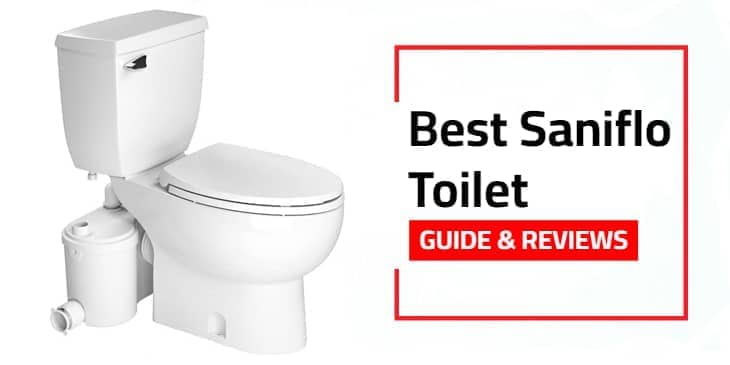
In 1957, a French company called SFA invented a toilet that didn’t need to connect to underground plumbing. Instead of flushing waste down through the floor, it ground the waste into slurry and pumped it up through small-diameter pipes to wherever the existing sewer line was — even if that meant pushing it 15 feet upward and 150 feet across a house.
That invention is the Saniflo upflush macerating toilet, and in 2026 it remains the only practical solution for adding a bathroom anywhere gravity plumbing can’t reach.
The decision to buy a Saniflo is different from buying any other toilet. You’re not choosing between designs or flush technologies — you’re solving a specific problem: a basement bathroom with no drain access below the slab, a garage or attic addition, a finished space where breaking the floor would cost $3,000–$8,000 in demolition alone.
This guide covers the three best Saniflo toilet systems for 2026 — the SaniPLUS for full residential bathrooms, the SaniBEST Pro for heavy-duty and commercial applications, and the SaniCOMPACT for compact half-bath installations — and explains exactly which situation each one is built for.
⚡ How a Saniflo Works — What Every Buyer Needs to Know First
The mechanism: When you flush, waste exits through the rear of the toilet bowl into a sealed macerator unit sitting behind or beside the toilet. Rotating blades grind the waste into fine slurry at 3,600 RPM. A pump then pushes the slurry up through small-diameter pipe (3/4″ or 1″) to your existing sewer stack — regardless of whether that stack is 15 feet above your bathroom floor.
What you need: A water supply connection (standard), a 115V GFI electrical outlet within reach of the macerator unit, and a 1.5″ vent pipe connected to your existing vent stack. The SaniCOMPACT is the exception — it does not require a vent connection.
What you cannot use: Flushable wipes, feminine hygiene products, dental floss, Q-tips, or paper towels in macerator models (SaniPLUS). These will jam the blades. The SaniBEST Pro grinder handles more waste types. Use only rapid-dissolving toilet paper in all Saniflo systems.
| ⚡ Quick Picks — Best Saniflo Toilet Systems of 2026 | |||||
|---|---|---|---|---|---|
| Pick | Model | Type | Vertical Lift | dBA | Buy |
| 🎯 Best Overall | SaniPLUS Full bath · Macerator · Quiet Range | Macerator | 15 ft | ~60 dBA | Amazon → |
| 🎮 Best Heavy-Duty | SaniBEST Pro Full bath + laundry · Grinder · 1 HP | Grinder | 25 ft | ~63 dBA | Amazon → |
| 🏆 Best Compact | SaniCOMPACT Half bath · Self-contained · Quietest | Self-Contained | 9 ft | ~53 dBA | Amazon → |
Saniflo SaniPLUS — Best Overall Residential Macerating System
| Specification | Detail |
|---|---|
| Type | Macerator pump — Quiet Range (new generation) |
| Motor | 1/2 HP — hardened stainless steel blades |
| Vertical Lift | Up to 15 feet above the unit |
| Horizontal Reach | Up to 150 feet from soil stack |
| Fixtures Supported | Toilet + sink + shower + bath (full bathroom) |
| Noise Level | ~60 dBA — 10dB quieter than previous generation |
| Flush Volume | 1.6 GPF |
| Discharge Pipe | 3/4″ or 1″ PVC, CPVC, or copper |
| Venting Required | Yes — 1.5″ vent pipe to main vent stack |
| Power | 115V — GFI circuit recommended |
| Certification | CSA (IPC, NSPC), IAPMO (UPC) — ASME A112.3.4 |
| Warranty | 2-year standard + 2-year extended with registration (4 years total) |
The SaniPLUS has been the most widely installed residential upflush system in North America for decades, and the updated Quiet Range version makes the case even stronger. The redesign reduced operating noise by 10 decibels — from roughly 70 dBA on the original to approximately 60 dBA on the new unit. That’s the difference between a system that’s comparable to a conventional toilet flush and one that sounds like a moderate dishwasher cycle. For a basement bathroom adjacent to finished living space, this matters considerably.
The 1/2 HP motor with hardened stainless steel blades is sealed for life in an oil-filled enclosure — there is no scheduled blade replacement or service interval on the cutting mechanism. The pressure chamber design means the unit starts and stops automatically on each flush with no manual intervention. At 15 feet of vertical lift and 150 feet of horizontal reach, the SaniPLUS handles the layout of virtually any residential basement, garage, or addition bathroom with access to a standard water supply and electrical outlet.
The honest limitation of the SaniPLUS is what it cannot handle. It is a macerator, not a grinder — the distinction matters. The blades are designed for human waste and toilet paper only. Flushing wipes (even products labeled “flushable”), feminine hygiene products, dental floss, cotton swabs, or paper towels will jam the macerator blades and can require a service call to clear.
In a single-family home where usage is controlled, this is manageable with household rules. In a rental unit, secondary apartment, or any bathroom where you don’t control who uses it, this is a significant operational risk — the SaniBEST Pro grinder is the correct choice for those situations.
Maintenance requires descaling the unit every 3 months using Saniflo’s descaler product ($15–$25 per treatment). This prevents calcium and mineral buildup in the macerator chamber and is non-negotiable in hard water areas. The SaniPLUS kit version includes the macerator pump, toilet bowl, tank, and soft-close seat — a complete system ready for installation.
Installation requires connecting to the water supply, routing the small-diameter discharge pipe to the soil stack, connecting the vent, and plugging into a GFI outlet. See our toilet installation cost guide for a full breakdown of labor costs by market.
Saniflo SaniBEST Pro — Best Heavy-Duty Grinder System
The SaniPLUS handles controlled residential use. The SaniBEST Pro handles everything the SaniPLUS cannot — commercial settings, rental units, and situations where you cannot guarantee only toilet paper goes down the drain.
| Specification | Detail |
|---|---|
| Type | Grinder pump — commercial-grade stainless steel blades |
| Motor | 1 HP — double the SaniPLUS motor power |
| Vertical Lift | Up to 25 feet above the unit |
| Horizontal Reach | Up to 150 feet from soil stack |
| Fixtures Supported | Toilet + sink + shower + bath + washing machine (full bath + laundry) |
| Waste Handling | Sanitary napkins, dental floss, Q-tips — grinder handles accidental items |
| Noise Level | ~63 dBA — slightly louder than SaniPLUS Quiet Range |
| Service Panel | Built-in access panel on top — electrical components accessible without disconnecting plumbing |
| Discharge Rate | 19 GPM at 25 ft — shut-off head 38 ft |
| Certification | CSA (IPC, NSPC), IAPMO (UPC) — trusted by US professionals 30+ years |
| Warranty | 2-year standard + 2-year extended with registration |
The SaniBEST Pro is not an upgraded SaniPLUS. It is a fundamentally different type of system. The SaniPLUS uses a macerator — rotating blades that liquefy waste. The SaniBEST Pro uses a grinder — a commercial-grade cutting system with a 1 HP motor and hardened stainless steel blades designed to pulverize sanitary napkins, dental floss, Q-tips, and other materials that would jam a standard macerator immediately. This distinction determines which unit you need, and it’s the single most important specification in this product category.
The 25-foot vertical lift is the SaniBEST Pro’s other key advantage. Standard basements sit 8–10 feet below grade; a first-floor sewer connection from a deep basement may require 12–18 feet of vertical lift. The SaniBEST Pro’s 25-foot capacity gives you a meaningful buffer for deep basements, multi-story routing, or installations where the discharge path involves significant height gain. The SaniPLUS’s 15-foot limit handles most standard basement depths, but anything unusual warrants the SaniBEST Pro specification.
The built-in service panel on top of the SaniBEST Pro is a practical maintenance advantage. Accessing the electrical components — capacitor, microswitch, circuit board, membrane — does not require disconnecting the plumbing. For a basement installation in a finished space where replumbing would mean opening walls or ceilings, this access design saves significant time and cost for any future service visit.
The honest limitation of the SaniBEST Pro is price and noise. At roughly $300–$400 more than the SaniPLUS kit, the grinder premium is real. At ~63 dBA during operation, it is 3 decibels louder than the Quiet Range SaniPLUS — not a dramatic difference, but noticeable in a quiet home.
For a primary family bathroom adjacent to bedrooms, this matters. For a basement utility bathroom, a garage, or a rental unit, it doesn’t. The SaniBEST Pro also supports washing machine connections — making it the correct choice for any basement bathroom that will include a laundry hookup. For comparison with other toilet brands at conventional price points, see our American Standard toilet guide.
Saniflo SaniCOMPACT — Best Self-Contained Half-Bath Solution
The SaniPLUS and SaniBEST Pro have a visible external pump box behind the toilet. The SaniCOMPACT has everything — bowl, macerator, and pump — contained inside a single vitreous china unit. No pump box. No external components. Just one toilet.
| Specification | Detail |
|---|---|
| Type | Self-contained one-piece — macerator and pump inside china base |
| Motor | 0.3 HP — 3,600 RPM macerator blades |
| Vertical Lift | Up to 9 feet above the unit |
| Horizontal Reach | Up to 100 feet from soil stack |
| Fixtures Supported | Toilet + 1 sink (half bath only — no shower or bath) |
| Flush Volume | 1.28 GPF / 1.0 GPF dual flush (WaterSense levels) |
| Noise Level | ~53 dBA — quietest unit in the Saniflo lineup |
| Venting Required | No — self-contained unit, no vent stack connection needed |
| Bowl Height | 18.5 inches — comfort height (ADA-compliant) |
| Discharge | 360-degree rotatable discharge elbow — flexible routing |
| Certification | CSA (IPC, NSPC) — ASME A112.3.4 |
The SaniCOMPACT solves a specific problem: you need a toilet in a space that is too small or too finished to accommodate a separate external pump box. The entire macerating and pumping system is housed inside the vitreous china base — when you look at it, it looks like a modern one-piece toilet with no visible external hardware.
For a closet conversion, an under-stair bathroom, a tight basement powder room, or any space where aesthetics matter and a plastic pump box beside the toilet is unacceptable, the SaniCOMPACT is the only Saniflo option that delivers a clean, finished look.
The no-vent-required design is a practical installation advantage that cuts roughly 25% of the installation work versus the SaniPLUS or SaniBEST Pro. You only need three connections: water supply to the bowl, discharge pipe to the soil stack, and electrical to the GFI outlet. This simplicity makes the SaniCOMPACT genuinely DIY-accessible — real-world installation reports from Home Depot reviews confirm half-day installations by homeowners with no plumbing background.
At ~53 dBA during operation, it is also the quietest unit in the lineup by a significant margin — 7 dB quieter than the SaniPLUS and 10 dB quieter than the SaniBEST Pro.
The honest limitation of the SaniCOMPACT is its maximum vertical lift of 9 feet and half-bath-only fixture capacity. If your installation point is in a deep basement — 10 or more feet below the sewer connection — the SaniCOMPACT will not reliably move waste the required distance.
Use the SaniPLUS or SaniBEST Pro. If you want a full bathroom with a shower or tub in addition to the toilet, the SaniCOMPACT cannot handle that volume — it supports only one additional fixture (a sink). The other limitation is serviceability: because all components are inside the ceramic base, any mechanical repair requires more access work than the external-pump models. For small bathroom applications comparing Saniflo to compact conventional toilets, see our best small toilet guide.
Saniflo vs Regular Toilet — The Honest Cost Comparison Nobody Does For You
Every Saniflo review lists the product price and calls it expensive compared to regular toilets. What they don’t do is compare the right thing. A Saniflo upflush system doesn’t compete with a $400 conventional toilet. It competes with what it would cost to install a conventional toilet in the same location — and in a basement, garage, attic, or finished space with no existing floor drain, those numbers are dramatically different.
Option A: Add a Toilet Via Conventional Plumbing in a Finished Basement
Concrete breaking and removal: $800–$2,000 · New drain line trenching and installation: $1,500–$3,500 · Concrete repair and floor restoration: $500–$1,500 · Standard toilet + installation: $400–$800 · Total: $3,200–$7,800. Permit requirements and inspection delays add further cost in many jurisdictions. This is before addressing any unexpected plumbing conditions discovered under the slab.
Option B: Add a Toilet Via Saniflo in the Same Basement
SaniPLUS kit: $900–$1,200 · Plumber installation (4 hours): $300–$500 · Pipe and fittings: $50–$150 · Total: $1,250–$1,850. No concrete breaking. No permit in most US jurisdictions for above-floor plumbing. Full installation in one day. The Saniflo option costs 60–80% less than the conventional option in this scenario.
When a Saniflo is NOT the Right Answer
If you’re replacing an existing toilet that already has floor drain access — a ground-floor bathroom replacement, an above-grade bathroom renovation — a conventional toilet at $300–$800 installed makes far more sense than a Saniflo at $900–$1,500+. Saniflo’s value proposition exists specifically where conventional below-floor plumbing is unavailable or prohibitively expensive to add. In locations where standard gravity plumbing is accessible, conventional toilet brands like TOTO or Kohler deliver superior flush performance at lower total cost.
The ongoing cost picture also matters. Saniflo systems require descaling every 3 months (approximately $60–$100 per year), rapid-dissolving toilet paper (slightly more expensive than standard), and periodic pump inspection. Conventional toilets require a wax ring replacement every 10–20 years and occasional fill valve or flapper servicing.
Over a 10-year ownership period, a Saniflo’s total cost of ownership exceeds a conventional toilet’s by approximately $500–$1,000 — but that comparison is irrelevant if the alternative was a $5,000–$7,000 excavation project. For full context on how the cost compares across all toilet types and installation scenarios, see our toilet installation cost guide.
Frequently Asked Questions — Saniflo Toilets
What is the best Saniflo toilet for a basement bathroom in 2026?
For most residential basement bathrooms, the SaniPLUS Quiet Range is the best choice — it handles a full bathroom including toilet, sink, shower, and bath, lifts waste 15 feet vertically, and operates at ~60 dBA with the new noise reduction design. If your basement is exceptionally deep (requiring more than 15 feet of vertical lift), or if the bathroom is in a rental unit where you can’t control usage, use the SaniBEST Pro.
If you only need a half bath (toilet and sink) and the space is very tight, the SaniCOMPACT’s self-contained design and no-vent requirement make it the simpler installation — provided your vertical lift requirement is 9 feet or less.
Why is my Saniflo toilet not working?
The most common cause of Saniflo failure is a blocked macerator — caused by flushing anything other than toilet paper and human waste. Wipes (including “flushable” labeled products), feminine hygiene products, dental floss, cotton swabs, or paper towels wrap around the macerator blades and stop the unit.
If the unit hums but doesn’t pump, the blades are likely jammed. Saniflo sells a descaler that can dissolve organic blockages; mechanical blockages require accessing the macerator chamber. Other common issues include a failed microswitch (unit doesn’t start after flushing), a tripped GFI outlet (check the outlet first — this is often mistaken for a unit failure), or a failed pressure chamber membrane. Saniflo’s US customer support line can diagnose most issues by model number and symptom description.
What is the Saniflo toilet installation cost in the USA in 2026?
Professional installation of a SaniPLUS or SaniBEST Pro system typically runs $300–$500 in US labor costs, plus $50–$150 in pipe, fittings, and connectors. Total professionally installed cost including the unit runs $1,250–$1,850 for a SaniPLUS system and $1,600–$2,200 for a SaniBEST Pro system. DIY installation is widely considered achievable in 4–6 hours with basic plumbing familiarity.
The SaniCOMPACT is the simplest DIY installation — three connections, no venting, reported half-day completion by homeowners with no professional plumbing background. Full regional pricing in our toilet installation cost guide.
Can I use regular toilet paper with a Saniflo?
Standard single-ply or thin two-ply toilet paper that dissolves rapidly in water is acceptable in all Saniflo macerator models. Thick quilted toilet paper, extra-strong multi-ply tissue, and toilet paper marketed as “extra soft” or “extra thick” dissolves more slowly and can accumulate in the macerator over time.
The safest choice is rapid-dissolving toilet paper — the type sold for RV, marine, or septic applications. What is never acceptable in any Saniflo macerator model (SaniPLUS) is any wipe, regardless of whether the packaging says “flushable” — those products do not dissolve and will jam the blades. The SaniBEST Pro grinder handles occasional accidental items more tolerantly, but still benefits from rapid-dissolving paper under normal use.
What is the difference between the SaniPLUS and the SaniBEST Pro?
The SaniPLUS is a macerator — it uses rotating blades to liquefy human waste and toilet paper only. The SaniBEST Pro is a grinder — it uses a more powerful 1 HP motor and commercial-grade cutting system designed to handle sanitary napkins, dental floss, Q-tips, and other materials that would immediately jam a standard macerator.
The SaniBEST Pro also lifts waste 25 feet vertically versus 15 feet for the SaniPLUS, and supports washing machine connections. Use the SaniPLUS for controlled single-family household use. Use the SaniBEST Pro for rental units, commercial settings, high-traffic applications, or anywhere usage is uncontrolled. The price difference between the two is approximately $300–$400 in kit pricing.
Can I install a Saniflo toilet in a garage or attic?
Yes — garages and attics are common Saniflo installation locations, and the technology is well suited to both. For a garage bathroom, the key requirement is that the discharge pipe must connect to your existing vent stack, and the unit must be protected from freezing if the garage is unheated — the water in the discharge pipe must drain fully by gravity after each pump cycle, or the pipe must be insulated or heated.
For an attic bathroom, the discharge pipe runs downward rather than upward, making vertical lift calculations more favorable. Horizontal distance is typically the limiting factor in attic installations — confirm your routing distance is within the model’s 100 ft or 150 ft horizontal specification. Both installations require a 115V GFI outlet within reach of the unit. See our small toilet guide for compact conventional alternatives if the installation location allows standard plumbing.
Verdict — Which Saniflo Toilet System Should You Buy?
Adding a full bathroom in a basement or finished space under controlled household use? Buy the SaniPLUS Quiet Range. The 15 ft vertical lift, full bathroom capability, and 10 dB noise reduction over the previous generation make it the right residential system for 90% of upflush bathroom installations.
Adding a bathroom in a rental unit, commercial setting, or anywhere usage is uncontrolled? Buy the SaniBEST Pro. The grinder system handles what the macerator cannot, the 25 ft vertical lift covers deep or complex installations, and the built-in service panel makes future maintenance simpler. The price premium is justified when protecting against blade jams from uncontrolled flushing habits.
Adding a half bath in a very small or finished space where aesthetics matter? Buy the SaniCOMPACT. The self-contained design, no-vent requirement, and ~53 dBA quiet operation make it the most installation-friendly and visually cleanest Saniflo option — as long as your vertical lift is 9 feet or less and you only need toilet plus sink.
A Saniflo toilet system is the right answer when conventional plumbing isn’t practical. Where it is practical, conventional brands deliver better flush performance and lower lifetime cost — our best toilet brands guide covers those options in full.
Saniflo Toilet for Basement Bathroom — What You Need Before You Buy
A basement bathroom is the most common Saniflo installation scenario, and the one where the cost comparison against conventional plumbing is most compelling. Before purchasing, measure two numbers: the vertical distance from where your toilet will sit to where the discharge pipe will connect to your soil stack (your vertical lift requirement), and the horizontal distance the pipe must travel (your horizontal reach requirement).
If vertical lift is under 15 feet and horizontal reach is under 150 feet, the SaniPLUS is your unit. If vertical lift exceeds 15 feet, the SaniBEST Pro is the correct model. Confirm there is a 115V GFI outlet within 4–6 feet of the installation point; if not, budget $150–$250 for an electrician to add one before the toilet installation. Most US jurisdictions do not require a permit for above-floor plumbing, but verify with your local building department — requirements vary by state and municipality.
Saniflo Toilet for Garage or Attic — Key Requirements
Garages and attics present the same basic Saniflo installation requirements as basements with two additional considerations. For garages: freeze protection is critical if the garage is unheated. After the pump stops, water must drain completely from the discharge pipe by gravity — if the pipe has any upward slopes or flat sections that retain water, that water will freeze in winter and potentially damage the pump or crack the pipe.
Route the discharge pipe with a slight downward slope toward the connection point wherever possible. For attics: the discharge runs downward to the sewer connection, making vertical lift favorable. Horizontal distance is the limiting factor — confirm your routing stays within 150 ft.
Both locations require a GFI outlet within reach of the unit. If your garage or attic is the only practical bathroom location and conventional plumbing access is unavailable, a Saniflo system is the only code-compliant above-floor solution in the US market.
Saniflo Toilet Installation Cost USA — Full 2026 Breakdown
Professional installation of a SaniPLUS or SaniBEST Pro by a licensed plumber runs $300–$500 in most US markets in 2026, with urban markets like New York, San Francisco, and Chicago running $400–$600. Add the unit cost ($900–$1,500 for SaniPLUS kit, $1,300–$1,800 for SaniBEST Pro kit) and materials ($50–$150 in pipe and fittings), and total installed costs range from $1,250–$2,250 depending on model and location.
DIY installation is the norm for Saniflo — the manufacturer designed the system for 4-hour self-installation, and the majority of buyers install without professional help. SaniCOMPACT installations are consistently reported as the simplest, with homeowners completing the job in half a day. Full market-by-market pricing in our toilet installation cost guide.
Whichever Saniflo toilet system you install, the long-term maintenance commitment is the same: rapid-dissolving toilet paper only, descaling every 3 months, and a quick visual check of the discharge line connection annually. These steps are non-negotiable for keeping the system running reliably for 10–15 years. For buyers who want to compare upflush technology against the best conventional options on the market before deciding, our best flushing toilets guide covers the leading conventional alternatives.
