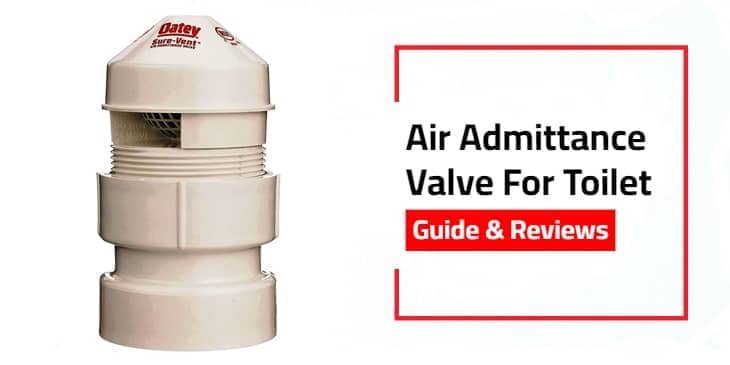
Most homeowners don’t know their toilet is being silently strangled. When a toilet flushes, it pulls 1.28 gallons of water down a 3-inch drain in under four seconds — and that rush creates a vacuum powerful enough to siphon the water right out of every P-trap in the bathroom.
Without proper venting, that vacuum turns into gurgling pipes, slow drains, and sewer gas entering your home. That’s exactly where the air admittance valve for toilet venting comes in. It’s one of the most misunderstood devices in residential plumbing — and one of the most useful when applied correctly.
This guide covers everything about air admittance valves: what they are, how they work, when they’re the right call, USA code compliance, sizing, troubleshooting, and cost. If you’re dealing with a gurgling toilet, planning a bathroom remodel, or adding a toilet where running a traditional vent isn’t practical, start here.
Also evaluating toilets for this new bathroom? Our best flushing toilets guide covers models that work well in tight-venting situations. Adding a basement bath? See our best two-piece toilet guide — two-piece models are the most common choice for basement additions.
⚠️ Common Mistake: Assuming AAVs Are Plug-and-Play
The most common error I see is homeowners buying an air admittance valve at Home Depot and installing it without checking local plumbing code first. AAVs are approved under the International Plumbing Code (IPC) in 37 states — but the Uniform Plumbing Code (UPC), used in California, Oregon, Washington, and others, restricts them significantly. Installing an AAV where the UPC applies can mean a failed inspection and mandatory rework. Always check your jurisdiction before purchasing.
| ⚡ AAV Quick Reference | ||||
| Topic | Detail | Topic | Detail | |
|---|---|---|---|---|
| Valve Type | One-way mechanical vent | Toilet Size | 2″ or 3″ adapter | |
| Code Standard | ASSE 1051 (individual/branch) | Min Height | 4″ above branch drain | |
| Toilet DFU Load | 3 DFUs (1.6 gpf toilet) | Still Needs | 1 roof vent (whole system) | |
| IPC Allowed | Yes — 37 states | UPC Allowed | Restricted — verify locally | |
| DIY Cost | $15–$60 (valve only) | Pro Install Cost | $150–$350 total | |
Best Air Admittance Valve for Toilet + Sink Combo — Studor 20346 Redi-Vent
If you’re adding a basement toilet alongside a sink and need a compact, code-compliant AAV that fits in tight cabinet spaces, the Studor 20346 Redi-Vent is the one most licensed plumbers reach for first.
| 📋 Studor 20346 Redi-Vent — Specifications | |
| Valve Type | Individual / Branch AAV (one-way, gravity-seal) |
| DFU Capacity | 20 DFU on a branch |
| Pipe Connection | 1½” or 2″ PVC adapter (solvent-weld) |
| Temperature Rating | -40°F to 150°F (-40°C to 65.6°C) |
| Code Compliance | ASSE 1050 and ASSE 1051 |
| Wall Box | Built-in mounting flange + snap-on grill (recessed installation) |
| Vermin Protection | Exclusive Studor screen — keeps insects and debris out of valve body |
| Best For | Toilet + sink combination, single bathroom group up to 4 DFU combined |
| Price Range | $18–$28 on Amazon |
| Warranty | Limited lifetime warranty for replacement of defective valves |
The Studor 20346 Redi-Vent is the version I see most often in finished basements and half-bath additions across the country. Its built-in wall box with snap-on grill solves the access requirement cleanly — the grill stays removable for inspection while the valve sits recessed inside the stud bay, completely out of sight. That’s a meaningful design advantage over bare-body AAVs that require a separate access panel to meet code.
At 20 DFU capacity, the Redi-Vent handles a toilet (3 DFUs) plus a bathroom sink (1 DFU) with substantial headroom to spare. The exclusive Studor vermin protection screen prevents insects and airborne debris from working into the valve body — a real-world failure mode on unprotected valves installed in unfinished basements or crawl spaces. The -40°F to 150°F temperature range covers every climate zone in the contiguous U.S., including attic installations in southern states where summer temperatures spike.
Installation is solvent-weld onto a 1½” or 2″ PVC sanitary tee. No threading, no special tools. The valve body is compact enough to fit inside a standard 2×4 stud bay — a 3½-inch cavity — which matters when you’re retrofitting into a finished wall with minimal clearance. For a half-bath addition or basement bathroom where the toilet is vented to a 2-inch vent pipe, this is the correct-sized valve with no guesswork.
Honest limitation: The 20346 is rated at 20 DFUs on a branch, but that number assumes the valve is installed within the maximum developed vent length and at the correct height above the branch drain. In real-world installations where the vent pipe runs long before reaching the AAV — over 6 feet on a 1½-inch line — effective capacity drops. If your vent run is borderline, step up to the Oatey 160 DFU valve below rather than gambling on the 20346’s rated ceiling.
- Built-in wall box + snap-on grill meets code access requirement without a separate panel
- Compact enough for 2×4 stud bay — works in retrofits with tight clearances
- Exclusive vermin screen keeps insects and debris out of the seal
- ASSE 1050/1051 certified — accepted by IPC inspectors
- Industry-leading brand with decades of U.S. installation history
- Limited lifetime warranty on defective valves
- 20 DFU cap — not sized for a full bathroom group with tub/shower (need 160 DFU valve)
- PVC only — ABS pipe requires the 20349 ABS-adapter version
- Not recognized as a mechanical vent under the International Building Code (IBC) commercial applications
- Price per unit is higher than generic no-name AAVs of similar size
Best Air Admittance Valve for Full Bathroom Groups — Oatey 39016 Sure-Vent 160 DFU
The Studor 20346 handles toilet-and-sink combinations easily. For a full bathroom group — toilet, sink, and tub or shower — the Oatey 39016 Sure-Vent 160 DFU is the valve that eliminates the guesswork on sizing.
| 📋 Oatey 39016 Sure-Vent — Specifications | |
| Valve Type | Individual / Branch / Stack AAV (one-way, gravity-seal) |
| DFU Capacity | 160 DFU on a branch / 24 DFU on a stack |
| Pipe Connection | 1½” or 2″ PVC Schedule 40 straight adapter |
| Opening Pressure | -0.01 psi (-0.25″ H₂O) — Sweet Spot™ technology |
| Sealing Pressure | 0 psi and above — seals completely against positive pressure |
| Code Compliance | ASSE 1050 and ASSE 1051; NSF 14 |
| Quality Testing | 100% individually tested at ¼” H₂O and 30″ H₂O before shipment |
| Air Inlet Screen | Built-in screening on air inlets to guard the seal |
| Best For | Full bathroom group: toilet + sink + tub/shower (6–8 DFU combined) |
| Price Range | $25–$38 on Amazon |
| Manufacturer | Oatey Co. — in business since 1916, trusted by plumbing professionals for 100+ years |
The Oatey 39016 Sure-Vent 160 DFU eliminates the single most common AAV installation error: undersizing. At 160 DFUs on a branch, it handles a full bathroom group — toilet at 3 DFUs, sink at 1 DFU, bathtub with shower at 2 DFUs — with a 154 DFU margin above the combined fixture load.
That margin matters because pipe length, bends, and elevation changes all reduce effective AAV capacity in real installations. A 160 DFU valve on a 6–8 DFU bathroom group will never be the bottleneck in your venting system.
Oatey’s Sweet Spot™ technology calibrates the opening threshold to exactly -0.01 psi — the precise pressure drop generated by a 1.28 gpf toilet flush. The valve opens fast enough to equalize pressure before the vacuum can siphon trap water.
Every unit is individually tested at both ¼” H₂O (low-end sensitivity) and 30″ H₂O (positive pressure seal integrity) before it leaves the factory — not random batch-tested, but every single unit. That QC protocol is why Oatey’s field failure rates are among the lowest in the AAV category.
The protective sleeve on the valve body provides grip during installation and keeps the valve free from debris during the construction phase. The built-in air inlet screens protect the internal disc from airborne contaminants once installed — passive protection that matters in a basement or crawl space where the valve won’t be checked again for years.
Honest limitation: The 39016 body is larger than the Studor Redi-Vent and does not include an integrated wall box. If you need a recessed installation inside a finished wall, you’ll need to purchase an Oatey Sure-Vent Wall Box separately (model 34471) at an additional $8–$15. The valve also comes only with a PVC adapter — ABS pipe installations require the 39019 ABS model instead. Factor both of those into your purchase if your situation calls for them.
- 160 DFU capacity — handles any residential bathroom group with massive headroom
- 100% individually factory-tested at two pressure points before shipment
- Sweet Spot™ technology opens at exactly -0.01 psi — matches toilet flush pressure signature
- ASSE 1050 / 1051 / NSF 14 certified — accepted by IPC inspectors nationwide
- Inlet screen guards the seal from debris and insects
- Oatey’s 100+ year brand track record — parts and support readily available
- No integrated wall box — recessed installation requires purchasing a separate Oatey wall box (~$8–$15)
- PVC adapter only — ABS pipe requires the 39019 ABS version
- Larger body than the Studor Redi-Vent — may require more clearance in tight cabinet spaces
- Slightly higher price point than 20 DFU valves — overkill for a single-fixture toilet-only vent
What Is an Air Admittance Valve for a Toilet?
An air admittance valve (AAV) is a one-way mechanical valve installed at or near a plumbing fixture that allows air to enter the drain-waste-vent (DWV) system when negative pressure develops inside the pipes. In plain terms: it lets air in to break the vacuum created when your toilet flushes, without requiring a pipe to run through your roof.
The device is sometimes called a Studor vent, mini-vent, or cheater vent — though “cheater vent” is a misnomer. When properly installed and code-compliant, an AAV is a fully legitimate venting solution used in U.S. plumbing systems since the mid-1980s, with millions installed across the country. The official 2024 IPC definition: a one-way valve that allows air into the drainage system when negative pressure develops, closes by gravity when pressure equalizes, and seals under positive internal pressure to block sewer gas.
For a toilet, this matters because flushing creates one of the highest short-duration vacuum events in a residential DWV system. A 1.28 gpf flush pushes a fast column of water down the drain, pulling air behind it. If that air can’t enter the pipe quickly enough, the vacuum siphons water out of every trap on the same branch — which causes that gargling sound from the sink after flushing.
How an Air Admittance Valve Works for Toilet Venting
Every drain pipe is simultaneously a drain and a vent — it moves waste out while air moves in from above to maintain atmospheric pressure. Without that balance, the vacuum created by draining water pulls trap water right out of the P-trap, leaving an open pathway for hydrogen sulfide and methane to enter your home.
A traditional vent pipe solves this by running through the wall cavity and out the roof. An AAV replaces that open pipe with a mechanical valve that responds to pressure changes, no roof penetration required.
Step 1 — Flush initiates: The flush valve opens and 1.28 gallons enters the bowl rapidly. Water rushes into the trapway and down the 3-inch drain pipe, creating a moving column that acts like a piston.
Step 2 — Negative pressure builds: As that water column descends, pressure inside the drain drops below atmospheric — typically to around -0.25 inches of water column (-0.01 psi).
Step 3 — AAV opens: That pressure drop lifts the internal sealing disc inside the AAV. Air rushes in from outside, enters the vent pipe, and equalizes pressure in the drain line.
Step 4 — Pressure equalizes and valve closes: As the flush water reaches the stack and flow slows, pressure returns to atmospheric. Gravity pulls the disc back down against its seat. The valve closes.
Step 5 — Positive pressure sealed: If sewer gases try to push back up, positive pressure holds the disc firmly against the seat. Sewer gas cannot exit through the AAV.
That entire sequence happens in under two seconds with every flush. The valve requires no electricity, no springs, and no manual intervention — it closes by gravity alone. This is why the IPC requires installation within 15 degrees of plumb. Install it sideways and gravity can’t close the disc.
One more critical point: an AAV cannot relieve positive pressure. This is why the IPC mandates that every building still have at least one traditional vent stack open to the atmosphere at the roofline, regardless of how many AAVs are installed.
Air Admittance Valve vs. Vent Pipe: When to Use Which
This is the decision most homeowners and remodelers actually need to make. The answer depends on three things: your local plumbing code, the physical layout of your bathroom, and the long-term maintenance trade-offs you’re willing to accept.
Use a traditional vent pipe when:
- You’re building new construction with open walls — running a vent pipe through studs and roof costs far less than in a remodel
- You’re in a UPC jurisdiction (California, Oregon, Washington, Idaho, Arizona, and others) where AAVs face significant restrictions
- The toilet is the only fixture on the drain line — a dedicated vent handles it cleanly with no mechanical parts to fail
- The bathroom is in an attic or enclosed space where there’s no airflow to feed an AAV
- Long-term reliability matters over short-term installation cost (a vent pipe has zero moving parts and lasts indefinitely)
Use an air admittance valve when:
- You’re adding a toilet to a finished basement, room addition, or island location where routing a vent through walls and roof would require opening drywall in multiple rooms
- You want to eliminate a roof penetration on a flat or low-pitch roof where leak risk is higher
- The toilet drain is more than 6 feet from the main vent stack on a 3-inch pipe (the IPC allows AAVs as the solution here)
- You’re in an IPC jurisdiction and have verified local permit acceptance with the authority having jurisdiction (AHJ)
- The AAV will be installed in an accessible, ventilated location — not enclosed in drywall or covered by insulation
Air Admittance Valve Code Rules in the USA
The U.S. operates under two primary model plumbing codes. The International Plumbing Code (IPC) governs roughly 37 states and permits AAVs under Section 918. The Uniform Plumbing Code (UPC) covers most Western states and restricts AAV use to alternate materials under Section 301.2 — requiring individual AHJ approval on a case-by-case basis.
Under the 2024 IPC, the core requirements for AAVs installed on toilet vent lines are:
| IPC Requirement | Specification |
|---|---|
| ASSE Standard | Individual/branch AAVs: ASSE 1051. Stack-type AAVs: ASSE 1050. |
| Minimum height | 4 inches above the horizontal branch drain being vented |
| Attic installations | 6 inches above any insulation material in the attic |
| Floor-level restriction | Individual and branch AAVs may only vent fixtures on the same floor level connected to a horizontal branch drain |
| Access required | AAV must be accessible for inspection and replacement — not permanently enclosed in a wall cavity |
| Ventilation required | Must be installed in a ventilated space that allows air to enter the valve — not in an airtight enclosure |
| Stack vent still required | At minimum one stack vent or vent stack must extend outdoors to the open air, regardless of AAV use |
| Branch interval limit | Individual/branch AAVs: maximum 4 branch intervals from the top of the drainage stack |
| Prohibited locations | Cannot be used in supply/return air plenums, cannot vent sumps or tanks without engineered design |
Two specific prohibited applications to note: AAVs cannot be used on sewage ejector systems (like a Saniflo macerator toilet) because the ejector pump creates positive pressure — the opposite of what an AAV handles. And in states under the UPC, always get written approval from the AHJ before installing. Verbal permission from an inspector isn’t enough if a different inspector shows up at final.
Air Admittance Valve Installation Guide
Installing an AAV for a toilet vent is a manageable task for someone comfortable working with PVC drain pipe — but the positioning and orientation requirements are non-negotiable. Get them wrong and the valve either won’t seal properly or won’t have the airflow it needs to function.
Tools and materials needed: PVC pipe cutter or hacksaw, PVC primer and cement (if using solvent-weld connections), thread tape for threaded connections, the correctly sized AAV (see sizing section below), and a sanitary tee fitting for the branch connection.
Step-by-Step Installation
1. Verify code compliance first. Confirm with your local building department that AAVs are permitted. Get permit approval if required.
2. Locate the installation point. The AAV must sit within the maximum developed vent length — typically within 6 feet of the toilet drain on a 3-inch pipe — and at least 4 inches above the horizontal branch drain centerline.
3. Install the sanitary tee. Cut into the vent pipe and install a sanitary tee with the side outlet facing up for the AAV connection.
4. Install the adapter. Solvent-weld: apply primer, apply cement, push with a quarter-turn and hold 30 seconds. Threaded: apply thread tape 3–4 wraps in the direction of thread rotation.
5. Install the AAV body. Thread or press the AAV onto the adapter. Must be vertical — within 15 degrees of plumb. Any greater angle and the disc won’t seat under gravity.
6. Confirm access and airflow. Not buried in a wall. Must have surrounding air — a sealed cabinet without air gaps will starve the valve.
7. Test. Flush 5–6 times and check for sewer gas smell. Odor = disc not seating or defective valve.
One important note: the IPC requires AAVs to be installed after DWV pressure testing. Rough-in plumbing is tested with the AAV removed or plugged — then the valve goes in after the test passes. For rough-in requirement context, see our toilet installation cost guide.
If you’re venting a full basement bathroom group through a single branch-type AAV, the valve must serve fixtures on the same floor level only. Individual/branch AAVs cannot legally vent fixtures across two floors under the IPC.
Air Admittance Valve Installation Cost USA
The cost range for air admittance valve installation varies significantly based on whether you’re doing it yourself or hiring a licensed plumber, and what condition the surrounding plumbing is in.
| Scenario | Material Cost | Labor Cost | Total Range |
|---|---|---|---|
| DIY — basic sink or toilet | $15–$60 | $0 (self) | $15–$60 |
| Pro install — accessible location | $20–$60 | $100–$200 (1–2 hrs) | $150–$280 |
| Pro install — basement remodel, tight access | $25–$70 | $200–$350 (2–3 hrs) | $225–$420 |
| vs. Traditional vent pipe (finished home) | $40–$120 pipe/fittings | $400–$900+ (wall cutting, patching, roofing) | $450–$1,100+ |
Plumbers in most U.S. markets charge $85–$150 per hour in 2025. The valve itself costs $15–$50 at Home Depot or Lowe’s. The real savings shows up on remodel work — in a finished basement, an AAV saves $400–$800 in labor over running a traditional vent pipe through existing walls and roof. In UPC states requiring alternate materials approval, factor in a permit fee of $75–$200 and a possible extra inspection visit, which can close that savings gap considerably.
Air Admittance Valve Size Guide for Toilets
Sizing an AAV incorrectly is the second most common installation mistake. An undersized valve won’t let enough air in to serve the fixture load — you’ll still get gurgling, slow drainage, and trap siphonage.
AAV capacity is measured in Drainage Fixture Units (DFUs) — a standardized measure based on flow volume, duration, and frequency. A standard toilet at 1.6 gpf or 1.28 gpf carries a DFU load of 3 for sizing purposes.
| Application | Total DFU Load | Min. AAV Rating | Adapter Size |
|---|---|---|---|
| Toilet only | 3 DFU | 6 DFU minimum | 2″ or 3″ |
| Toilet + bathroom sink | 3 + 1 = 4 DFU | 6 DFU minimum | 2″ |
| Toilet + sink + tub/shower | 3 + 1 + 2 = 6 DFU | 20 DFU (step up) | 2″ |
| Full bathroom group (toilet + 2 sinks + tub) | 3 + 2 + 2 = 7+ DFU | 20 DFU | 2″ or 3″ |
The adapter connection size — 1½”, 2″, 3″, or 4″ — matches the diameter of the vent pipe, not the drain. A toilet drain is 3 inches; the vent off it is typically 1½” minimum, though most plumbers use 2″ for margin. Oversizing an AAV is always acceptable. Undersizing is the failure mode — an undersized valve won’t open fully under a toilet’s flush pressure spike.
For pipe material: PVC adapters require PVC cement, ABS adapters require ABS cement. Never mix materials without a transition fitting.
When the Answer Flips — When to Skip the AAV and Run a Traditional Vent
AAV vs. Traditional Vent Pipe — Decision Matrix
| Deciding Factor | Air Admittance Valve | Traditional Vent Pipe |
|---|---|---|
| Installation cost (finished home remodel) | ✅ $150–$350 | ❌ $450–$1,100+ |
| Long-term maintenance | ❌ Seal can fail (5–20 yrs) | ✅ Zero — no moving parts |
| Handles positive pressure | ❌ No | ✅ Yes |
| UPC state approved | ⚠️ Restricted | ✅ Always approved |
| Roof penetration required | ✅ No | ❌ Yes |
| Works with ejector/macerator toilet | ❌ No | ✅ Yes |
| DIY-friendly | ✅ Yes (with permits) | ❌ Complex (wall/roof work) |
Air Admittance Valve Not Working? How to Fix It
If you’re experiencing gurgling, sewer smell, or slow drainage after installing an AAV, the problem almost always falls into one of four categories. Work through these in order before replacing the valve.
Cause: The sealing disc is not seating properly — the valve is installed beyond 15 degrees from vertical, the disc is worn, or debris is holding it partially open.
Fix: Check the installation angle first — the valve must be within 15 degrees of plumb. If it’s already vertical, remove the AAV and visually inspect the disc. Clean the seat surface with a damp cloth. A cracked or permanently deformed disc means replacement — AAVs cost $15–$50 and are not field-repairable.
Cause A: The AAV is undersized for the DFU load — a 6 DFU valve on a toilet-plus-sink-plus-shower branch (6+ DFUs total) may not open wide enough fast enough.
Cause B: The AAV is in a location with no surrounding air — inside a sealed cabinet it can’t draw in air to equalize pressure.
Fix A: Recalculate your DFU load and upgrade to a 20 DFU or 160 DFU valve.
Fix B: Add ventilation to the enclosure — a louvered door panel or gap at the back of the cabinet is sufficient.
Cause: Debris, insects, or mineral buildup has lodged against the sealing disc or inlet, preventing it from opening under negative pressure.
Fix: Remove the AAV from its adapter and flush the adapter below with water to confirm the vent pipe is clear. Inspect the inlet screen and clean with a soft brush. If the disc is stuck closed and cleaning doesn’t free it, replace the valve — internal components are not serviceable on most residential AAVs.
Cause: This signals an inadequate or blocked main vent stack — or a partial drain clog creating pressure fluctuations across the whole branch. An AAV can only fix venting at its own location; it cannot compensate for a blocked stack or main line restriction.
Fix: Snake the main drain line and inspect the roof vent stack — bird nests, leaves, and ice dams are common culprits. If both are clear, revisit AAV sizing and placement.
Frequently Asked Questions — Air Admittance Valve for Toilet
Q: Can an air admittance valve be used to vent a toilet?
Yes — an air admittance valve can vent a toilet when installed according to IPC Section 918 requirements and where the local authority having jurisdiction permits it. The valve must be ASSE 1051 certified for individual or branch applications, rated for at least 6 DFUs to cover the toilet’s drainage load, and positioned at least 4 inches above the horizontal branch drain.
It must also be installed in a ventilated, accessible location. Confirm your local code jurisdiction before installation — UPC states restrict AAV use significantly compared to IPC states.
Q: Does a toilet need its own vent pipe if it has an air admittance valve?
The toilet’s individual vent can terminate at an AAV rather than extending through the roof — that’s the whole point of the device. However, the entire plumbing system in the building still requires at least one traditional vent stack that extends outdoors to the open air, per IPC Section 918.7 and IRC Section P3114.7. The AAV handles the individual toilet venting; it doesn’t eliminate the system-level requirement for one open roof penetration.
Q: Where should an air admittance valve be installed on a toilet vent line?
The AAV should be installed on the vent pipe serving the toilet, positioned at least 4 inches above the centerline of the horizontal branch drain. It must be within the maximum developed vent length allowed by code — for a 3-inch drain pipe with a 3-inch vent, most codes allow up to 6 feet between the toilet and the vent connection point. The valve must be vertical (within 15 degrees of plumb), in a ventilated space, and accessible for future inspection without demolishing finished surfaces.
Q: What size air admittance valve do I need for a toilet?
For a toilet vented alone, a minimum 6 DFU-rated AAV with a 2-inch adapter is sufficient (a toilet drains at 3 DFUs). If the AAV also vents a bathroom sink, you need 4 DFUs minimum — a 6 DFU valve still works. Add a bathtub or shower (2 DFUs each) and you’re at 6+ DFUs total for the branch, which means stepping up to a 20 DFU-rated valve.
Always size up rather than at the rated limit — a 20 DFU valve on a 4 DFU branch is fine; a 6 DFU valve on a 6 DFU branch is at its edge.
Q: Is an air admittance valve legal in all U.S. states?
Not universally. States adopting the IPC — roughly 37 states including Texas, Florida, New York, Illinois, and most of the Midwest and Southeast — generally permit AAVs under Section 918. States under the UPC — California, Oregon, Washington, Idaho, Nevada, and Arizona among others — restrict AAVs to alternate materials approval, requiring case-by-case AHJ sign-off. Even within IPC states, individual municipalities can adopt amendments. Always verify with your local building department before purchasing an AAV for a permitted project.
Q: How long does an air admittance valve last?
Quality AAVs from manufacturers like Studor and Oatey are designed for extended service life — Studor claims their valves meet the 500,000 cycle test requirement, which translates to decades of normal residential use. Realistically, residential AAVs in accessible, properly ventilated locations often last 10–20+ years before the internal sealing disc shows signs of degradation.
The failure mode is gradual: the seal softens or hardens with age and eventually allows minor sewer gas odor before it fails completely, giving you a warning sign. Valves in environments with temperature extremes or chemical exposure fail faster.
Verdict: Which Situation Is Right for an AAV?
If you’re adding a toilet to a finished basement or room addition where running a vent through existing walls and the roof would require opening drywall in multiple rooms → an ASSE 1051-compliant AAV in an IPC jurisdiction is the right call. Confirm the permit with your AHJ, size for at least 6 DFUs, and install in an accessible, ventilated location.
If you’re in a UPC state (California, Oregon, Washington, and others) and the local AHJ hasn’t previously approved AAVs for your type of application → run a traditional vent pipe. The approval process under alternate materials often adds more cost and time than the venting itself saves.
If your toilet uses a Saniflo macerator pump or sewage ejector system → do not use an AAV under any circumstances. Ejector systems operate under positive pressure during the pump cycle, and an AAV cannot vent a system that produces positive line pressure. A dedicated open vent pipe is required regardless of code jurisdiction.
Studor Vent Air Admittance Valve: The Industry Standard
When plumbers and inspectors talk about AAVs, “Studor vent” is often used as a generic term — like “Kleenex” for facial tissue. The name comes from Studor AG, a Swedish company that developed the technology in the early 1970s and introduced it to the U.S. market around 1986. Today, Studor (now part of IPS Corporation) and Oatey are the two dominant AAV brands in residential plumbing.
The Studor line runs from the compact Redi-Vent (20 DFU, 1½”–2″ pipe, built-in wall box) up through the Maxi-Vent (3″–4″ pipe, 500+ DFU capacity, outdoor-rated). For most residential toilet applications — a half-bath addition or basement bathroom — the Redi-Vent reviewed above is the right product. For more on how these fit into a bathroom plan, see our guide to best small toilets where compact DWV design is a recurring consideration.
Air Admittance Valve for Bathroom Sink and Toilet
The most common residential AAV application is a single branch-type valve serving a toilet and sink on the same floor — typically in a basement bathroom or half-bath where running a roof vent isn’t practical. The combined DFU load is toilet (3 DFUs) + sink (1 DFU) = 4 DFUs. A 20 DFU valve like the Studor 20346 covers this with comfortable headroom; a 6 DFU valve sits right at the edge and is not the right choice.
The branch drain must be on a single floor level. A basement toilet and a main-floor sink cannot share one branch-type AAV under the IPC — each floor level needs its own venting. For a full group — toilet, sink, tub, shower — the combined DFU load hits 6–8 DFUs, requiring a 20 DFU valve minimum. This is where the Oatey 39016 earns its place. See our wall-mounted toilet guide for AAV placement considerations on in-wall carrier systems.
Air Admittance Valve Pros and Cons
The case for and against AAVs comes down to trade-offs between installation cost, code flexibility, and long-term reliability. Here’s the honest picture from 20 years of seeing both installed in the field.
- Eliminates roof penetrations, reducing long-term leak risk on flat and low-pitch roofs
- Saves $400–$800 in labor on bathroom remodels where walls are already finished
- Allows more flexible fixture placement — island sinks, remote bathroom groups, basement additions
- No electricity required — purely mechanical, gravity-operated
- Approved under IPC in 37 states for residential use
- Installs in under 30 minutes once pipe access is available
- Cannot relieve positive pressure — not suitable for ejector pumps or macerator toilets
- Restricted or disallowed in UPC jurisdictions without AHJ alternate materials approval
- Has a finite service life — the sealing disc can harden, crack, or collect debris over 10–20 years
- Must remain accessible and ventilated — cannot be permanently enclosed
- One open roof vent is still required for the whole building — AAVs don’t eliminate all roof penetrations
- Failure is a slow leak of sewer gas before it becomes obvious — requires periodic inspection
The air admittance valve for toilet venting is a legitimate, code-compliant solution in the right jurisdiction and application. Use it where a traditional vent pipe is genuinely impractical, size it correctly, install it in an accessible location, and verify your local code first. For those planning a bathroom upgrade alongside the venting work, our best comfort height toilet guide covers models most frequently installed in new basement bathrooms where AAVs are the standard venting approach.
