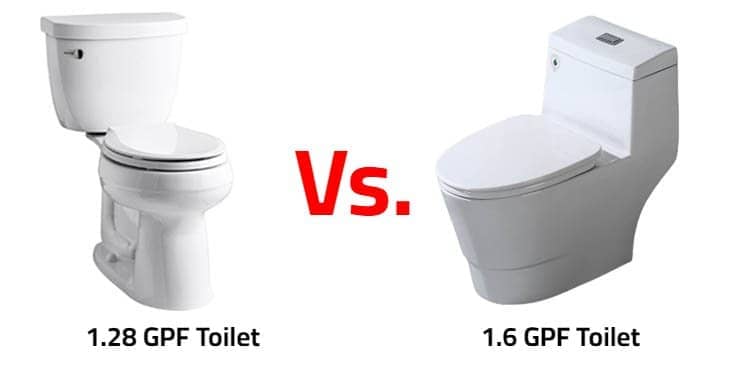
The toilet that uses less water isn’t automatically the weaker toilet — and if you’re still making buying decisions based on that assumption, you could be overpaying on your water bill for the next 15 years. The 1.28 vs. 1.6 GPF toilets debate comes down to five specific conditions: where you live, how many people use your bathrooms, whether you’ve had low-flow clogging problems before, how long your drain line runs, and whether you’re replacing one toilet in a house full of water hogs.
Get those conditions right and the answer is straightforward. Ignore them and you’ll either install the wrong toilet or spend money on water you didn’t need to use.
This guide resolves the 1.28 vs. 1.6 GPF toilets comparison completely. It’s written for homeowners replacing a toilet in an existing residence, contractors advising clients in regulated states, and anyone who has heard conflicting advice on whether 1.28 GPF toilets clog more often. After reading, you’ll know exactly which GPF rating belongs in your home and why — and you’ll have the MaP score data that most comparison guides never mention.
⚠️ Common Mistake: Choosing GPF Rating Without Checking MaP Score
The most frequent error I see when homeowners replace a toilet is picking based on GPF alone. A 1.28 GPF toilet with a MaP score of 350 grams will underperform. A 1.28 GPF toilet with a 1,000g MaP score will outflush most 1.6 GPF models sold in big-box stores.
GPF tells you how much water the tank holds. MaP tells you how effectively the bowl and trapway design converts that water into flushing power. Both numbers together determine whether you’ll be reaching for the plunger. Never buy on GPF alone.
What GPF Actually Means — and Why the Difference Matters More Than You Think
GPF — gallons per flush — is the volume of water released from the tank each time you flush. The federal maximum has been 1.6 GPF since the Energy Policy Act of 1992 replaced the previous standard of 3.5–5 GPF per flush. 1.28 GPF toilets are classified as High-Efficiency Toilets (HETs) and carry the EPA’s WaterSense label, which certifies they use at least 20% less water than the 1.6 GPF federal ceiling.
WaterSense certification also requires a minimum flush performance threshold of 350 grams of waste removal per flush — but that floor is low enough that MaP score, not the WaterSense label, is what separates a reliable toilet from a chronic double-flusher.
The difference between the two is exactly 0.32 gallons per flush. That sounds small, but in a household of four flushing an average of five times per day, it adds up to 2,336 fewer gallons per year per toilet. The EPA estimates homeowners save roughly $90 annually per toilet by switching from 1.6 GPF to 1.28 GPF — and over a toilet’s 15–20-year lifespan, that’s $1,350–$1,800 per unit before any local utility rebates.
The more important number — one that very few buyers look up — is the MaP score. Maximum Performance (MaP) testing is the industry-standard independent evaluation that measures how many grams of solid waste a toilet removes in a single flush using realistic organic-based test media. Scores run from 250 to 1,000 grams.
The WaterSense minimum requirement is 350 grams. A score of 600g is solid residential performance. A score of 800–1,000g means the toilet will clear heavy loads in a single flush regardless of GPF rating.
Here’s the critical insight: MaP score and GPF rating are independent variables. A well-engineered 1.28 GPF toilet from TOTO, American Standard, or Kohler commonly achieves MaP scores of 800–1,000g — the same range as strong-performing 1.6 GPF models. The performance difference between the two GPF ratings is almost entirely a function of bowl geometry, trapway diameter (3-inch vs 2-inch), flush valve size, and rim jet configuration, not the water volume alone.
This is why the original 1.6 GPF toilets introduced in the mid-1990s were terrible performers — manufacturers hadn’t yet redesigned the bowl and trapway to work with reduced water volume. Today’s 1.28 GPF toilets are engineered specifically for that water volume, and the engineering is better.
The 5 Conditions That Determine Your 1.28 vs. 1.6 GPF Toilet Choice
In the 1.28 vs. 1.6 GPF toilets comparison, most buyers will find their answer in Conditions 1 or 2. Use this map to locate yourself before reading the individual sections. Most buyers will find their answer in Conditions 1 or 2. Conditions 3 through 5 apply to specific situations where the standard recommendation reverses.
| Your Situation | Recommended GPF | See Condition |
|---|---|---|
| You live in CA, TX, CO, GA, or WA state | 1.28 GPF — required by law | Condition 1 |
| Reducing your water bill is the primary goal | 1.28 GPF with 800g+ MaP | Condition 2 |
| 4+ people, heavy daily flush demand | 1.28 GPF with 1,000g MaP — not 1.6 GPF | Condition 3 |
| Prior low-flow toilet clogged frequently | 1.6 GPF or 1.28 GPF with 3″ trapway | Condition 4 |
| Replacing one toilet in a home with 3.5–5 GPF units | 1.6 GPF — drain line compatibility | Condition 5 |
Condition 1 — You’re in a State That Mandates 1.28 GPF or Lower
If you live in California, Texas, Colorado, Georgia, or Washington State, the decision has already been made for you by law. California — through Title 20 Appliance Efficiency Regulations enforced by the California Energy Commission — prohibits the sale of any toilet exceeding 1.28 GPF. Texas codified the same standard under House Bill 2667, effective January 1, 2014. Colorado requires all tank-type toilets sold in the state to be WaterSense-labeled under Senate Bill 14-103, effective September 1, 2016.
Georgia bans sale or installation of any toilet exceeding an average of 1.28 GPF under Georgia Code § 8-2-3. Washington State extended equivalent California Title 20 standards to all fixtures sold after January 1, 2021 under House Bill 1444.
New York City — while not a state-wide mandate — enforces WaterSense standards for all new construction and replacements under the NYC Green Code. As of the EPA’s revised WaterSense specification effective July 1, 2025, even dual-flush toilets with full-flush volumes exceeding 1.28 GPF no longer qualify for the WaterSense label, which means they cannot be sold in states that require WaterSense certification.
If you’re in one of these jurisdictions and a contractor, plumber, or home improvement retailer suggests a 1.6 GPF toilet for new installation or replacement, that is a code violation — not just a preference issue. The penalty exposure falls on the installer, not just the product supplier. In California, violations can result in CEC enforcement action. In Georgia, installation of a non-compliant fixture is classified as a misdemeanor under state code.
If you’re in a mandated state:
Install a 1.28 GPF WaterSense-labeled toilet with a MaP score of 600g or higher. The MaP floor matters — the mandate says nothing about performance, only water volume. A WaterSense label guarantees ≤1.28 GPF but only requires 350g MaP minimum. Spend the extra $30–60 for a model with a verified 800g+ score and you eliminate any double-flush risk.
Condition 2 — Water Savings: When 1.28 vs. 1.6 GPF Makes a Real Dollar Difference
If you’re outside a mandated state but water costs are your driving reason for replacing a toilet, 1.28 GPF is the correct choice — provided you select a model with a documented MaP score of 800g or higher. The water math is straightforward: at the EPA’s average of 5 flushes per person per day, a family of four generates 7,300 flushes annually. At 0.32 gallons saved per flush, that’s 2,336 fewer gallons per year per toilet.
At a national average water rate of roughly $0.004 per gallon (including sewer charges), the annual saving per toilet is approximately $9–$12 in direct water cost. At higher-rate cities — San Francisco, Atlanta, Phoenix — where combined water and sewer costs run $0.009–$0.012 per gallon, that figure scales to $21–$28 per toilet annually, and closer to $90 per household when multiple toilets are replaced.
The savings argument collapses only when the 1.28 GPF toilet requires double flushing. If a toilet designed for 1.28 GPF regularly needs two flushes to clear solid waste, the effective water consumption climbs to 2.56 GPF — worse than a 1.6 GPF single-flush unit. This is why MaP score selection is not optional when choosing a water-saving toilet. A 1.28 GPF toilet rated at 1,000g MaP will clear in one flush with consistency. One rated at 350g MaP will not.
Additionally, most states with WaterSense programs offer utility rebates for 1.28 GPF toilet installation. Rebate amounts range from $25–$100 per toilet depending on jurisdiction. The EPA’s WaterSense rebate finder at epa.gov/watersense lists current programs by ZIP code. In water-stressed regions — Southern California, Nevada, Arizona, Florida — rebate programs are aggressively funded and can offset 25–50% of the toilet purchase price in the year of installation.
If water savings is your goal:
Buy a 1.28 GPF toilet with an 800–1,000g MaP score from a major brand (TOTO, American Standard, Kohler). Do not buy based on WaterSense label alone. Verify the MaP score through the MaP testing database at map-testing.com. The TOTO Drake II at 1.28 GPF carries an 800g MaP score and has a documented 20+ year lifespan in rental and residential applications. The American Standard Cadet 3 at 1.28 GPF consistently scores 1,000g MaP. These are not edge cases — they are the mainstream market leaders.
Condition 3 — Your Household Has Heavy Daily Flush Demand (4+ People)
A household of four or more generates sustained high-frequency flush demand — think 20–30 flushes daily in a busy family bathroom. In this scenario, the instinct is to go with 1.6 GPF for “more power.” That instinct is wrong. The correct answer for high-demand households is 1.28 GPF with a certified 1,000g MaP score, not 1.6 GPF with an average or unknown MaP rating.
Here’s why: a 1,000g MaP score means the toilet clears the maximum waste load the test protocol measures — every flush, consistently. At that performance level, the 0.32-gallon difference between 1.28 GPF and 1.6 GPF has no functional impact on single-flush clearance.
A 1.28 GPF toilet at 1,000g MaP doesn’t leave residue, doesn’t require double flushing, and in a four-person household will save approximately 9,300 gallons per year over a 1.6 GPF unit — the equivalent of roughly 3–4 months of drinking water for the same family.
The specification details that matter for high-demand households are the flush valve diameter and trapway size. Toilets with a 3-inch flush valve (vs the standard 2-inch) release water at a significantly higher flow rate, generating more turbulence and hydraulic energy per flush. A 3-inch valve at 1.28 GPF produces more flushing force than a 2-inch valve at 1.6 GPF.
Similarly, a fully glazed 2.5-inch trapway reduces the friction and build-up points that cause clogs, regardless of GPF. When shopping for a 1.28 GPF toilet for a busy household, verify: (a) flush valve diameter is 3 inches, (b) trapway is fully glazed, and (c) MaP score is 1,000g. Every other spec is secondary to those three.
For households with 4+ daily users:
Choose a 1.28 GPF toilet rated at 1,000g MaP with a 3-inch flush valve. The American Standard Champion 4 (1.28 GPF, 1,000g MaP, 4-inch accelerator flush valve) is the standard recommendation for high-demand residential use. Do not default to 1.6 GPF simply because the household is large — that reasoning doesn’t hold when you compare MaP scores directly. For verified top performers in this category, see our best American Standard toilet guide.
Condition 4 — You’ve Had Clog Problems with Low-Flow Toilets Before
This is the condition where some buyers may have a legitimate case for 1.6 GPF — but it’s more nuanced than it appears. If you previously had a 1.28 GPF or 1.6 GPF toilet that clogged regularly, the first question is: what was the MaP score of that toilet? Cheap 1.28 GPF units with MaP scores in the 350–500g range and 2-inch trapways will clog consistently in households with any meaningful solid waste load. That is a product quality problem, not a GPF problem.
The second question is about your drain line configuration. In older homes — particularly those built before 1980 — the main drain runs long horizontal distances before reaching the stack or street connection. Plumbers working in these homes understand a phenomenon that almost no comparison guide addresses: low-flow toilets discharge waste into the drain line quickly, but the reduced water volume may not carry it all the way to the main.
In long horizontal runs — typically 30+ feet of 4-inch cast iron from toilet to stack — the water from a 1.28 GPF flush can exhaust itself before moving all waste to the vertical drop. The result is slow accumulation in the horizontal section that eventually causes blockage.
If your home has horizontal drain runs longer than 25 feet, old 4-inch cast iron pipe with significant mineral build-up, or a history of main line clogs since installing a low-flow toilet, 1.6 GPF is the safer specification. The extra 0.32 gallons per flush provides meaningful additional line-flushing capacity in these configurations. In a home with a short drain run — 10–15 feet to the stack — this concern largely disappears, and 1.28 GPF with a strong MaP score will perform identically.
🔴 Before assuming a 1.6 GPF is your solution:
If your current 1.28 GPF toilet clogs, snake the main line before replacing the toilet. A partial main blockage will cause clogs regardless of GPF. I have seen homeowners spend $300–400 on a new 1.6 GPF toilet when a $150 professional drain cleaning would have resolved the problem in the existing unit. Diagnose the drain first.
If you’ve had consistent low-flow clogging problems:
If the drain line is clear and still clogging → the prior toilet had a low MaP score. Replace with a 1.28 GPF unit rated 1,000g MaP with a 3-inch flush valve.
If drain line is long (30+ feet horizontal) and regularly clogs → choose 1.6 GPF with a verified MaP of 800g+. A quality 1.6 GPF unit is a better solution than a cheap 1.28 GPF one in this scenario. See our best TOTO toilets guide for top 1.28 GPF performers with verified MaP scores.
Condition 5 — You’re Replacing One Toilet in an Older Home with 3.5–5 GPF Units
This is the least obvious condition and one that comes up regularly in older homes — replacing a single failed toilet in a house where the other bathrooms still have 3.5 or 5 GPF units installed. The concern here is drain line hydraulics, not toilet performance.
A 4-inch main drain line that was designed and installed for 3.5–5 GPF flow volumes will have been sloped and sized to move waste efficiently at those water volumes. When one toilet in that system drops to 1.28 GPF, the reduced flow from that single fixture may not move waste effectively through the shared horizontal sections — particularly if the new 1.28 GPF toilet is the furthest point from the main stack.
This is more of a concern in older homes with minimal drain slope (less than 1/4 inch per foot) and cast iron pipe with decades of mineral and scale accumulation that reduces effective internal diameter.
In newer homes with PVC drain lines, proper slope, and a drain run under 20 feet, this concern is essentially zero — the 1.28 GPF toilet will perform without issue. In homes built before 1980 with the combination of long runs, cast iron, and high-GPF existing fixtures, choosing 1.6 GPF for that single replacement is a reasonable precaution until the other toilets are also upgraded.
If replacing one toilet in a high-GPF older system:
If your home has PVC drain lines under 20 feet → install 1.28 GPF confidently. If your home has cast iron drain lines, pre-1980 construction, and drain runs over 25 feet → use 1.6 GPF for that single replacement and plan to upgrade the other toilets to 1.28 GPF at the same time to bring the whole system to consistent low-flow performance.
What Every Other Comparison Misses: MaP Score Is the Real Metric — Not GPF
Every 1.28 vs. 1.6 GPF comparison article online presents the same framework: water savings on one side, flushing power on the other, with a vague middle ground about “modern technology has improved.” None of them explain the MaP testing program in a way that changes how you shop. That’s the gap this section fills.
How MaP Testing Works
The Maximum Performance (MaP) program, established in 2002, is the only independent third-party testing protocol that certifies toilet flush performance up to 1,000 grams of solid waste removal. Testing uses a realistic organic-based media — soybean paste and toilet paper — to simulate actual flush conditions. Each model is tested to failure: waste is added incrementally until the toilet fails to clear in a single flush. That failure threshold becomes the certified MaP score.
The WaterSense minimum is 350g — barely twice the 150g average per-use waste load for most adults. A 1,000g score means the toilet can clear nearly 7 times the average single-use demand in one flush, every time. The MaP testing database at map-testing.com lists verified scores for thousands of models — searchable by brand and model number.
Why GPF Alone Doesn’t Predict Performance
The TOTO Drake II at 1.28 GPF carries an 800g MaP score. A generic 1.6 GPF toilet at a big-box store may score 350–500g MaP. The 1.6 GPF toilet uses 25% more water and flushes significantly less effectively than the TOTO.
The American Standard Champion 4 at 1.28 GPF scores 1,000g MaP — the maximum. These are not cherry-picked examples. They are the best-selling units in their categories. The performance advantage of 1.28 GPF over generic 1.6 GPF at current MaP score levels is documented, not theoretical.
The Double-Flush Problem — Real Numbers
A 1.28 GPF toilet that consistently requires double flushing uses 2.56 gallons per effective flush cycle — 60% more water than a well-performing 1.6 GPF single-flush toilet. This is where water savings evaporate. In a four-person household flushing 20 times daily, a chronic double-flusher at 1.28 GPF consumes 18,688 gallons per year vs. 11,680 gallons for a single-flush 1.6 GPF unit. The solution is not choosing 1.6 GPF. The solution is choosing a 1.28 GPF toilet with a 1,000g MaP score that doesn’t double flush.
⚡ When the Answer Flips — The Specific Scenarios Where 1.6 GPF Is the Right Call
For the vast majority of homeowners, a well-selected 1.28 GPF toilet is the correct choice in 2025 and beyond. But these specific scenarios represent genuine cases where 1.6 GPF remains the better option:
- Septic system with known sludge and scum layer buildup — higher water volume per flush pushes waste through drain field lines more effectively in aging systems with reduced biological activity
- Older commercial or multi-unit property with shared horizontal drain runs over 40 feet — the hydraulic requirements of very long runs in pre-1990 cast iron systems may exceed what 1.28 GPF provides
- Vacation or seasonal property with infrequent use — a toilet flushed only a few times per week needs the extra water volume to prevent trap evaporation and to move any residual waste fully through an underused drain system
- Regulated state jurisdiction has a waiver or exemption for specific commercial applications — confirm with your local building department
1.28 vs. 1.6 GPF Toilets: Full Decision Matrix
| Condition | 1.28 GPF | 1.6 GPF | Winner | Why |
|---|---|---|---|---|
| Regulated state (CA, TX, CO, GA, WA) | ✅ Required | ❌ Illegal to sell | 1.28 GPF | State law mandates ≤1.28 GPF |
| Water bill reduction | ✅ Saves 20% | Baseline | 1.28 GPF | 2,300+ gallons/year savings per toilet with 800g+ MaP |
| Heavy household demand (4+ people) | ✅ 1,000g MaP wins | Depends on MaP score | 1.28 GPF (1,000g) | 3″ valve + 1,000g MaP = no performance gap |
| Short drain run, PVC, modern home | ✅ No concern | No advantage | 1.28 GPF | No hydraulic reason to overpay for water |
| Long cast iron drain runs (30+ ft) | May need 3″ trapway | ✅ Better line flushing | 1.6 GPF | Extra volume clears long horizontal runs more reliably |
| Aging septic system | Marginal | ✅ More flush-through | 1.6 GPF | Better hydraulic push through aging field lines |
| Seasonal/vacation property | Less ideal | ✅ Better for infrequent use | 1.6 GPF | Higher volume clears traps and underused drain lines |
Frequently Asked Questions: 1.28 vs. 1.6 GPF Toilets
What is the main difference between 1.28 vs. 1.6 GPF toilets?
The primary difference in a 1.28 vs. 1.6 GPF toilet is 0.32 gallons of water per flush. The 1.28 GPF unit is classified as a High-Efficiency Toilet (HET) and carries the EPA WaterSense label when it meets the ≤1.28 GPF standard and passes a minimum 350g flush performance test. The 1.6 GPF toilet meets the federal standard established by the Energy Policy Act of 1992.
Performance — the ability to clear solid waste in a single flush — is determined by MaP score and bowl/trapway design, not GPF rating alone. A well-engineered 1.28 GPF toilet from a major brand commonly outperforms a generic 1.6 GPF unit on flush performance while using 20% less water.
Does a 1.28 GPF toilet clog more easily than a 1.6 GPF toilet?
Not if the MaP score is 800g or higher. The clogging reputation of low-flow toilets comes from the first generation of 1.6 GPF models introduced in the mid-1990s, which used the original high-flow bowl designs without modification. Today’s 1.28 GPF toilets are engineered from the bowl geometry outward for reduced-flow efficiency.
Models with a 3-inch flush valve, fully glazed trapway, and 1,000g MaP score have lower clog rates than average 1.6 GPF units. If you’ve experienced chronic clogging with a 1.28 GPF toilet, the problem was an undersized MaP score — typically 350–500g — not the GPF rating.
How much water and money does a 1.28 GPF toilet save over a 1.6 GPF model?
For a family of four averaging 5 flushes per person per day, switching from 1.6 GPF to 1.28 GPF saves approximately 2,336 gallons per toilet per year. In low-cost water markets, that translates to $9–$12 annually per toilet. In high-cost markets such as Phoenix, Atlanta, or coastal California where combined water and sewer rates run $0.009–$0.012 per gallon, the savings reach $21–$28 per toilet annually.
The EPA estimates an average lifetime saving of approximately $2,000 per toilet over a 15–20-year lifespan. Utility rebates in WaterSense program jurisdictions can add $25–$100 in year-one offsets.
Is a 1.6 GPF toilet still legal to buy and install?
At the federal level, yes — 1.6 GPF remains the maximum allowed by the Energy Policy Act of 1992 and is legal for sale and installation in most U.S. states. However, it is illegal to sell or install a 1.6 GPF toilet in California, Texas, Colorado, Georgia, and Washington State, and in New York City.
As of July 1, 2025, the EPA’s revised WaterSense specification also prohibits dual-flush toilets with full-flush volumes exceeding 1.28 GPF from carrying the WaterSense label, which effectively makes them ineligible for sale in any WaterSense-mandatory jurisdiction. If you’re uncertain about your local code, check with your municipal building department before purchasing.
What is a MaP score and why does it matter for this comparison?
MaP (Maximum Performance) is the independent third-party testing program that measures how many grams of solid waste a toilet removes in a single flush. Scores range from 250 to 1,000 grams. The WaterSense minimum requirement is 350g — barely above the approximately 150g average per-use waste load for most adults.
The reason MaP score matters in the 1.28 vs. 1.6 GPF comparison is that it makes the GPF comparison meaningful: a 1.28 GPF toilet with a 1,000g MaP score will outperform a 1.6 GPF toilet with a 350g MaP score on every relevant real-world metric. GPF tells you how much water is in the tank. MaP tells you how effectively the bowl and trapway use that water. Both numbers together determine whether you’ll be plunging.
In the 1.28 vs. 1.6 GPF toilets market, can I still buy a quality 1.6 GPF model?
Quality 1.6 GPF toilets remain available in states where they are legal, and there are specific scenarios where they remain the better choice — particularly in homes with long cast iron drain runs, aging septic systems, or seasonal properties. Brands such as American Standard, Kohler, and TOTO continue to offer 1.6 GPF models with strong MaP scores for these use cases.
However, the market has shifted substantially: the majority of new residential toilet installations in the U.S. are now 1.28 GPF or lower, driven by state mandates covering approximately 40% of the national population and by WaterSense rebate incentives. The 1.6 GPF market will continue to shrink as additional states align with WaterSense standards.
Verdict: 1.28 vs. 1.6 GPF Toilets — The Final Call
If you live in California, Texas, Colorado, Georgia, or Washington State → 1.28 GPF is the only legal option. Install a WaterSense-labeled model with a verified MaP score of 600g or higher. Don’t buy on the label alone — confirm the MaP number.
If you live outside a mandated state and your home has PVC drain lines under 25 feet → 1.28 GPF with a 1,000g MaP score is the right choice for virtually every household size and use pattern. The performance gap between 1.28 and 1.6 GPF disappears at 1,000g MaP. The water savings do not.
If your home has long horizontal cast iron drain runs (30+ feet), an aging septic system, or infrequent occupancy → 1.6 GPF is the correct specification. The extra water volume provides meaningful hydraulic benefit in these specific configurations and the performance trade-off is justified.
1.28 GPF Toilet Pros and Cons: What Buyers Get Right and Wrong
The most consistent mistake buyers make when evaluating a 1.28 GPF toilet is treating all models as equivalent. They are not. The advantages of 1.28 GPF — lower water bills, WaterSense rebate eligibility, compliance in regulated states, and equivalent or superior performance vs. generic 1.6 GPF units — are real and documented. The disadvantages are equally real but nearly always specific to product selection, not GPF rating.
The pros: roughly 2,300 gallons saved per toilet per year in a four-person household, full compliance with every state code in the country, eligibility for WaterSense utility rebates ranging $25–$100, and — when a model with 800–1,000g MaP score is chosen — flush performance that exceeds what most 1.6 GPF big-box models deliver.
The cons: a higher upfront cost in the range of 10–20% premium over comparable 1.6 GPF units, and the specific drain-line scenarios described in Conditions 4 and 5 above where reduced water volume can create performance issues in older homes.
The practical takeaway: a 1.28 GPF toilet from a reputable brand with a verified 800g+ MaP score is the correct specification for the vast majority of residential replacements. For a curated list of tested models across performance tiers, see our best flushing toilets guide, which covers MaP scores, flush valve diameters, and real-world performance data across 8 categories.
Water Savings with 1.28 GPF vs. 1.6 GPF Toilets: The Real Math
Calculating actual water savings from switching to 1.28 GPF requires three inputs: household size, average daily flushes per person, and your local water and sewer rate. The EPA average of 5 flushes per person per day is a reasonable baseline for most homes. At that frequency, a two-person household saves approximately 1,168 gallons per toilet per year. A four-person household saves 2,336 gallons. A six-person household — a busy family bathroom running constantly — saves 3,504 gallons per toilet annually.
The dollar value of those savings depends heavily on your utility. National average residential water rates hover around $0.004 per gallon when combined water and sewer charges are factored together. High-cost urban markets run $0.009–$0.014 per gallon — San Francisco, New York, and Atlanta consistently rank among the most expensive.
At $0.004/gallon, a four-person household saves $9.30 per toilet annually. At $0.012/gallon, that household saves $28 per toilet. Across a three-toilet home on a $0.012/gallon rate, total annual savings reach $84 — and over a 15-year toilet lifespan, that compounds to approximately $1,260 in direct water cost avoidance, not counting utility rate inflation.
The savings calculation breaks down only if double flushing is factored in. A 1.28 GPF toilet double-flushed on 30% of uses has an effective consumption of 1.472 GPF — still below 1.6 GPF, but barely. At 50% double-flush rate (indicating a toilet with inadequate MaP score for the household’s demand), effective consumption climbs to 1.92 GPF — exceeding the 1.6 GPF standard. See our best dual flush toilet guide if you want to maximize savings potential further with a 0.8/1.28 dual-flush configuration.
Choosing Between 1.28 and 1.6 GPF: The Short Answer for Every Situation
For most homeowners in 2025, choosing between 1.28 and 1.6 GPF comes down to one question before all others: are you in a state that mandates 1.28 GPF? If yes, the decision is made.
If no, the next question is whether your home has a drain configuration — specifically long cast iron horizontals or an aging septic system — that creates a hydraulic disadvantage for low-flow flushing. If neither of those conditions applies, 1.28 GPF with a verified MaP score of 800g or higher is the right answer for your household.
The 1.28 vs. 1.6 GPF question is effectively settled at the market level. The broader toilet market has already voted: as of 2024, the majority of new residential toilet installations in the U.S. are 1.28 GPF or lower. The technology has matured past the point where GPF rating is a meaningful proxy for flushing power.
If you’re still shopping 1.6 GPF because “more water means stronger flush,” that logic applied to the first-generation models of 1996. It hasn’t applied to any toilet made by a major manufacturer in the last decade.
The right toilet for 1.28 vs. 1.6 GPF toilet decisions isn’t whichever uses more water — it’s whichever matches your drain configuration, household demand, and local code with the highest MaP score for the money. For specific product recommendations across comfort height, one-piece, and two-piece configurations at 1.28 GPF, visit our complete toilet buying guide or our breakdown of the best comfort height toilets.
