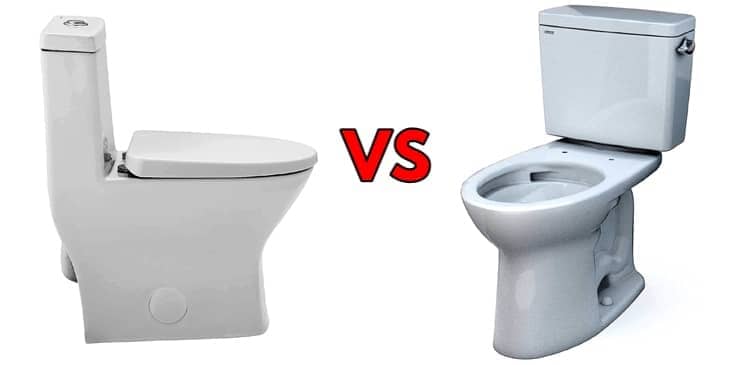
The wrong choice costs you twice — once at the register, and again when you’re paying a plumber to deal with a leak, a cracked seam, or a toilet that simply doesn’t fit the space. The one piece vs two piece toilet debate almost always comes down to five decision points: price, space, cleaning, repairability, and installation weight.
This guide walks you through each one with actual numbers and specific conditions — so you can make the right call before you buy, not after.
The most common mistake buyers make is choosing by aesthetics alone, then discovering after delivery that their bathroom’s rough-in dimension, floor layout, or storage access makes the choice a problem to live with. Read the decision matrix in this guide before committing to either type. The answer depends on your specific conditions — not on which style looks better in a showroom photo.
⚠️ Common Mistake: Deciding Before Measuring
Most buyers choose between a one piece vs two piece toilet based on photos. The first question should be your rough-in distance — the measurement from the center of your drain to the finished wall behind the toilet. Two-piece toilets are available in 10-inch, 12-inch, and 14-inch rough-ins. Many one-piece models are optimized for 12-inch only. If your bathroom has a non-standard rough-in, your choice may already be made for you.
What Actually Separates a One-Piece From a Two-Piece Toilet
A one-piece toilet is manufactured as a single, fused unit — the tank and bowl are molded together during production, leaving no seam between them. A two-piece toilet ships with the tank and bowl as separate components, which are bolted together during installation using a tank-to-bowl gasket, a set of tank bolts, and a rubber spud washer. That seam between the two pieces is the central difference from which every other distinction flows.
The internal mechanisms — fill valve, flush valve, flapper or canister, float, and supply line connection — are functionally identical between the two styles. Both types use the same siphon-jet or gravity-flush technology. Both are available in 1.28 GPF WaterSense-certified models and in comfort height (17 to 19 inches) configurations. Flush performance is not a function of whether the tank is fused or separate. It is a function of the specific flush valve diameter, trapway size, and water volume.
What the construction difference does affect: weight, cleaning access, seam leak risk, repair part availability, shipping cost, and installed height profile. A standard two-piece toilet weighs 60 to 80 pounds total, with the bowl and tank handled separately at 30 to 45 pounds each. A one-piece toilet of comparable size weighs 88 to 120 pounds as a single unit. That weight difference is not academic — it determines whether you need one person or two for installation, and it affects shipping damage risk significantly.
Key Construction Differences at a Glance
| Dimension | One-Piece | Two-Piece |
|---|---|---|
| Construction | Tank and bowl fused at factory | Tank and bowl bolted at installation |
| Shipping weight | 88–120 lbs as one unit | 60–80 lbs total, two separate boxes |
| Seam between tank/bowl | None — fully sealed at manufacture | Present — sealed by tank-to-bowl gasket |
| Internal mechanisms | Identical to two-piece | Identical to one-piece |
| Rough-in availability | Mostly 12-inch; limited 10-inch options | 10-inch, 12-inch, and 14-inch widely available |
| Profile height | Typically lower/sleeker tank profile | Tank sits slightly higher; more traditional profile |
One-Piece Toilet Pros and Cons: When It Wins
A one-piece toilet earns its higher price in three specific situations: bathrooms where hygiene is the top priority, bathrooms with a modern or minimalist design where the seamless profile matters aesthetically, and households where the owner will never want to deal with a tank-to-bowl seam leak. If none of those three conditions apply to your situation, the premium may not be justified.
The cleaning advantage is real and measurable. With no seam between the tank and bowl, there is no horizontal ledge collecting mineral deposits, no gasket area that gradually turns black from mold and bacteria, and no tank bolt areas that accumulate residue. A one-piece toilet can be wiped down in a single continuous motion — there are no interruptions in the surface. In a household where the bathroom gets heavy daily use, that translates to meaningfully less scrubbing time per week.
One-piece toilets are also lower in overall profile. The tank sits closer to the bowl — overall height from floor to tank top is typically 27 to 30 inches, compared to 28 to 32 inches for a standard two-piece. In bathrooms where over-the-toilet storage is not planned, that lower profile creates a cleaner sightline.
If you are installing a high-performance one-piece toilet, the additional investment over a two-piece often pays for itself in reduced cleaning time and no seam maintenance over the toilet’s lifespan.
✅ One-Piece Pros
- No tank-to-bowl seam — no seam leak risk
- Easier to clean — one continuous surface
- Sleeker, lower profile — suits modern bathrooms
- Slightly more durable factory construction
- No tank bolts to loosen or rust over time
- Ships as one unit — installation positioning is straightforward once in place
❌ One-Piece Cons
- Heavier — 88 to 120 lbs requires two people to carry
- Higher unit price — $300 to $1,200 vs $100 to $600 for two-piece
- If the porcelain cracks, the entire unit must be replaced
- Limited rough-in options — mostly 12-inch configurations
- Higher shipping cost due to weight and bulk
- Harder to maneuver in tight stairwells or narrow doorways
Two-Piece Toilet Pros and Cons: When It Wins
A two-piece toilet is the right choice in any situation where budget, repairability, or rough-in flexibility is a primary constraint. It remains the most widely sold toilet configuration in the United States for a reason — the separate tank and bowl design makes it easier to ship, easier to carry up stairs, and far easier to repair in the event of a cracked tank or bowl.
If you crack the tank on a two-piece toilet, you buy a replacement tank for $40 to $120 and bolt it on. If the equivalent happens with a one-piece, you replace the entire toilet.
The repairability advantage matters most in multi-bathroom households, rental properties, and older homes where unexpected damage is more likely. Two-piece replacement tanks and bowls are stocked at every plumbing supply house. Finding parts for a discontinued two-piece model is far easier than locating matching components for a one-piece unit that has been out of production for five years. For landlords and property managers, the two-piece toilet’s part availability is not a minor consideration — it is a genuine operational advantage.
Two-piece toilets are also the correct choice when the toilet must be installed on an upper floor, moved through a narrow hallway, or positioned in a bathroom with difficult access. Carrying two 30 to 45-pound pieces separately is manageable for a single experienced installer.
Carrying a 100-pound one-piece unit up a flight of stairs through a 28-inch doorway is a two-person job with real risk of wall damage, dropped porcelain, and injury. If you are choosing a quality two-piece toilet for a demanding household, the lower upfront cost and easier logistics make it the more practical specification for most installs.
✅ Two-Piece Pros
- Lower unit price — $100 to $600 at major retailers
- Tank or bowl replaced individually if damaged
- Easier to transport — two manageable pieces
- 10-inch, 12-inch, and 14-inch rough-in availability
- Wider range of models, heights, and bowl shapes
- Parts universally available at plumbing supply houses
❌ Two-Piece Cons
- Tank-to-bowl seam can leak as gasket ages
- Seam area collects mineral deposits and mold
- Tank bolts can rust or loosen over years
- Taller overall profile — more traditional look
- Installation takes slightly longer — aligning and sealing seam requires care
- Less streamlined appearance in modern bathroom designs
One Piece vs Two Piece Toilet Installation Cost Compared
The price gap between one-piece and two-piece toilets is real at every price tier. A basic two-piece from American Standard or Kohler starts at $120 to $250 at Home Depot or Lowe’s. Comparable one-piece models from the same brands start at $300 to $500.
A premium two-piece with a skirted design and 1.28 GPF WaterSense flush runs $350 to $600. The equivalent one-piece in the same performance tier runs $550 to $900. At the high end, luxury two-piece models reach $600 to $900 while comparable one-piece units push $900 to $1,200.
Labor cost is where the one-piece disadvantage compounds. Professional plumber installation of a standard two-piece toilet on a ground floor runs $150 to $275 in most US markets, including wax ring, supply line, and leak check. A one-piece install in the same conditions runs $200 to $350 — slightly higher because the heavier unit requires two-person handling.
On upper floors or in tight bathrooms, that gap widens: $250 to $450 for one-piece vs $175 to $300 for two-piece.
Total installed cost for a typical bathroom replacement: a mid-range two-piece toilet runs $300 to $600 all-in (unit plus labor). A mid-range one-piece runs $500 to $950 all-in. That $200 to $350 premium is the decision point.
If the cleaning advantage and no-seam durability of the one-piece will be used — meaning the bathroom gets heavy daily use and the owner cleans it regularly — the premium is justified. If the toilet will see moderate traffic in a secondary bathroom, the two-piece and the savings is the better specification. For regional labor benchmarks see toilet installation cost in the USA.
💰 Installed Cost Summary (Unit + Labor, US Market 2026)
| Tier | Two-Piece (unit only) | One-Piece (unit only) | Labor add-on |
|---|---|---|---|
| Entry-level | $100–$250 | $300–$500 | $150–$275 |
| Mid-range | $250–$500 | $500–$800 | $175–$350 |
| Premium | $500–$900 | $800–$1,200+ | $200–$450 |
One Piece vs Two Piece Toilet Flush Performance
Flush performance between one-piece and two-piece toilets is not determined by the construction type — it is determined by the specific flush system inside each individual model. Both configurations use the same siphon-jet, gravity-assisted flush technology refined for decades in American residential plumbing.
A two-piece TOTO Drake II with a 3-inch flush valve and 1.28 GPF will outflush a budget one-piece with a 2-inch valve at 1.6 GPF. The number that matters is the Maximum Performance (MaP) score — the gram weight a toilet can clear in a single flush.
MaP scores above 800 grams are considered strong performers. Both one-piece and two-piece toilets achieve 1,000-gram MaP ratings across multiple models. The flush valve diameter is the primary mechanical factor — 3-inch flush valves move water approximately 40% faster than 2-inch valves, producing more complete bowl evacuation.
When comparing specific models between the two types, look at the flush valve size and MaP rating, not the construction configuration.
Water efficiency is also independent of the one-piece vs two-piece distinction. Both types are available in 1.28 GPF WaterSense-certified configurations — the current EPA-compliant residential standard. If replacing a toilet installed before 1994, any modern model will use 60 to 70% less water per flush than the older unit.
For households prioritizing flush performance and water savings, our guide to the best flushing toilets evaluates specific models from both construction types by MaP score and flow rate.
One Piece vs Two Piece Toilet Cleaning Ease
Cleaning ease is the category where one-piece toilets have the clearest and most measurable advantage. The seam between a two-piece toilet’s tank and bowl is a horizontal shelf roughly one inch wide running the full width of the bowl. That ledge traps water, collects mineral deposits, and in high-humidity bathrooms becomes a mold and mildew growth zone within 12 to 18 months.
Cleaning that seam requires a dedicated brush and consistent weekly attention. Skipping it leads to discoloration and odor that no surface cleaning will reach without dismantling the tank.
On a one-piece toilet, that seam does not exist. The cleaning path from the top of the tank to the base of the bowl is one uninterrupted curved surface. In bathrooms where a weekly wipe-down is the cleaning standard, a one-piece toilet will maintain a cleaner appearance with meaningfully less effort.
In households with young children, primary bathrooms that see daily heavy use, or any application where sanitation standards matter — medical households, immune-compromised members — the one-piece is the correct specification on sanitation grounds alone.
One-piece models with skirted designs add a second cleaning advantage: the concealed trapway. Skirted toilets eliminate the exposed S-curve trapway at the back of the bowl, replacing it with a smooth vertical surface that is far easier to wipe down. Most one-piece toilets incorporate this skirted design as standard. Most two-piece toilets do not, though skirted two-piece models exist at the mid-to-premium price tier. If the skirted design is a priority for cleaning ease, look at both categories before assuming that skirted equals one-piece.
One Piece vs Two Piece Toilet Maintenance and Repair
Internal repair — replacing a fill valve, flapper, flush valve, or float — is identical in cost and complexity between one-piece and two-piece toilets. The internal mechanisms are the same. A Fluidmaster 400A fill valve costs the same and installs the same way in either configuration. A fill valve replacement takes 20 to 30 minutes in either type. A flapper swap takes under five minutes in either. The difference in maintenance cost between the two types is not internal — it is structural.
Two-piece toilets have two structural failure points that one-piece toilets do not: the tank-to-bowl gasket and the tank bolts. Gaskets are rubber, and rubber degrades. In an average household, a tank-to-bowl gasket can be expected to start weeping between 10 and 15 years after installation as the rubber hardens and loses compression.
Replacing the gasket requires draining and dismounting the tank — a 45-minute job for an experienced homeowner, or $75 to $150 in plumber labor. Tank bolts are steel with rubber washers; they can rust through in high-humidity bathrooms within 8 to 12 years, causing the tank to rock and accelerating gasket failure.
On the other hand, two-piece toilets have a decisive advantage when porcelain is damaged. A cracked two-piece tank — from impact, overtightening a supply line, or freeze damage — costs $40 to $150 to replace with a manufacturer-matched or universal tank. A cracked one-piece tank means replacing the entire toilet.
Replacement cost for a mid-range one-piece is $500 to $1,200 for the unit plus labor. If you are in a rental property, vacation home, or any high-risk environment where physical damage is a real possibility, the two-piece’s modular repairability is a genuine financial protection. For readers comparing top-performing models in each category, factor the long-term maintenance scenario into your 10-year cost of ownership.
🔧 Repair Cost Comparison at a Glance
| Repair Type | One-Piece | Two-Piece |
|---|---|---|
| Fill valve replacement | $10–$20 DIY / $75–$150 pro | $10–$20 DIY / $75–$150 pro |
| Flapper replacement | $5–$15 DIY | $5–$15 DIY |
| Tank-to-bowl gasket | N/A — no seam | $8–$20 part + $75–$150 labor |
| Cracked tank | Full unit replacement: $500–$1,200+ | Tank only: $40–$150 |
| Cracked bowl | Full unit replacement: $500–$1,200+ | Bowl only: $80–$250 |
Decision Matrix: Which Type Is Right for You?
Every factor covered in this guide feeds into a set of conditional decisions. The following matrix converts those factors into specific if/then conditions so that the right choice for your specific bathroom, budget, and usage pattern is clear before you purchase.
🔵 If/Then Decision Framework
- If your rough-in is 10 inches or 14 inches → choose a two-piece toilet. One-piece models at non-standard rough-ins are rare and expensive.
- If you are installing on a second floor or above through a narrow stairwell → choose a two-piece toilet. Carrying a 100-pound one-piece unit up stairs is a two-person job with real damage risk.
- If your primary bathroom sees 4+ users daily → choose a one-piece toilet. The cleaning advantage over 10 years exceeds the price premium.
- If this is a secondary bathroom, guest bath, or rental property → choose a two-piece toilet. Lower cost and modular repairability match the usage profile.
- If your bathroom has a modern or minimalist design → choose a one-piece toilet. The seamless profile fits the aesthetic and the skirted trapway coverage completes the look.
- If budget is the primary constraint → choose a two-piece toilet. You can buy a high-performing two-piece (1,000g MaP, 1.28 GPF) for $200 to $350 — well below entry-level one-piece pricing.
- If the toilet is in a vacation home, rental unit, or any high-damage-risk location → choose a two-piece toilet. Cracked-tank replacement at $40 to $150 vs full one-piece replacement at $500 to $1,200 is the deciding factor.
- If the bathroom has a small footprint under 40 square feet → choose a one-piece toilet. The lower, more compact profile creates more visual space in tight rooms.
Summary Decision Matrix
| Condition | One-Piece | Two-Piece | Winner |
|---|---|---|---|
| Non-standard rough-in (10″ or 14″) | Limited options | Wide selection | Two-Piece ✅ |
| Heavy daily use (4+ users) | Easier to clean, no seam | Seam area requires attention | One-Piece ✅ |
| Rental property or high damage risk | Full replacement if tank cracks | Tank replaceable at $40–$150 | Two-Piece ✅ |
| Modern/minimalist bathroom design | Seamless, lower profile | Visible seam, taller profile | One-Piece ✅ |
| Budget under $400 total installed | Difficult to achieve | Achievable at mid-range | Two-Piece ✅ |
| Upper floor installation | Heavy, two-person carry required | Two lighter pieces, easier carry | Two-Piece ✅ |
| Small bathroom under 40 sq ft | Lower profile, more space | Taller, more visual bulk | One-Piece ✅ |
| Long-term leak risk (10+ years) | No seam — zero seam leak risk | Gasket may need replacement at 10–15 years | One-Piece ✅ |
🔄 When the Answer Flips — When to Skip the One-Piece
The one-piece toilet’s advantages are real — but they disappear in three specific scenarios. First: if the installation location is a second-floor or higher bathroom accessed through a doorway narrower than 30 inches, the one-piece’s weight and bulk make installation high-risk without a two-person crew. Second: if your rough-in distance is 10 inches, one-piece options are extremely limited and typically require ordering non-stock items.
Third: if you are a landlord managing multiple units — a cracked one-piece tank is a full toilet replacement at $500 to $1,200 plus labor, while a two-piece tank swap costs $40 to $150 and 45 minutes. In all three conditions, a premium two-piece toilet is the superior specification regardless of aesthetic preference.
Frequently Asked Questions
Is a one piece vs two piece toilet better in terms of flush performance?
Neither construction type is inherently better at flushing. Flush performance is determined by the specific flush valve diameter, trapway size, water volume (GPF), and the individual model’s engineering — not by whether the tank and bowl are fused or bolted. A two-piece TOTO Drake II with a 3-inch flush valve outperforms many entry-level one-piece toilets. Compare MaP scores and GPF ratings for the specific models you are evaluating, not the construction category.
How much more does a one-piece toilet cost to install compared to a two-piece?
In most US markets, professional installation of a one-piece toilet runs $25 to $75 more than a two-piece of comparable size, primarily because the heavier unit requires more careful handling and often a two-person crew for positioning. The bigger cost difference is in the unit price itself — one-piece toilets run $150 to $400 more than comparable two-piece models at the same performance tier. Total installed cost is typically $200 to $400 higher for a one-piece across the board.
Which is easier to clean — a one piece or two piece toilet?
One-piece toilets are measurably easier to clean. The absence of a tank-to-bowl seam eliminates the horizontal ledge that collects mineral deposits, mold, and bacteria in two-piece models. A one-piece toilet can be wiped in a single continuous motion. A two-piece requires dedicated brush cleaning of the seam area, tank bolt areas, and the underside of the tank-bowl junction — areas that are difficult to reach and accumulate residue over time.
Can you replace just the tank on a two-piece toilet if it cracks?
Yes — and this is one of the key repairability advantages of two-piece toilets. A replacement tank for a current-production two-piece toilet costs $40 to $150 at plumbing supply houses or online. The replacement requires draining the old tank, disconnecting the supply line, unbolting the tank from the bowl, and bolting the new tank in place — a job most experienced homeowners can complete in under an hour. On a one-piece toilet, a cracked tank means replacing the entire toilet unit.
Which is better for a small bathroom — one piece or two piece toilet?
If your bathroom is under 40 square feet, a one-piece toilet generally serves better. The lower profile (27 to 30 inches tank height vs 28 to 32 for two-piece) and compact integrated design create more visual space in a tight room. The skirted trapway on most one-piece models also reduces visual bulk at the rear.
For small bathrooms, consider also a compact elongated or round bowl to maximize front-to-wall clearance. Our guide to best small toilets covers both types sized for tight spaces.
Do one-piece toilets last longer than two-piece toilets?
The porcelain body of both types can last 40 to 50 years with normal use. The internal mechanisms — fill valve, flapper, flush valve — require replacement every 5 to 10 years in either type. The maintenance difference is structural: two-piece toilets have a tank-to-bowl gasket and tank bolts that degrade over 10 to 15 years.
One-piece toilets have no equivalent maintenance point. On pure structural longevity, the one-piece has a marginal advantage from the absence of that gasket failure mode.
Is a one-piece toilet harder to install?
It depends on the installation location. The plumbing connections — wax ring, flange bolts, supply line, shutoff valve — are identical between the two types. What differs is the physical handling challenge. A one-piece toilet weighs 88 to 120 pounds as a single unit.
Positioning that weight over the flange bolt holes while maintaining level is genuinely difficult alone. A two-piece allows you to set the lighter bowl first, verify alignment, and then add the tank — meaningfully easier for upper-floor installations or tight bathrooms without professional help.
⚖️ Verdict: Which One Is Right for Your Bathroom?
- If your bathroom sees heavy daily use, you prioritize cleaning ease, and budget allows $500+ installed: choose a one-piece toilet. The no-seam construction and lower maintenance burden justify the premium for a primary bathroom in a household with four or more users.
- If you are on a budget, installing in a secondary bathroom, or working with a non-standard 10-inch or 14-inch rough-in: choose a two-piece toilet. Performance is equal, repairability is superior, and the $150 to $400 in savings buys a high-performing model with room to spare.
- If you are a landlord, property manager, or installing in a vacation home with physical damage risk: choose a two-piece toilet. The ability to replace a cracked tank for $40 to $150 vs. replacing the entire unit is the defining factor for high-turnover or high-risk environments.
When the one piece vs two piece toilet decision is made correctly, you get a fixture that fits your bathroom and serves your household for decades. For brand-specific model recommendations in both categories, see our guides to the best one-piece toilets and the best two-piece toilets.
Pros and Cons of One Piece vs Two Piece Toilet: The Full Breakdown
When buyers compare the pros and cons of one piece vs two piece toilets, the list often looks similar on both sides — until you apply real-world conditions. On paper, a one-piece toilet offers easier cleaning, a sleeker profile, and no seam leak risk. A two-piece offers lower cost, easier transport, modular repairability, and wider rough-in compatibility. The pro and con list doesn’t tell you which is right for your bathroom — the decision matrix does.
The most underrated pro of the two-piece toilet is not the price — it is the ease of moving it into position. Anyone who has carried a 110-pound one-piece toilet through a 28-inch doorway, around a corner, and into a second-floor bathroom understands why experienced plumbers often quote a higher labor rate for one-piece installations.
For a DIY installer, the two-piece toilet’s split weight is the difference between a manageable install and a job that requires calling a crew. For households replacing an existing high-performance toilet, confirm the installation access path before ordering a one-piece model.
Long-term, the most underrated con of the two-piece is the seam. A failing tank-to-bowl gasket doesn’t announce itself with a dramatic leak — it begins as a slow weep that collects at the tank base, mimics condensation, and is routinely misdiagnosed for months before floor damage becomes visible.
If you choose a two-piece toilet, inspect the tank-to-bowl junction annually, especially in humid climates where temperature differential between tank water and room air accelerates gasket compression loss.
One Piece vs Two Piece Toilet Installation Cost: What You’ll Actually Pay
The one piece vs two piece toilet installation cost comparison depends on three line items: the toilet unit itself, the labor charge, and the consumables (wax ring, supply line, closet bolts). Consumables cost $15 to $45 regardless of toilet type. Unit costs were detailed in Section 4 of this guide. The labor differential between the two types is typically $25 to $75 per install in normal conditions — primarily driven by the one-piece’s handling difficulty and heavier weight requiring two-person crew coordination.
The real installation cost variable for either type is not the toilet — it is what the plumber finds when they pull the old unit. If your floor flange is cracked, corroded, or set below floor level (a common issue in bathrooms with multiple flooring upgrades), a flange repair runs $145 to $300 before the new toilet goes in.
If the subfloor shows soft spots from a slow prior leak, floor repair can add $200 to $600 to the project. These costs are identical regardless of which toilet type you chose. Budget a contingency of $150 to $300 on any toilet replacement in a home older than 20 years.
For homeowners who want to DIY the installation, a two-piece toilet is the safer choice for a first install. Setting and verifying bowl positioning before lifting the tank eliminates the most difficult coordination challenge — lining up the wax ring seal while managing 100+ pounds of porcelain.
A two-piece DIY install is achievable by one person with basic plumbing experience in 60 to 90 minutes. A one-piece DIY install in a tight bathroom alone is not recommended — the weight and alignment difficulty creates real risk of cracking the toilet on the flange if positioning is off. See also: toilet installation cost USA for regional labor benchmarks.
One Piece vs Two Piece Toilet Flush Performance: The Technical Truth
The one piece vs two piece toilet flush performance question is one of the most common misconceptions in toilet purchasing. Buyers often assume that the integrated design of a one-piece toilet creates a flush advantage — a more direct water path, a stronger siphon, or a more powerful bowl evacuation.
This is not how toilet flush mechanics work. The flush system operates entirely within the tank and trapway. Whether the tank is fused to the bowl or bolted to it has no effect on water velocity, siphon strength, or gallons per flush delivered.
The variables that determine flush performance are: flush valve diameter (2-inch vs 3-inch — the 3-inch moves water approximately 40% faster), trapway diameter (2-inch minimum, with 2.375-inch being fully-glazed and high-performance), and water volume in gallons per flush (1.28 GPF is the current WaterSense standard; 1.6 GPF is the older standard).
Any toilet — one-piece or two-piece — with a 3-inch flush valve, a fully-glazed 2.375-inch trapway, and a 1,000-gram or higher MaP score is a high-performance flush regardless of construction type. Both the best flushing toilets and the best dual flush toilets lists include verified MaP scores and flush valve dimensions for direct comparison.
Understanding the difference between one piece and two piece toilets comes down to construction mechanics, not performance mystique. The right toilet for your bathroom is the one that matches your rough-in dimension, your installation access, your cleaning commitment, your repair risk tolerance, and your budget — in that order. For further guidance on pairing these decisions with the right toilet height for your household, see our guide on comfort height vs chair height toilets.
