One number — the rim height of your toilet — changes how comfortable every person in your household feels using the bathroom every day for the next 20 years. Get it right and nobody thinks about it. Get it wrong and you’ll hear about it from the taller adults, the shorter adults, the kids, and eventually the elderly parent who just moved in.
The frustrating part: toilet height marketing uses three different names — comfort height, chair height, and standard height — and the industry does almost nothing to explain what separates them or who actually benefits from each one.
This guide cuts through the terminology confusion first, then gives you a concrete decision tree based on the exact mix of users in your household. By the end, you will know which toilet height is right for your specific situation — not based on marketing copy, but based on ergonomics, building codes, and 20 years of professional plumbing experience watching homeowners make the same height mistake over and over again.
⚠️ Common Mistake — Reading Before You Shop
Most buyers pick the taller toilet because it sounds better, or because a salesperson mentioned it’s “like a chair.” They skip measuring who in their household will use this toilet most and what their inseam height is. Comfort height is genuinely wrong for a significant portion of the population — including most children and many petite adults under 5’4″. Choosing by name alone without understanding the measurement is the single most common toilet purchase error I see as a plumber.
What These Three Terms Actually Mean (and Why Two Are the Same)
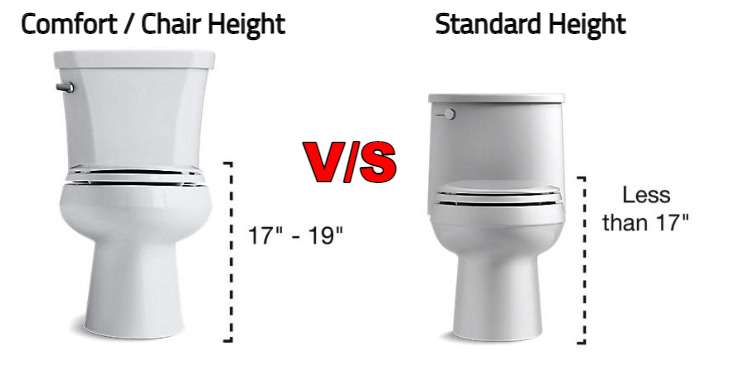
Here is the first thing you need to understand: chair height and comfort height are the same thing. They are two marketing names for a toilet with a rim height of 17 to 19 inches from the finished floor to the top of the bowl rim, not counting the seat. American Standard popularized the term “right height.” TOTO uses “universal height.” Kohler uses “comfort height.” Some retailers use “chair height.” All of these terms describe a toilet with a rim in the 17–19 inch range.
The traditional standard dimension, by contrast, refers to a rim height of 14 to 15 inches from the finished floor. That dimension has been the industry baseline since residential indoor plumbing became common in the early 20th century, and the vast majority of toilets installed in American homes before 2000 are at this dimension. The traditional height is not a euphemism for inferior — it is simply the original ergonomic design, built around average adult leg length before ADA accessibility requirements changed the market.
Quick Terminology Reference
| Term | Rim Height | Same As | Notes |
|---|---|---|---|
| Comfort Height | 17–19 inches | Chair Height, Right Height, Universal Height | ADA-compliant range |
| Chair Height | 17–19 inches | Comfort Height | Different brand name, identical dimension |
| Standard Height | 14–15 inches | Traditional height | Not ADA-compliant on its own |
| With Seat Added | +1.5–2 inches | — | Seat adds 1.5–2 inches to all rim measurements above |
The seated height — what you actually feel when you sit down — adds the toilet seat thickness on top of the rim measurement. A standard toilet seat adds approximately 1.5 to 2 inches. So a toilet with an 18-inch rim becomes about 19.5 to 20 inches seated.
A toilet with a 15-inch rim becomes approximately 16.5 to 17 inches seated. This distinction matters for the ergonomic analysis below, because the seated height determines whether your feet rest flat on the floor or dangle.
Exact Measurements: Comfort Height vs Standard Height
Rim height measurements are taken from the finished floor surface to the top edge of the porcelain bowl, before the seat is installed. These numbers are printed in every toilet specification sheet and are the measurement you should be comparing when shopping.
Standard Height (14–15 in) — Key Measurements
- Rim height (no seat): 14–15 inches from finished floor
- Seated height (with standard seat): 15.5–17 inches
- Ideal for users: Adults 5’0″–5’8″ with proportional inseam; children; users who squat-type posture benefits
- ADA compliant: No — 14–15 inch rim falls below the 17-inch minimum
Comfort Height / Chair Height — Measurements
- Rim height (no seat): 17–19 inches from finished floor
- Seated height (with standard seat): 18.5–21 inches
- Ideal for users: Adults 5’8″–6’4″; adults with knee, hip, or mobility limitations; elderly users
- ADA compliant: Yes — ADA requires 17–19 inches rim height
The practical difference in seated height between the two categories is approximately 3 to 4 inches. That gap is meaningful. On the lower traditional bowl, a 6-foot adult sits with knees bent at a sharp angle and may feel cramped or find standing up difficult.
On a taller seat, a 5-foot adult may find their feet dangling slightly off the floor, which shifts pelvic posture and can increase straining. Neither scenario is a crisis, but over years of daily use, the wrong height produces real discomfort.
One measurement worth noting: the 20-inch “Extra Tall” or “Tall Comfort” category exists as a third tier. Brands like Convenient Height and some specialty lines offer 20-inch rim toilets for users over 6’2″ or for those recovering from significant lower-body surgery. This category is outside the mainstream but worth knowing exists if you are shopping for an exceptionally tall household member.
Who Should Choose Comfort Height — And Who Should Not
The marketing around taller toilets is almost universally one-sided: taller, more comfortable, ADA-compliant, better for seniors. What the marketing does not say is that the elevated seat is ergonomically worse for a significant portion of users. The rule is straightforward when you understand the underlying physiology.
✅ This Height Is the Right Choice If:
- Primary users are 5’8″ or taller — seated height matches femur length and feet stay flat
- Household includes adults over 60 with any degree of knee, hip, or lower back limitations
- A household member uses a wheelchair and transfers to the toilet — ADA height aligns with standard wheelchair seat height (17–19 inches)
- Any user has undergone hip replacement surgery — surgeons typically recommend 17+ inch seated heights post-op
- The bathroom will serve as the accessible bathroom in a home with an elderly or mobility-impaired resident
- Primary users have knee arthritis or chronic knee pain — the reduced bend angle reduces joint stress on sit-to-stand
❌ When to Choose Standard Height Instead:
- Primary users are under 5’4″ — seated height will leave feet partially suspended, shifting pelvic angle
- The bathroom is used primarily or frequently by children — feet dangling increases straining, a documented contributor to constipation in children
- Any user has a history of hemorrhoids or chronic constipation — the lower position promotes better elimination posture (squatting angle)
- The household is a rental with mixed unknown tenants — the lower seat serves a wider range of adult body types neutrally
- The bathroom is a children’s bathroom — standard height plus a step stool serves kids far better than comfort height
The physiological reason for these recommendations: optimal bowel elimination posture requires a slight forward lean with knees at or above hip level — a posture closer to a natural squat. Traditional 14–15 inch toilets achieve approximately 35 degrees of hip flexion.
Taller toilets in the 17–19 inch range reduce that angle to approximately 22–25 degrees, which is closer to sitting in a chair. For users with mobility limitations where sit-to-stand ease matters more than elimination posture, the tradeoff favors the higher seat. For users where elimination ease matters more — including children and those with constipation — the tradeoff favors the lower seat.
Decision Tree: Which Toilet Height Is Right for You?
Work through this tree top to bottom. Stop at the first branch that applies to your household. The answer at the end of each branch is the right toilet height for your situation.
BRANCH 1 — Accessibility or Mobility Need?
If any regular user of this toilet uses a wheelchair, has had a hip replacement in the past 12 months, or has a diagnosed mobility condition that makes sitting down or standing up from low surfaces difficult → Choose Comfort Height (17–19 inch rim). This is not a preference question — it is a function question. ADA height reduces fall risk and joint stress for mobility-impaired users. Stop here.
BRANCH 2 — Is This a Children’s Bathroom?
If the toilet is in a bathroom used primarily by children under age 10 → Choose Standard Height (14–15 inch rim). Pair it with a step stool. That seat height is too tall for most children’s proportions and will make independent use harder, not easier. Stop here.
BRANCH 3 — Primary User Height Under 5’4″?
If the primary or only adult user of this toilet is under 5’4″ in height and has no mobility limitation → Choose Standard Height. At comfort height seated (18.5–21 inches), a 5’2″ adult sits with feet partially or fully off the floor, which produces a posture that is neither comfortable nor ergonomically sound for daily use. Stop here.
BRANCH 4 — Mixed Household with Adults of Varying Heights?
If the household includes adults ranging from 5’3″ to 6’1″ with no specific mobility need → This is the genuine conflict zone. For bathrooms where both extremes use the toilet daily, a taller seat serves taller users better and the lower rim serves shorter users better.
A 17-inch rim (the lower end of that range) is the best compromise — it adds 2–3 inches over standard without reaching the full 18–19-inch height that causes foot-off-floor issues for shorter adults. See the decision matrix below for a side-by-side breakdown.
BRANCH 5 — Primary Users Are Adults Over 60 with No Height Extremes?
If the household is primarily adults over 60, heights between 5’4″ and 6’0″, no wheelchair dependency → Choose Comfort Height. The sit-to-stand ease benefit outweighs the marginal posture advantage of the lower seat at this life stage. Knee and hip joints benefit meaningfully from the reduced bend angle even before clinical mobility limitations emerge. Stop here.
BRANCH 6 — All Other Cases (Average Adult Household, No Specific Constraints)?
If primary users are adults between 5’5″ and 6’0″ with no mobility limitations and no children regularly using this bathroom → The taller seat is the appropriate default. The taller seat makes sitting and standing slightly easier for average adults, and the ADA compliance ensures the bathroom remains accessible if household needs change over time.
ADA Compliance and Toilet Height: What the Code Actually Says
The Americans with Disabilities Act specifies that accessible toilet seats must be positioned between 17 and 19 inches from the finished floor, measured to the top of the seat surface (not the rim). This is why this taller toilet category — which places the rim at 17–19 inches — meets ADA requirements with a standard seat installed: the seat surface ends up at 18.5 to 21 inches, which exceeds the ADA minimum while remaining within reasonable reach distance for most wheelchair users.
One important distinction that causes confusion: ADA compliance in a public or commercial restroom is a legal requirement under federal law. ADA compliance in a private residential bathroom is a design recommendation, not a legal mandate — unless the home is a covered multi-family dwelling built after 1991, a federally assisted housing project, or is being designed to meet Fair Housing Act guidelines.
For most private single-family homes, choosing the traditional lower toilet does not violate any code. The decision is ergonomic and personal, not regulatory.
⚠️ ADA Grab Bar Requirement — Separate from Toilet Height
Installing an ADA-compliant toilet does not, by itself, make a bathroom ADA compliant. True ADA compliance in a residential setting also requires specific grab bar placement (36 inches on the side wall, 42 inches on the rear wall), a minimum 60-inch turning radius for wheelchairs, and specific clear floor space dimensions. If you are retrofitting a bathroom for a family member with a disability, toilet height is the starting point — not the complete answer.
State and local building codes occasionally add requirements beyond federal ADA standards. California’s Title 24, for example, has specific adaptable housing requirements that affect bathroom design in new construction. If you are building new or doing a permitted renovation, confirm with your local building department whether toilet height requirements apply to your project type before purchasing.
Common Mistakes Buyers Make When Choosing Toilet Height
Mistake #1 — Choosing by Name, Not Measurement
“Comfort height” sounds better than “standard height” — this is intentional marketing language. Many buyers choose the taller seat height without verifying that 17–19 inches actually suits the primary users of that bathroom. The name implies universal improvement. The reality is height-specific ergonomics. Always check the rim measurement in the spec sheet, not just the product category name.
Mistake #2 — Forgetting the Seat Adds Height
A toilet listed at “17-inch rim height” will seat you at approximately 18.5–19 inches once a standard seat is installed. Buyers who compare rim heights and don’t account for seat thickness can end up significantly higher than expected. If you are right at the threshold in terms of body proportions, the seat addition matters. Measure the seated height for the specific seat you plan to use.
Mistake #3 — Installing a Taller Toilet in a Mixed-Use Family Bathroom
In a household with adults and children sharing one primary bathroom, the taller seat causes daily inconvenience for the children and any shorter adults in the home. Many buyers install the taller toilet throughout the house without thinking about which bathroom children use most. If the home has one bathroom and children are regular users, the lower traditional seat — not the taller model — is the better choice for that bathroom.
Mistake #4 — Assuming the Current Toilet’s Height Is Wrong
Homeowners replacing an aging toilet sometimes assume they should “upgrade” to a taller seat, even when the existing lower toilet worked fine for all household members for 15 years. Replacement is not automatically the right time to switch height categories. If no one in the household complained about the old toilet’s height, measure it and replace it with the same category.
When the Answer Flips — When to Skip Comfort Height
When to Skip Comfort Height and Choose Standard
That recommendation flips entirely in these four scenarios:
- If the household’s primary daily users average under 5’4″ in height → the lower rim positions them with feet flat on the floor, which is both more comfortable and ergonomically superior for elimination
- If the bathroom is used primarily or regularly by children under age 12 → the taller seat forces children to either dangle their feet or use a step stool on every visit; standard height plus a step stool only when needed is the practical solution
- If anyone in the household has chronic constipation or hemorrhoid issues → gastroenterologists consistently recommend a more angled squat posture; the lower 14–15 inch rim produces a closer approximation than the taller seat
- If you are replacing the current toilet in a home you plan to sell within 5 years → standard height serves a broader spectrum of buyers and avoids a feature some buyers will see as a problem; it is a preference item, not a universal improvement
In all four of these scenarios, the marketing language around taller toilets points buyers in exactly the wrong direction. The right choice depends entirely on the specific people using the toilet — not on the product label.
Decision Matrix: Comfort Height vs Standard Height by Household Condition
| Condition | Standard Height | Comfort Height | Winner | Why |
|---|---|---|---|---|
| Adults 5’8″+ only, no mobility limits | Knees too high, cramped | Feet flat, natural posture | Higher Seat ✅ | Better femur-to-seat alignment |
| Adults under 5’4″ only, no mobility limits | Feet flat, elimination posture correct | Feet off floor, strained posture | Lower Seat ✅ | Proportional fit for shorter users |
| Elderly adults, knee or hip limitations | Harder to stand up from | Reduced bend angle, easier to rise | Higher Seat ✅ | Sit-to-stand ease reduces fall risk |
| Wheelchair transfer required | Height mismatch with chair | Aligns with wheelchair seat height | Higher Seat ✅ | ADA standard designed for this use case |
| Children’s bathroom, primary child users | Reachable, proportional | Too tall, feet dangle | Lower Seat ✅ | Children’s proportions require lower seat |
| Mixed household, adults 5’3″–6’1″ | Good for shorter users | Good for taller users | 17″ Comfort Height ⚖️ | Lower end of comfort range is best compromise |
| Chronic constipation or hemorrhoids | Better elimination angle | Reduced pelvic angle | Lower Seat ✅ | Closer to squat posture for elimination |
| Post hip replacement recovery | Surgeon typically restricts | Meets typical 17″+ post-op requirement | Higher Seat ✅ | Orthopedic protocol requires elevated seat height |
Frequently Asked Questions — Comfort Height vs Standard Height Toilet
Q1: What is the difference between comfort height and chair height toilets?
There is no difference — both are marketing names for the same rim height: 17 to 19 inches from finished floor to bowl top, before the seat is installed. American Standard calls it “right height,” TOTO calls it “universal height,” Kohler uses “comfort height,” and many retailers use “chair height.” All describe the same ADA-compliant dimension. Always compare the actual rim measurement in the spec sheet, not the label.
Q2: How tall is a comfort height toilet with the seat on?
A toilet with a 17 to 19 inch rim adds approximately 1.5 to 2 inches when a standard seat is installed, producing a seated height of approximately 18.5 to 21 inches from the finished floor to the top of the seat surface.
The exact number depends on the specific rim height (which varies within that range) and the thickness of the seat. Cushioned or elongated seats tend to add slightly more height than standard plastic seats.
Q3: Is a comfort height toilet better for elderly users?
For most elderly adults — particularly those experiencing knee stiffness, hip tightness, or reduced lower-body strength — the taller seat is the better choice. The higher rim reduces the angle of knee and hip flexion required to sit and stand, which decreases joint stress and lowers fall risk.
For elderly adults who also use a wheelchair, the ADA-specified 17–19 inch range aligns with wheelchair seat height for easier lateral transfers. The benefit is most pronounced for users over 65 with any existing joint limitation.
Q4: Should I choose a taller or lower toilet for a family with children?
If children regularly use the bathroom in question, the lower seat is the better choice. A rim in the 17–19 inch range is proportionally too tall for most children — their feet will dangle partially or fully off the floor, which makes an uncomfortable posture and can make independent bathroom use harder for young children.
If the home has multiple bathrooms, install a taller toilet in the master or adult bathroom and a lower 14–15 inch rim in the bathroom children use most. If the home has only one bathroom, the traditional lower seat serves the full household better.
Q5: Does toilet height affect elimination?
Yes — the physiology is well documented. A lower seated position produces greater hip flexion and a forward lean that more closely approximates a natural squatting posture, which relaxes the puborectalis muscle and opens the anorectal angle for easier elimination. Traditional lower toilets produce a seated angle of approximately 35 degrees of hip flexion.
Taller toilets in the ADA height range produce approximately 22–25 degrees — closer to sitting in a standard chair. For users with no elimination issues, the difference is minor. For users with chronic constipation or hemorrhoids, the posture difference is clinically relevant and the lower seat — or a footstool — is generally recommended.
Q6: Can I convert a standard height toilet to comfort height?
There is no retrofit that converts the bowl’s rim height — the porcelain bowl is a fixed dimension set during manufacturing. However, two practical workarounds exist. First, a raised toilet seat (a bolt-on accessory adding 2–5 inches) can elevate any conventional toilet to ADA height or above, widely available for $25–80 and commonly used in post-surgical and elder care settings.
Second, a toilet safety frame (a freestanding device with arm rests) provides more stability but takes up more floor space. If you are replacing the toilet anyway, installing an actual taller model is simpler and produces better long-term results than any accessory solution.
Verdict — Which Toilet Height Should You Choose?
If any household member has a mobility limitation, uses a wheelchair, or has recently had hip or knee surgery → choose a comfort height model (17–19 inch rim) without question. This is an accessibility decision, and that taller category is the correct functional answer.
If the primary daily users are adults between 5’8″ and 6’4″ with no children regularly sharing the bathroom → a taller toilet is the right choice. Taller adults sit and stand from the elevated seat more naturally, and the ADA-compliant dimension adds long-term flexibility as household needs change.
If children under 12 use the bathroom regularly, or if the primary adults are under 5’4″ → choose the lower bowl. Marketing language notwithstanding, the 14–15 inch rim is ergonomically correct for shorter users and essential for households where children are regular bathroom occupants.
If you have a mixed household and are uncertain → choose a 17-inch rim model (the lower end of the comfort height range). It provides meaningful sit-to-stand improvement over the traditional lower bowl for taller adults while reducing the foot-off-floor issue for shorter users. It is the best available compromise when a single toilet must serve a wide range of body types.
For our top-tested toilet recommendations by category, see Best Comfort Height Toilets and Best Flushing Toilets.
Difference Between Comfort Height and Standard Height Toilets
The difference between these two toilet categories comes down to a single measurement: the rim height from the finished floor. The traditional category has a rim of 14 to 15 inches, producing a seated height of roughly 15.5 to 17 inches with a standard seat installed. The taller ADA-compliant category has a rim of 17 to 19 inches, producing a seated height of 18.5 to 21 inches. That 3–4 inch gap is the entire distinction between the two categories.
The practical consequence of that gap is ergonomic. A taller person on the lower bowl sits with knees bent more sharply and may find standing up requires more effort, particularly over time or with aging joints. A shorter user on the taller seat sits with feet partially or fully elevated off the floor, shifting pelvic posture and producing less natural body alignment. Neither is dangerous, but both produce daily inconvenience when the toilet height does not match the user’s body proportions.
From a plumbing installation standpoint, both heights connect to the same rough-in dimensions — standard 12-inch rough-in, standard water supply connection height, and standard floor bolt pattern. Swapping between height categories during a renovation requires no plumbing changes.
The toilet installs directly in the same position. The only structural consideration is the overall toilet height difference, which affects grab bar positioning if bars are being installed alongside. See our guide to the best comfort height toilets for specific model comparisons across both the 17-inch and 19-inch ends of the range.
Best Toilet Height for Elderly
For elderly users — specifically adults over 65, or any adult experiencing reduced lower-body strength or joint stiffness — a higher seat is the appropriate starting point. The elevated rim reduces the angle of knee and hip flexion required to sit down and, more importantly, to stand back up.
Sit-to-stand transitions from lower surfaces put significantly more load on the quadriceps, glutes, and hip flexors than transitions from elevated surfaces. As muscle mass decreases with age and joint flexibility declines, a 3–4 inch height difference becomes genuinely meaningful for daily functional independence.
For elderly users who require wheelchair assistance, the ADA-specified 17–19 inch range is not a preference — it is a functional requirement. Standard wheelchair seat heights range from 17 to 19.5 inches. A toilet rim within that range allows lateral transfers with minimal vertical height change, reducing the lift requirement and lowering fall risk during the transfer.
Beyond toilet height, two additions improve bathroom safety for elderly users: grab bars and a toilet safety frame. A wall-mounted grab bar on the side wall — positioned 33–36 inches from the finished floor, 6–8 inches forward of the toilet centerline — provides a stable push point for standing.
A freestanding toilet safety frame that bolts to the floor flanges provides arm rests on both sides. Either addition matters more than toilet height alone — combine all three for a genuinely safer bathroom. The best comfort height toilets guide covers specific models suited for elderly and accessibility installations. For broader bathroom decisions, see our best flushing toilets review for models that combine accessibility height with reliable flush performance.
Is Chair Height the Same as Comfort Height?
Yes — chair height and comfort height are the same specification described using two different marketing names. Both refer to a toilet with a rim height of 17 to 19 inches from the finished floor, measured to the top of the porcelain bowl before the seat is installed.
The terminology varies by manufacturer: American Standard uses “right height,” TOTO uses “universal height,” Kohler and many other brands use “comfort height,” and several retailers use “chair height.” All of these labels describe the same ADA-compliant dimension range.
The “chair height” label came from a specific marketing analogy: a standard dining chair seat is approximately 17 to 18 inches from the floor, which falls within the ADA toilet height range. The comparison was intended to communicate that sitting on a taller toilet feels like sitting in a chair — a natural, accessible position — compared to the traditional lower bowl.
The analogy is partially accurate: the seated height does approximate a chair, which is why taller adults and those with mobility limitations prefer it. The limitation of the analogy is that chairs are ergonomically appropriate for dining, not necessarily for elimination — but the marketing stuck.
When comparing specifications across brands, always check the rim height measurement directly in the product spec sheet rather than relying on the category name. Some manufacturers list their products as “17.5 inches” or “18 inches” — both fall within the ADA range, but the difference matters when shopping at the borderline between what works for shorter and taller users in the same household.
For detailed model comparisons, see our best comfort height toilet guide, and for one-piece vs two-piece decisions at both height levels, see our best one-piece toilets and best two-piece toilet reviews.
