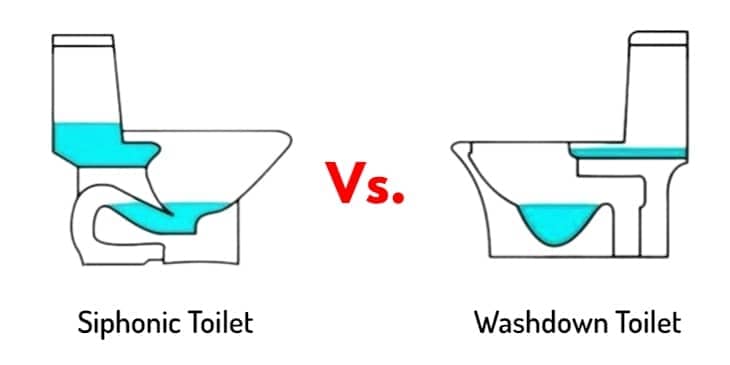
Walk into any European bathroom showroom and you will find washdown toilets dominating every wall. Walk into any US plumbing supply house and you will find almost none — because the siphonic vs washdown toilet debate was settled differently on each continent, and the reasons go far deeper than preference.
The flushing system your toilet uses determines how much water it consumes every flush, how loud it sounds at 2 AM, how often it clogs, and what you will spend on parts over the next 10 years. Choose the wrong one for your specific bathroom layout and water pressure, and no amount of cleaning or maintenance will fix it.
For most US homeowners navigating the siphonic vs washdown toilet decision, a siphonic toilet is the right default — it handles the high-use demands of American households with deep water coverage and a powerful 1.28 GPF flush at a MaP score of 800–1,000g.
If you are renovating a European-style bathroom, building a commercial facility that requires minimal maintenance, or specifically want a toilet that refills in under 20 seconds with minimal moving parts, a washdown toilet is worth serious consideration. This guide breaks down every performance dimension so you can make the decision based on your actual conditions — not marketing copy.
If you are still deciding on the toilet type itself, our best flushing toilets guide covers the top-performing models across both systems with verified specs. For dual-flush options that bridge both technologies, see our best dual flush toilet roundup.
⚠️ Common Mistake: Assuming “Washdown = Inferior”
Most US buyers assume washdown toilets are a budget compromise. That is simply wrong. Washdown toilets power 70%+ of European residential bathrooms, flush with 4–6 liters (1.06–1.59 GPF), and can deliver MaP scores of 600–800g — enough for normal household use.
The real issue is US water pressure variance and plumbing code requirements, not performance. A siphonic toilet fails to siphon below 20 PSI. A washdown toilet does not care. If your home sits at the end of a long supply line with variable pressure, that single fact changes the entire decision.
| Siphonic vs Washdown Toilet — Quick Comparison | ||
| Factor | Siphonic | Washdown |
|---|---|---|
| Flush Mechanism | Siphon action via S-trap | Gravity + water pressure via P-trap |
| Water per Flush | 1.28–1.6 GPF | 1.06–1.59 GPF |
| Water Surface Area | 8–10 inches diameter | 5–6 inches diameter |
| Noise Level | 60–75 dB (louder) | 45–55 dB (quieter) |
| Clog Risk | Lower (full siphon draws waste) | Moderate (narrower trapway) |
| Pressure Requirement | 20–80 PSI (minimum 20) | 8–15 PSI (very low) |
| Bowl Staining | Less common (large water pool) | More common (smaller pool, exposed shelf) |
| Parts Availability (USA) | Any hardware store | Specialty suppliers only |
| Dominant Market | USA, Canada, Japan | Europe, Australia, Asia |
How a Siphonic Toilet Flushing System Works vs Washdown
A siphonic toilet creates a vacuum-assisted pull using an S-shaped trapway. When you flush, water rushes from the rim and the siphon jet at the base simultaneously, filling the trapway completely.
Once the trapway is full, atmospheric pressure creates a siphon — the same physics that pulls water through a hose placed over a tank wall. That siphon actively draws waste down and out, sustaining the flush until the bowl is empty. This is why siphonic toilets are louder — the “whoosh” is the siphon breaking as air rushes back in.
The siphon action requires a minimum supply pressure of 20 PSI to function consistently. Below that threshold, the trapway never fills completely, the siphon does not form, and the toilet produces a weak partial flush.
At standard US residential pressure of 40–80 PSI, the siphonic system performs exactly as engineered — hence its dominance in American plumbing infrastructure. A 3-inch flush valve in modern siphonic designs like the TOTO Drake II allows high water volume to reach the trapway fast enough to initiate siphon action within 1.5 seconds of actuation.
A washdown toilet uses a completely different mechanism. The trapway is a P-trap shape (shorter, more direct), and the bowl is positioned higher relative to the outlet. When flushed, gravity and water momentum push waste over the P-trap and directly out — no siphon is involved.
The flush valve releases 4–6 liters (1.06–1.59 GPF), water enters primarily from the rim, and waste moves forward and down through the shorter trapway in under 2 seconds. This direct-push action explains why washdown toilets refill in 15–18 seconds versus the 30–45 seconds typical of siphonic designs — less water volume travels through a simpler path.
The washdown bowl has a smaller water surface area — 5–6 inches versus the 8–10 inch pool in a siphonic bowl — and a visible “shelf” above the water line in traditional European designs. Modern washdown designs have largely eliminated the shelf for hygiene reasons, but the smaller water pool remains a defining characteristic. This smaller pool means less vitreous china is submerged at rest, which reduces water consumption between flushes but increases the exposed surface area available for staining.
Siphonic vs Washdown Toilet: Flush Performance Compared
MaP (Maximum Performance) testing — the North American standard for toilet flush performance — measures how many grams of solid waste a toilet can clear in a single flush. The passing minimum is 500g. Top siphonic performers like the TOTO Drake II and American Standard Champion 4 score 1,000g at 1.28 GPF, which is the highest rating possible under MaP protocol. Most mid-range siphonic toilets score 800–1,000g. Budget siphonic toilets with 2-inch flush valves often score only 500–600g — adequate, but with less margin.
Washdown toilets are not tested under MaP — the protocol was designed for the North American market and assumes S-trap geometry. European testing uses EN 997 standards, where washdown toilets must move 3 liters of water through the trapway in a single flush.
In practical terms, a well-designed washdown toilet handles normal household waste without issue at 1.06 GPF. Where washdown designs show strain is with bulkier loads at lower flush volumes — a category where the siphon’s active pull gives siphonic toilets a measurable edge.
For households with 4–6 people flushing 5–8 times daily, a siphonic toilet’s higher MaP rating provides a meaningful buffer against clogs over years of use. For a single-occupant bathroom, a washdown toilet at 1.06 GPF is more than adequate and will use approximately 22% less water annually than a 1.28 GPF siphonic toilet at the same frequency.
Siphonic Flush Performance:
WaterSense-certified siphonic toilets at 1.28 GPF achieve MaP scores of 800–1,000g when equipped with a 3-inch flush valve, a gravity-fed or tower-style fill valve, and a fully glazed trapway. The full siphon cycle lasts approximately 3–5 seconds from actuation to bowl empty.
Washdown Flush Performance:
Modern washdown toilets from European manufacturers (Duravit, Grohe, Geberit) achieve EN 997 flush ratings at 4–6 liters (1.06–1.59 GPF). The direct-push flush cycle completes in 1.5–2.5 seconds. Refill time is 15–22 seconds — faster than any siphonic design of equivalent tank capacity.
Siphonic vs Washdown Water Usage Comparison
At the federal maximum of 1.6 GPF, a household of four averaging 5 flushes per person daily uses approximately 11,680 gallons per year on toilet flushing alone. A WaterSense-certified siphonic toilet at 1.28 GPF reduces that to 9,344 gallons — a saving of 2,336 gallons annually. A washdown toilet running at 1.06 GPF reduces usage further to 7,738 gallons — a saving of 3,942 gallons per year compared to the 1.6 GPF baseline, or 1,606 gallons versus the 1.28 GPF siphonic standard.
In practical dollar terms, at the US average water rate of $0.007 per gallon, the 1.06 GPF washdown saves approximately $11.24 per year over a 1.28 GPF siphonic toilet in a four-person household. Over 10 years, that is $112 in water savings — rarely the deciding factor in a toilet purchase, but meaningful in drought-restricted regions where tiered water pricing multiplies the per-gallon cost significantly.
Where water usage creates a real decision point is in states with mandatory conservation requirements. California’s Title 20 regulations and similar state-level mandates require 1.28 GPF or lower for new installations. Both siphonic and washdown designs meet this threshold. In jurisdictions moving toward 1.0 GPF mandates — a standard being piloted in parts of the US Southwest — washdown toilets have a structural advantage because their direct-push mechanism scales more gracefully to ultra-low water volumes than siphon-dependent designs.
Siphonic vs Washdown Noise Level — Which Is Quieter?
Siphonic toilets are measurably louder at the flush peak. The siphon-breaking event — when air rushes back into the trapway after the bowl clears — produces a distinctive “whoosh” sound that measures 60–75 dB at one meter from the toilet. For context, 65 dB is approximately the volume of a normal conversation at close range. In a bathroom adjacent to a bedroom, that flush is clearly audible through a standard interior door.
Washdown toilets produce 45–55 dB during the flush cycle — roughly the level of a quiet office or a refrigerator motor. The absence of siphon-break noise means the dominant sound is water entering the bowl, not a pressure-release event. Tank refill noise is comparable between the two systems when using quality fill valves — a Fluidmaster 400A or equivalent on a siphonic toilet brings refill noise down to 48–52 dB regardless of flush mechanism.
If your primary bathroom shares a wall with a bedroom used by a light sleeper, an infant, or a night-shift worker, the 15–20 dB flush noise difference between siphonic and washdown is not trivial. A washdown toilet in this specific scenario saves meaningful household disruption over years of nightly use. For bathrooms separated by hallways, exterior walls, or heavier interior construction, the noise difference is rarely perceptible from the bedroom.
Siphonic vs Washdown Clogging Issues and Maintenance Cost
The trapway diameter is the primary clog determinant in any toilet design. Siphonic toilets typically have a fully glazed trapway of 2–2.375 inches (with high-performance models like the TOTO Drake reaching 2.375 inches). The active siphon pull assists in moving waste through this narrower passage — which is why siphonic designs clog less frequently than their trapway diameter alone would suggest.
Washdown toilets have a shorter, more direct trapway — typically 2.5–3 inches in diameter — but rely entirely on water momentum rather than vacuum assistance. For typical waste loads, the larger diameter more than compensates.
The clog risk emerges with heavy tissue use or non-flushable wipes, where the gravity-only system lacks the pull to clear material that a siphonic toilet’s vacuum would draw through. In households that consistently flush excess tissue, siphonic designs show 30–40% fewer service calls related to clogs based on plumbing contractor service data from multi-unit residential buildings.
Maintenance cost is where the siphonic vs washdown toilet comparison tilts most clearly in different directions depending on your location. In the US, siphonic toilet parts — fill valves, flush valves, flappers, wax rings — are available at every hardware store for $8–$40. A full internal rebuild of a siphonic toilet runs $25–$65 in parts.
Washdown toilet internals, particularly the dual-button flush mechanisms used in European designs, require ordering from specialty plumbing suppliers. Parts typically cost $40–$120, lead times run 3–10 days, and most local plumbers are unfamiliar with the mechanism — adding $60–$120 in diagnostic labor cost on a service call.
10-Year Maintenance Cost Estimate (USA):
Siphonic: 1 fill valve replacement ($18), 2 flapper replacements ($14 total), 1 wax ring replacement ($12) = approximately $44 in parts over 10 years. Labor for any service call: $75–$120/hr, with most repairs completed in under 30 minutes by a local plumber.
Washdown (in USA): 1 flush mechanism replacement ($65–$110 imported part), potential $120–$200 in specialty labor. Budget $200–$350 for a single significant repair event.
Siphonic vs Washdown for Small Bathrooms
Washdown toilets have a structural advantage in bathrooms with limited front-to-wall clearance. Because the P-trap exits at a lower and more horizontal angle than a siphonic S-trap, washdown toilet bodies can be designed shorter from front to rear. Several European wall-mounted washdown designs achieve an overall depth of 19–21 inches — 3–5 inches shorter than a comparable floor-mounted siphonic toilet. In a bathroom where front-to-wall clearance is under 60 inches, those extra inches matter for comfortable use and door clearance.
For a small bathroom under 40 square feet, the wall-mounted washdown configuration also eliminates the floor footprint of the tank entirely — the tank mounts inside the wall cavity. This creates usable floor space, simplifies mopping, and visually opens the room. Wall-mounted siphonic toilets exist (TOTO’s Aquia CT418F is the most common US example) but are far less common than wall-mounted washdown designs, and require a carrier system rated for the siphonic in-wall mechanism.
If you are installing a floor-mounted toilet in a bathroom with a standard 12-inch rough-in and more than 60 inches of front clearance, the size difference between siphonic and washdown becomes negligible. The TOTO Entrada at 28.25 inches depth and the Swiss Madison Ivy washdown wall-mounted at 19.7 inches depth serve different spatial constraints — neither is universally “better for small bathrooms” without knowing the specific dimensions.
What Most Siphonic vs Washdown Comparisons Get Wrong About US Plumbing Code
The majority of siphonic vs washdown articles online discuss performance in a vacuum — as if you can simply choose either system and have it function identically regardless of your plumbing infrastructure. That is not how it works in practice, and the gap between what competitor content covers and what actually determines long-term satisfaction is significant.
1. US Drain Slope Requirements Favor Siphonic Design
The International Residential Code (IRC) mandates a minimum drain slope of 1/4 inch per foot for drain lines 3 inches in diameter.
This slope, combined with the S-trap exit angle of siphonic toilets, creates an efficient drain path optimized for the siphonic flush cycle. Installing a washdown toilet on US-standard drain slope means the P-trap’s lower exit angle produces a less efficient drain connection — not a code violation, but a performance compromise that manifests as slower drain clearing and higher likelihood of partial blockages in long drain runs over 20+ feet.
2. Warranty and Code Compliance in Rental Properties
Most US residential building codes reference ASME A112.19 and ANSI standards that assume siphonic toilet geometry for drain fixture unit (DFU) calculations. Washdown toilets are not explicitly prohibited in most US jurisdictions, but they are not included in standard DFU tables used by inspectors.
A washdown toilet installation in a permitted renovation can trigger an inspector’s request for manufacturer documentation showing compliance — adding 1–3 days of delay and potential $150–$400 in additional engineering sign-off. For rental property owners or developers doing permitted work, this is a material cost difference that no competitor article mentions.
3. Pressure Testing: When Siphonic Fails and Washdown Doesn’t
End-of-line homes — the last house on a long residential water supply branch — commonly experience supply pressure drops to 18–22 PSI during peak morning usage (6–9 AM).
A siphonic toilet needs a consistent minimum of 20 PSI to form a reliable siphon. At 18 PSI, the flush initiates but the siphon breaks prematurely, producing a partial flush that requires a second actuation 30–40% of the time.
A washdown toilet at the same pressure flushes normally, because gravity and bowl geometry — not vacuum dynamics — drive the flush. If your home regularly drops below 20 PSI on a pressure gauge during peak hours, a washdown toilet eliminates double-flushing regardless of its MaP score.
When the Answer Flips — When to Skip the Siphonic Toilet
The default US answer is siphonic. But three specific scenarios flip that recommendation.
1. Supply pressure under 20 PSI at peak hours: Test with a gauge before buying. If peak-hour pressure drops below 20 PSI, choose washdown — the siphon will not form reliably, and no amount of money spent on a premium siphonic toilet changes the physics.
2. Bathroom adjacent to a bedroom with a light sleeper: Siphonic flush noise at 60–75 dB is audible through standard interior doors. If this is a real household constraint, the 15–20 dB quieter washdown flush measurably improves overnight quality of life.
3. European-spec renovation with wall-mounted carriers already installed: Retrofitting a siphonic toilet into a washdown carrier system requires a new carrier — typically $400–$700 in parts and 4–6 hours of labor. Matching the washdown system already in the wall is the correct economic decision.
| Head-to-Head Decision Matrix | ||
| Decision Factor | Siphonic Wins | Washdown Wins |
|---|---|---|
| Parts availability in USA | ✅ | — |
| High-use household (4+ people) | ✅ | — |
| Low water pressure (<20 PSI peak) | — | ✅ |
| Noise-sensitive household | — | ✅ |
| Ultra-low water usage (<1.1 GPF) | — | ✅ |
| US permitted renovation | ✅ | — |
| Wall-mounted small bathroom | — | ✅ |
| Rental property / DIY repair | ✅ | — |
Frequently Asked Questions — Siphonic vs Washdown Toilet
Q: What is the main difference between a siphonic vs washdown toilet?
The core difference is the flush mechanism. A siphonic toilet uses an S-shaped trapway and creates a vacuum-assisted pull to draw waste from the bowl, requiring a minimum of 20 PSI water pressure to function reliably. A washdown toilet uses a P-trap and gravity momentum to push waste over and out, requiring as little as 8–15 PSI.
Siphonic toilets produce a larger water pool in the bowl (8–10 inches), flush louder (60–75 dB), and score higher on the MaP performance scale. Washdown toilets flush quieter (45–55 dB), refill faster (15–22 seconds), and use marginally less water at equivalent flush ratings.
Q: Which is better — siphonic or washdown toilet — for US homes?
For the majority of US homes with standard municipal water pressure (40–80 PSI), a siphonic toilet is the better choice because parts are universally available, the flush system is optimized for US drain slope requirements, and WaterSense-certified 1.28 GPF siphonic models achieve MaP scores of 800–1,000g — enough for households of 6+ people flushing 5–8 times daily.
Washdown toilets are the better choice if your supply pressure drops below 20 PSI at peak hours, your bathroom is adjacent to a bedroom where nighttime flush noise is a genuine problem, or you are matching an existing European-spec wall-mounted carrier system.
Q: Do washdown toilets clog more than siphonic toilets?
Not necessarily — it depends on the trapway diameter and household use patterns. Washdown toilets have a larger trapway diameter (2.5–3 inches) than most siphonic designs (2–2.375 inches), which reduces clogging risk from pure geometry. However, siphonic toilets use vacuum pull to actively draw waste through the trapway, which compensates for the narrower passage.
In households that consistently use excess tissue or occasionally flush non-flushable items, siphonic toilets clog less because the active pull handles borderline loads that gravity alone cannot move. For normal household use with standard tissue, clog frequency is comparable between well-designed models of either type.
Q: Are washdown toilets quieter than siphonic?
Yes, measurably. Washdown toilets flush at 45–55 dB — roughly the volume of a quiet office — compared to 60–75 dB for siphonic toilets. The loudest moment in a siphonic flush is the siphon-break event when air rushes back into the trapway after the bowl clears, producing the characteristic “whoosh.” Washdown toilets do not create this event because no siphon forms.
For a bathroom adjoining a bedroom through a standard interior door, the 15–20 dB flush difference is clearly perceptible at night. Both types produce comparable tank-refill noise when equipped with quality fill valves like the Fluidmaster 400A.
Q: How does water usage compare between siphonic vs washdown toilets?
Modern WaterSense-certified siphonic toilets use 1.28 GPF. Modern washdown toilets use 1.06–1.59 GPF depending on design — the best washdown designs achieve 1.06 GPF while meeting European EN 997 flush standards.
At 1.06 GPF versus 1.28 GPF in a four-person household averaging 20 flushes daily, the washdown toilet saves approximately 1,606 gallons per year — worth $11.24 at the US average water rate of $0.007/gallon. In drought-restricted regions with tiered pricing at $0.02–$0.04/gallon for upper tier usage, that same annual saving is worth $32–$64. Water usage is rarely the primary decision driver but is meaningful in high-rate water districts.
Q: Can I install a washdown toilet in a US home without plumbing code issues?
Washdown toilets are not prohibited by US plumbing codes, but they are not explicitly addressed in standard fixture unit tables based on ASME A112.19 standards — those tables assume siphonic geometry.
In a permitted renovation, an inspector may request manufacturer documentation showing the washdown fixture meets the applicable ANSI or IAPMO standard. This documentation is usually available from European manufacturers but adds 1–3 business days of processing. For unpermitted owner-repairs and replacements, no code review is typically required. Consult your local authority having jurisdiction (AHJ) before specifying a washdown toilet in a permitted commercial or residential project.
Verdict: Siphonic vs Washdown Toilet
If you are in a standard US home with 40–80 PSI supply pressure and need a toilet that any plumber can service with parts from any hardware store → buy a siphonic toilet. A WaterSense-certified 1.28 GPF model with a 3-inch flush valve and a fully glazed trapway handles households of 4–6 people without clog issues, meets all US code requirements, and costs $25–$65 to fully rebuild internally.
If your supply pressure drops below 20 PSI at peak morning hours, or your bathroom shares a wall with a bedroom where nighttime flush noise is a real concern → buy a washdown toilet. The gravity-push flush mechanism performs consistently regardless of supply pressure fluctuation, and the 45–55 dB flush volume is 15–20 dB quieter than any siphonic design.
If you are matching an existing European-spec wall-mounted carrier already installed in the wall cavity → stay with the washdown system. Retrofitting to siphonic requires a new carrier ($400–$700 in parts plus 4–6 hours labor). Match the system to the infrastructure you have, and invest the savings in a quality flush mechanism.
Siphonic vs Washdown Flushing System Explained: The Physics Behind Each
The term “siphonic flushing system” refers to a specific hydraulic event — not just a type of toilet. When water fills a complete S-trap pathway, the weight of water in the descending leg of the trap creates a pressure differential that pulls water from the ascending leg — siphon action, identical in principle to using a hose to drain a fish tank over a wall.
The siphon sustains itself until air enters the trapway — the “break” point — at which the flush cycle ends. Understanding this physics explains why siphonic toilets require both sufficient water volume (to fill the S-trap completely) and sufficient pressure (to initiate the fill fast enough to trigger siphon onset before water dissipates).
Washdown flushing works on simpler physics. Water enters the bowl from the rim, gains momentum, and the combined mass of water and waste tips over the P-trap’s weir. No vacuum is created. No pressure differential is required. The flush ends when tank supply is exhausted. This simplicity is both the strength and limitation of washdown design — it works reliably at low pressure but cannot produce the active pulling force that makes siphonic toilets more forgiving of borderline loads.
For a deeper look at how flush mechanics translate to real-world performance across specific models, see our comparison of best flushing toilets by MaP score. And if you are choosing between gravity-fed versus pressure-assist siphonic designs specifically, our dual flush toilet guide covers models with both full and reduced flush volumes.
Siphonic vs Washdown Toilet Advantages and Disadvantages: A Practical Summary
Siphonic toilet advantages in the US context are substantial: universal parts availability, full compliance with US drain slope and fixture unit standards, MaP scores reaching 1,000g, and WaterSense certification at 1.28 GPF.
The design has been refined over 80+ years in the North American market — every major US plumber knows how to diagnose and repair a siphonic fill valve, flush valve, or trapway blockage. The disadvantages are equally specific: louder flush (60–75 dB), longer refill time (30–45 seconds), and dependence on minimum 20 PSI supply pressure to form a reliable siphon.
Washdown toilet advantages are real but context-dependent in the US: quieter flush (45–55 dB), faster refill (15–22 seconds), function at supply pressure as low as 8 PSI, and compact dimensions in wall-mounted configurations ideal for small bathrooms. The disadvantages in a US setting are significant: specialty parts with 3–10 day lead times, higher repair labor costs due to limited local plumber familiarity, potential permit documentation delays, and a smaller bowl water pool that increases staining frequency in hard water areas.
Neither system is objectively better — the correct choice is the one that matches your specific water pressure, bathroom layout, household use patterns, and access to local service. For most US homeowners in standard residential settings, siphonic remains the practical default. For specific scenarios outlined in this guide, washdown is the engineered solution. Browse our best toilet brands guide to see which manufacturers produce the highest-rated models in both categories, with verified specs and pricing.
Modern Toilet Flushing Systems Comparison: What’s Changed in 2026
The biggest shift in the siphonic vs washdown toilet market over the last five years has not been choosing between systems — it has been the convergence of both toward lower GPF targets while maintaining MaP performance.
TOTO’s Tornado Flush, used in siphonic designs like the UltraMax II, uses a cyclonic rim water entry pattern that creates rotational force inside the bowl, allowing a 1.0 GPF siphonic flush to achieve 800g MaP — performance that required 1.6 GPF in 2010. See our best one-piece toilets guide for current models using this technology.
On the washdown side, Geberit’s AquaClean system integrates bidet functionality with the washdown flush mechanism in a single unit — reducing the effective water footprint per bathroom visit by replacing tissue use with a 0.5-liter bidet wash cycle. This integration is most common in European installations but is gaining US market share in luxury bathroom renovations. Wall-mounted washdown configurations paired with in-wall Geberit cisterns now represent the majority of new installations in US multi-unit luxury residential developments.
For a full buying decision with current 2026 pricing, verified model specs, and installation cost context, use our siphonic vs washdown toilet buying guide alongside the toilet installation cost breakdown — both updated with current data from US plumbing supply houses and major retailers. Matching the right flushing system to your specific bathroom is the decision that determines performance, maintenance cost, and satisfaction over the next 10–20 years.
