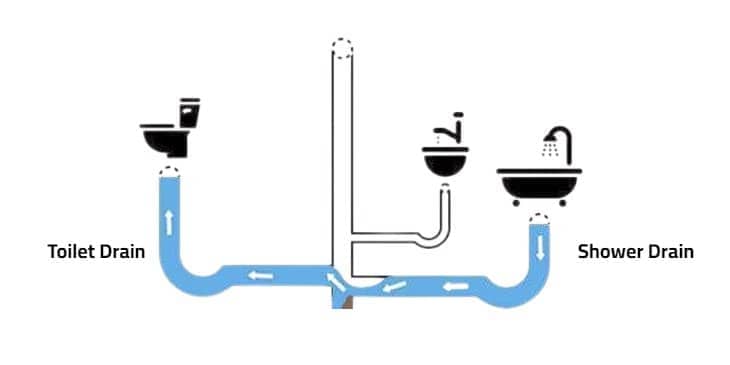
Your toilet and shower already connect to the same main sewer line downstream — but sharing the branch drain line is a different story. In my 20+ years installing bathrooms across the U.S., I’ve seen homeowners try to save money by tying them together only to end up with backups, gurgling traps, and code violations that cost thousands to fix.
The short answer: yes, a toilet and shower can share the same drain line — but only if your setup meets strict plumbing code requirements for pipe size, slope, venting, and fixture order. Get it wrong and you risk clogs affecting both fixtures or sewer gas entering your home. This guide gives you the exact conditions that decide whether sharing works in your bathroom.
Most assume “if it drains, it’s fine” and simply tie the shower drain into the toilet line with a basic tee. That creates an unvented or improperly vented section that siphons the toilet trap or backs up the shower every time you flush. I’ve pulled out more than a dozen failed DIY jobs like this — always because the wet vent rules were ignored.
4 Conditions That Decide If Sharing a Drain Is Allowed
Whether a toilet and shower can share the same drain line depends on four real-world factors. Run through them before you pick up a saw or call a plumber.
Condition 1: New Construction or Full Remodel — Wet Venting Usually Wins
In new builds or gut remodels, sharing the drain line is straightforward and code-approved in most areas. The International Plumbing Code (IPC) and Uniform Plumbing Code (UPC) both allow horizontal wet venting for an entire bathroom group (toilet + shower + lavatory).
Here’s how it works in the field: The lavatory drain is dry-vented to the roof, then that same pipe becomes the “wet vent” for the toilet and shower downstream. The toilet must be the most downstream fixture on the horizontal branch. Pipe size is critical — minimum 3-inch for the combined line when a 1.6 GPF toilet is included.
If your bathroom is on the same floor and you’re running new pipe, wet venting saves you one roof penetration and cuts material costs by about 30%. I use this setup on 80% of the new bathrooms I install.
Condition 2: Existing Bathroom Remodel — Slab vs Raised Floor Changes Everything
If you’re remodeling an existing bathroom, the foundation type is the deal-breaker.
- Raised floor (crawlspace or basement): Easy. You drop new 3-inch pipe below the floor, tie the shower into the toilet branch with a sanitary wye and 45° elbow, and wet vent through the lavatory. Total extra cost is usually under $800.
- Slab-on-grade: Much harder. You’ll need to saw-cut the concrete, run new pipe, and patch. Many local inspectors require a separate 2-inch shower branch that joins the 3-inch toilet line only after the toilet trap arm. Expect $1,500–$3,000 extra and a plumber with a concrete saw.
In 20 years I’ve never seen a successful DIY slab tie-in without a plumber. The slope has to stay at ¼ inch per foot or the shower will never drain properly.
Condition 3: Local Plumbing Code — IPC vs UPC vs Your Town’s Rules
Most U.S. areas follow either the IPC or UPC. Both allow wet venting, but the limits differ:
- IPC (most common): Up to two full bathroom groups on one horizontal wet vent. Lavatory can serve as the wet vent. Toilet must connect downstream of the shower drain.
- UPC: One bathroom group only. Lavatory must be individually vented first. Stricter distance rules between fixtures.
Check your local building department — some cities add amendments that ban wet venting entirely or require a 4-inch line when a toilet is involved. I always pull the permit myself on remodels because the inspector’s interpretation is what matters.
Condition 4: Drain Pipe Size, Slope & DFU Load
A toilet alone needs a 3-inch drain. Adding a shower (2 DFU) pushes the total load higher. The combined line must be at least 3 inches throughout. Slope must be exactly ¼ inch per foot — any less and solids settle and clog both fixtures.
If your shower is more than 6 feet from the toilet or you’re in a slab house with no easy access to the main line, separate drains are cheaper and safer long-term. The extra vent pipe and branch line cost less than the headaches of a shared system that fails.
Shared vs Separate Drains — Head-to-Head Comparison
| Factor | Shared Drain (Wet Vent) | Separate Drains |
|---|---|---|
| Upfront Cost | Lower — saves one vent stack | Higher — extra pipe and vent |
| Clog Risk | Higher if not sized perfectly | Lower — each fixture independent |
| Code Compliance | Allowed with wet venting | Always allowed |
| Best For | New builds, raised floors | Slab homes, older plumbing |
Frequently Asked Questions
Can a toilet and a shower share the same drain?
Yes, when the setup follows wet venting rules in the IPC or UPC. The shower and toilet connect to the same 3-inch horizontal branch drain, with the lavatory providing the wet vent. They must connect independently and the toilet must be downstream. Direct tie-in without proper venting or sizing violates code in every jurisdiction I’ve worked in.
Is it legal for a toilet and shower to share a drain?
Legal only if your local code permits wet venting and you meet the exact pipe size, slope, and fixture order requirements. Most areas that adopt the IPC or UPC allow it. Always pull a permit — inspectors will check trap arm lengths and vent connections before they sign off.
Does sharing a drain between toilet and shower cause clogs or backups?
It can if the line is undersized, slope is wrong, or venting is missing. A clogged main line or shared branch will back up into the lowest fixture first — usually the shower. Proper 3-inch pipe and wet venting keep flow smooth. I’ve fixed dozens of shared systems where the original installer used a 2-inch line — they clogged every 6–12 months.
What size drain pipe for combined toilet and shower?
Minimum 3 inches throughout the horizontal branch. The toilet requires 3-inch minimum; the shower adds 2 drainage fixture units (DFU). Never reduce below 3 inches after the toilet connects. Slope stays ¼ inch per foot the entire run to the main stack.
How to connect shower to existing toilet drain line?
In a raised floor, cut into the 3-inch toilet line with a sanitary wye and 45° elbow, run 2-inch pipe from the shower trap (maximum 6 feet trap arm), and tie it upstream of the toilet but downstream of the wet vent connection. In slab, you’ll saw-cut concrete and usually run a separate branch that joins after the toilet trap. Always add proper venting.
Can a clogged shower drain affect the toilet?
Yes — if they share a branch line without proper venting, a shower clog can back up into the toilet and vice versa. That’s why code requires independent connections and correct wet vent placement. Separate drains eliminate this cross-contamination risk.
If you’re building new or have a raised floor and local code follows IPC/UPC → Share the drain with horizontal wet venting. It’s safe, code-compliant, and saves money.
If you’re in a slab house or your inspector bans wet venting → Run separate drains. The extra cost is cheaper than future repairs.
If you’re not 100% sure about pipe sizing, slope, or venting → Hire a licensed plumber before you cut anything. One wrong fitting and you’ll have backups for years.
How to Properly Vent a Shared Toilet and Shower Drain
The secret to a reliable shared system is the wet vent. The lavatory drain pipe becomes the vent for the toilet and shower. It must stay 1½–2 inches minimum depending on toilet size and connect before any other fixtures on the branch. Never use an air admittance valve (AAV) on a wet vented system — most codes require a true roof vent. I always test the entire branch with a smoke test after installation to confirm no leaks or siphoning.
For more on proper bathroom venting, see our guide to toilet installation costs and requirements.
What Size Drain Pipe for Combined Toilet and Shower
Stick to 3-inch PVC or ABS for the entire horizontal run. The shower trap arm can be 2 inches but must transition to 3 inches before joining the toilet line. Distance from shower trap to vent cannot exceed code limits (usually 6–8 feet depending on pipe size). Undersizing is the #1 reason shared systems fail in the homes I service.
Learn more about fixture sizing in our best small toilet guide — the same principles apply when space is tight.
Separate Versus Shared Drains for Toilet and Shower
Separate drains give you independence — a shower clog won’t affect the toilet and vice versa. Shared drains save money and roof penetrations but require precise installation. In my experience, separate drains are worth the extra $400–$800 in older homes or slab foundations. New construction almost always benefits from the shared wet vent approach. Choose based on your foundation and local inspector’s preference.
Ready to upgrade your bathroom? Check our best comfort height toilet recommendations or one-piece vs two-piece toilet comparison for your next project.
Whether you choose to share the drain or run separate lines, the key is following code and doing it right the first time. A properly installed shared system will last decades without issues. Need help deciding for your specific bathroom? Drop your foundation type and local code in the comments or call a licensed plumber — it’s the cheapest insurance you’ll ever buy.
