Most homeowners reach for whatever drain tool is under the sink when the toilet clogs. If that tool is a standard drum auger — the kind sold for sink and tub drains — you need to know exactly how to use it on a toilet before you push a single inch of cable into the bowl.
The geometry of a toilet trap is nothing like a sink drain. The wrong technique doesn’t just fail to clear the clog — it scratches the porcelain, kinks the cable, or pushes the blockage deeper into the drain line where a plunger can never reach it again.
This guide covers the complete procedure: the right approach, the correct insertion depth, the rotation technique that works, and the specific red flags that mean you need to stop and call a licensed plumber. It also covers what to do when the toilet is still clogged after you have already run the drum auger — a situation most guides ignore entirely.
📋 Who This Guide Is For — Read Before You Start
This guide is for: Homeowners dealing with a single clogged toilet who have a standard drum auger (25 ft cable, 1/4-inch or 5/16-inch cable diameter) and want to attempt clearing the clog before calling a plumber.
Tools assumed on hand: Drum auger with working cable lock, rubber gloves, old towels, a bucket, and a flashlight.
Experience level assumed: No prior plumbing experience required. Every step is explained in plain language.
What this guide does NOT cover: Electric power augers, removing and resetting the toilet, clearing a sewer main line, or clogs caused by collapsed pipe or tree root intrusion.
When to hire instead: If multiple fixtures are backing up simultaneously, if sewage is surfacing at a floor drain, or if you have already run the drum auger twice with no improvement — stop and call a licensed plumber.
⚠️ The Most Common Mistake: Forcing the Cable at the First Sign of Resistance
The single most damaging thing a homeowner can do with a drum auger in a toilet is to shove the cable forward when it stops moving. That first resistance point — at roughly 3 to 4 inches of insertion — is not the clog. It is the beginning of the toilet’s internal trapway curve.
Forcing the cable at that point bends it against the porcelain under full load, scratching the bowl, and simultaneously coils the cable on itself inside the trap, creating a secondary obstruction. The correct response: slow down, increase rotation, and let the spinning cable find its own path around the bend.
What Is a Drum Auger and Why It Works on Deep Toilet Clogs
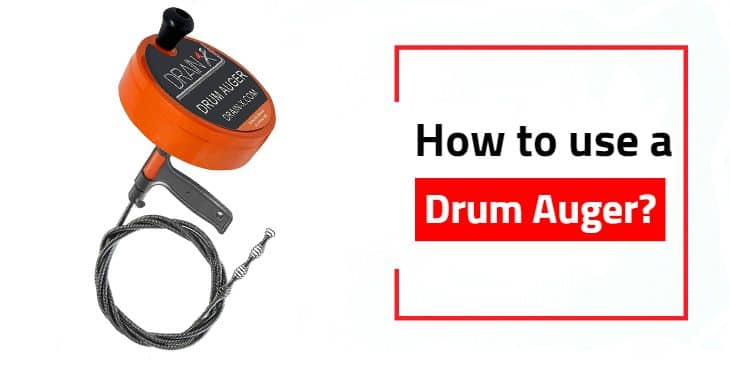
A drum auger is a hand-operated drain clearing tool built around a rotating drum that stores a long coiled metal cable — typically 15 to 25 feet. The drum locks the cable at any chosen length so the operator can spin the cable by rotating the drum handle while simultaneously pushing forward. The cable tip is usually a blunt corkscrew or a coiled hook, designed to either break through a clog or hook into it for retrieval.
The reason a drum auger works on toilet clogs when a plunger fails is reach. A plunger creates hydraulic pressure effective only within the toilet’s internal trapway — typically the first 6 to 10 inches of the drain path. Once a clog is lodged in the drainpipe downstream of the trapway, no amount of plunging moves it. A drum auger can extend 25 feet or more into the drain line, well past the trapway and into the horizontal drain run.
One important note before using any drum auger in a toilet: a standard drum auger is not the same as a closet auger. A closet auger has a protective rubber boot over its curved guide tube specifically to prevent metal from contacting the porcelain bowl surface. A drum auger has no such protection. Cable management and insertion angle require more careful attention than they would with a purpose-built toilet auger. The procedure below accounts for this difference at every step.
Tools and Materials You Need Before You Start
Gather everything below before touching the toilet. Having to stop mid-procedure to find a bucket or a second pair of gloves is how floors get flooded.
Required Tools and Supplies
- Drum auger — 25 ft cable recommended; 15 ft is the minimum practical length for toilet work
- Heavy-duty rubber gloves — not thin latex; the cable and drum carry sewage residue
- Old towels or drop cloth — place around the base of the toilet before starting
- 5-gallon bucket — for controlled water removal if the bowl is overfull
- Flashlight — to inspect the drain opening and check cable angle at insertion
- Plastic sheeting or garbage bag — to set the auger drum on; keeps the floor cleaner
- Disinfectant spray — for cleanup after the clog clears
If the toilet bowl is filled to or near the rim, use the bucket to remove enough water to bring the level down to roughly half-full before inserting the drum auger. Working with a nearly-overflowing bowl means any splashing during rotation lands on the floor, the walls, and you. Half-full gives working clearance and still provides enough water to lubricate the cable through the trapway.
Check your auger cable before insertion. Run 2 feet of cable out of the drum by hand and inspect it for kinks, sharp bends, or corrosion. A kinked cable does not transmit rotation cleanly — it twists against the pipe wall instead of spinning the tip, which means it clears nothing. If the cable has a hard kink that won’t straighten, adjust the cable lock so the kinked section stays inside the drum during the entire procedure.
How to Use a Drum Auger on a Toilet — Step-by-Step
Step 1 — Shut Off the Water Supply and Prepare the Area
Locate the shut-off valve behind or below the toilet and turn it clockwise until it stops. This prevents an accidental flush from refilling the bowl while the cable is inside the drain. Lay towels around the toilet base and set a piece of plastic sheeting on the floor beside the toilet for the drum auger to rest on.
Step 2 — Set Up the Auger and Release 6 Inches of Cable
Place the drum auger on the plastic sheeting beside the toilet. Open the cable lock (setscrew or thumb lever depending on the model) and manually pull approximately 6 inches of cable out of the drum. Re-engage the cable lock to hold that length in place.
Angle the cable tip downward toward the drain opening at roughly 45 degrees — not straight down and not horizontal. This angle matches the entry curve of the toilet trapway and reduces the likelihood of the tip catching on the porcelain rim at the drain entrance.
Step 3 — Insert the Cable Into the Drain and Begin Clockwise Rotation
Gently lower the cable tip into the drain opening. Do not push the body of the drum auger against the porcelain rim — keep it several inches above the bowl so the cable enters at a controlled angle. Once the tip is seated in the drain opening, begin rotating the drum handle clockwise with your dominant hand while your other hand guides the cable away from the bowl surface.
Clockwise rotation is critical. The cable’s coiled wire construction is engineered to tighten and extend under clockwise rotation. Counter-clockwise rotation loosens the cable coils, causing the cable to bunch rather than advance — a common mistake that results in a cable jam inside the trapway.
Step 4 — Navigate the Trapway Curve (The Critical Phase)
The toilet’s internal trapway curves upward and then back down in an S or P configuration — the exact geometry that creates the water seal at the base of the bowl. For most standard toilets, this curve begins approximately 3 to 4 inches from the drain opening and extends for another 6 to 8 inches before the drain transitions to the exit pipe running toward the floor flange.
You will feel the cable slow or stop as it hits this curve. This is the moment most homeowners make the forcing mistake. Instead of pushing harder, increase rotation speed slightly and apply only light forward pressure. The spinning cable tip will find the natural path through the bend if given enough rotation and time.
On a typical household toilet, this phase takes 30 to 90 seconds of continuous rotation before the cable clears the trapway curve. Once the cable clears, resistance drops noticeably. At that point, release the lock, pull out another 6 to 8 inches of cable, re-engage the lock, and continue.
Step 5 — Advance the Cable in 6-to-8-Inch Increments Until Resistance Changes
Continue the pattern: lock the cable, rotate clockwise while applying moderate forward pressure, advance 6 to 8 inches, unlock, pull out more cable, repeat. You are looking for two specific changes in cable feel that indicate contact with the clog.
Sudden increase in resistance with a springy or spongy feel: This typically indicates an organic clog — compacted toilet paper, waste material, or a combination. Continue rotating. The corkscrew tip will work into the material and either break it apart or hook into it.
Sudden firm stop with no spring: This indicates a solid object — a toy, a hygiene product, or hard material. Do not force the cable further. Shift your goal from breaking to hooking: slow the rotation and apply steady backward pressure to attempt retrieval. Solid objects that cannot be hooked cannot be cleared with a drum auger — they require toilet removal.
Step 6 — Work Through the Clog With Rotating Pressure
Once you have located the clog, maintain clockwise rotation and alternate between two motions: pushing the cable forward 1 to 2 inches, then pulling back 1 to 2 inches, all while rotating continuously. This back-and-forth movement combined with rotation is what physically breaks apart an organic clog. Rotation alone without reciprocating motion tends to spin in place rather than cutting through the obstruction.
If the cable stalls — stops rotating even though you’re turning the handle — the cable has likely coiled on itself inside the drain. Stop immediately. Reverse direction briefly (counter-clockwise, 4 to 5 rotations), then return to clockwise. This typically unwinds a minor coil. If reversing doesn’t free the cable within 10 to 15 seconds, do not force it further. Slowly retract the cable, re-examine it, and re-insert.
You’ll know the clog has cleared when the bowl water level drops visibly, or when the cable advances significantly farther without resistance. At that point, retract the cable slowly — pulling steadily while rotating clockwise to keep the cable taut and prevent it from tangling in the drain as it exits.
Step 7 — Retract the Cable and Test the Drain
Retract the cable by engaging the cable lock in short increments and pulling the cable back into the drum. As you retract, continue rotating clockwise — a counter-rotating retraction can cause the tip to snag on the drain pipe interior. Move slowly enough to feel whether any material is attached to the cable tip. If you feel weight or drag, maintain steady retraction without jerking.
Once the cable is fully retracted, restore the water supply and allow the tank to fill. Perform two full test flushes, watching the bowl drain rate carefully. A fully cleared drain empties within 5 to 7 seconds of flushing. A slow drain after drum auger use typically means the clog was only partially cleared — see Section 5 below for how to handle this.
Step 8 — Clean the Auger and the Work Area
A drum auger used in a toilet requires thorough cleaning before storage. Extend the full cable length into a tub, spray with disinfectant or diluted bleach solution (1 part bleach to 10 parts water), and wipe down the cable while wearing gloves. Retract the cable and allow it to dry fully in an open position before sealing the drum — storing a wet cable in a closed drum creates corrosion that stiffens the cable and shortens tool life significantly.
Wipe down all floor surfaces with disinfectant spray and dispose of the floor towels or plastic sheeting used during the procedure.
Red Flags — Stop and Call a Plumber Immediately
Recognize these conditions before they escalate. Each one is a signal that the drum auger procedure should stop and a licensed plumber should take over.
🚨 Red Flag #1: Multiple Fixtures Are Draining Slowly or Backing Up
If the bathtub, sink, or floor drain are sluggish or backing up at the same time the toilet is clogged, the problem is not in the toilet’s internal trapway. It is in the main drain line or sewer stack.
A drum auger inserted into the toilet will not reach this blockage, and forcing the cable further only risks damaging the drain pipe interior. This requires professional drain cleaning equipment — typically a power auger with 1/2-inch or larger cable, or a hydro-jetting unit.
🚨 Red Flag #2: The Cable Cannot Be Retracted After Being Advanced
If you advance the cable and then cannot retract it — it won’t pull back regardless of reverse-rotation or backward pressure — the cable has either coiled severely inside the drain, hooked onto a damaged pipe fitting, or wrapped around an obstruction that won’t release.
Do not attempt to yank the cable free. Doing so can crack a cast iron or older PVC drain pipe from the inside, turning a $200 plumbing call into a $2,000 pipe repair. Leave the cable in place, call a plumber, and describe exactly what happened and how far you inserted it.
🚨 Red Flag #3: You Hear a Cracking or Grinding Sound From the Toilet
A cracking sound during drum auger use almost always means the metal cable is contacting the vitreous china of the toilet bowl or trapway under load. Vitreous china does not flex — it fractures. A hairline crack in the toilet’s internal trapway or base is not always visible immediately, but will present as a leak at the floor within days.
Stop all cable movement and retract slowly. Inspect the bowl with a flashlight. If you see any crack — even a hairline fracture — call a plumber. A cracked toilet base requires full toilet replacement. The porcelain cannot be repaired.
🚨 Red Flag #4: Sewage Is Backing Up at a Different Fixture While You Work
If running a sink or flushing a nearby toilet causes sewage to bubble up at another fixture while you are working, you are dealing with a blocked sewer main — not a localized toilet clog. Evacuate the bathroom, shut off the water supply to the affected toilet, and call a licensed plumber. This condition can cause significant property damage if not addressed promptly.
Why Your Toilet Is Still Clogged After Using a Drum Auger
A toilet that’s still slow or completely blocked after a full drum auger run is one of the more frustrating plumbing situations a homeowner faces — and one that almost no online guide addresses directly. Here’s what is actually happening in each common scenario.
Scenario 1: The Cable Bypassed the Clog Instead of Clearing It
This is the most common reason. When a drum auger is used in a toilet, the cable can coil around a soft organic clog rather than breaking through it — particularly when the clog has a semi-solid consistency. The cable spins next to the obstruction, the operator feels some resistance that then passes, and concludes the drain is clear. But the clog is still in place.
The test: after retracting the cable, pour a gallon of water directly into the bowl (not a flush) and watch the drain rate. If it drains in under 7 seconds, the clog is cleared. If it drains slowly or not at all, the clog was bypassed. Re-insert the drum auger and focus on the same depth where you felt the original resistance.
Scenario 2: The Clog Is Deeper Than the Auger Reached
A standard drum auger cable is 25 feet. Most household toilet clogs occur within 10 feet of the toilet’s drain outlet — but not all. In older homes where drain lines have accumulated grease, soap scum, and mineral scale over decades, a partial obstruction can build to a full blockage 20 or more feet downstream in the horizontal drain run.
If you advanced the full cable length without finding clear resistance, the blockage is likely beyond 25 feet. This requires a professional power auger with 50 to 100 feet of cable, or a hydro-jetting service.
Scenario 3: A Solid Object Is Lodged in the Trapway
If a child flushed a toy, cap, or other solid object, a drum auger cannot retrieve it. The cable tip does not have the gripping ability to grab a smooth solid object and maintain that grip through the resistance of the trapway curve on the way out.
In this scenario, the toilet must be removed to access the trapway from below. This is a 2-hour job for an experienced plumber and typically costs $150 to $300 in labor depending on location, plus service fees. Attempting to push the object further into the drain with the drum auger is the worst possible response — a rigid object that lodges in the horizontal drain pipe is exponentially harder to remove.
🔄 When the Answer Flips — When to Skip the Drum Auger Entirely
A drum auger is the right tool if: the clog is an organic blockage in a single toilet, the toilet is a standard floor-mounted model, and all other fixtures in the house are draining normally.
Skip the drum auger and call a plumber directly if any of these conditions apply:
- You can see or suspect a child flushed a solid object (toy, cap, bottle top)
- The toilet has a concealed trapway (skirted design) — the drum auger cable cannot navigate the modified geometry without a proper closet auger’s guide tube
- You used chemical drain cleaner within the past 24 hours — drum auger use after chemical treatment creates dangerous splashing risk
- Two or more fixtures are affected simultaneously
- The toilet is wall-mounted — never use a drum auger in a wall-hung toilet; the in-wall rough-in geometry requires a closet auger or professional service only
Frequently Asked Questions
How do you use a drum auger on a toilet — is the technique different from using it on a sink?
Yes, meaningfully different. In a sink drain, you insert the cable vertically and advance in a relatively straight line. In a toilet, the drain opening leads immediately into a curved trapway that rises before it descends. The insertion angle matters: the cable tip needs to be aimed at roughly 45 degrees downward, and the cable must be rotated continuously as it navigates the curve rather than pushed in a straight line.
The other key difference is bowl contact risk — a drum auger’s bare metal cable can scratch the toilet’s porcelain interior if it rubs against the bowl during insertion. A drum auger in a sink carries no such risk. Keep the cable away from the bowl walls throughout the entire procedure.
How far should you insert a drum auger into a toilet?
Insert as far as needed to reach the clog — but advance in 6-to-8-inch increments and stop when you feel a change in resistance that indicates clog contact. For most household toilet clogs, the blockage is within 3 to 5 feet of the toilet’s drain outlet. The trapway curve itself spans roughly 10 to 12 inches from the drain opening.
If you’ve advanced 4 to 5 feet of cable and haven’t encountered any resistance, the clog is either further downstream or wasn’t an organic clog at all. There is no universal correct depth — advance until you find the clog and stop when it’s cleared.
How does a drum auger work on toilet pipes compared to a standard toilet snake?
A drum auger and a toilet snake (closet auger) use the same basic mechanical principle — a rotating cable that either breaks apart or hooks a clog. The practical differences are significant: a closet auger has a protective rubber boot that prevents the guide tube from scratching the porcelain bowl, making it much safer inside the toilet itself. A drum auger has no such protection, requiring more careful cable management at insertion.
A closet auger typically has a 3-to-6-foot cable — enough for clogs in the toilet’s internal trap but no further. A drum auger’s 15-to-25-foot cable makes it the better choice for clogs downstream of the trap. If you’re unsure where the clog is, use the drum auger for its reach advantage.
Can a drum auger damage a toilet?
Yes, in two specific ways. First, the bare metal cable can scratch the porcelain interior of the bowl if it contacts the bowl surface during insertion — scratches that are permanent. Second, forcing the cable against the toilet’s internal vitreous china trapway under load can crack the porcelain from the inside. Both types of damage are entirely preventable: keep the cable from touching the bowl surface, do not force the cable when it meets resistance, and rotate continuously rather than pushing without rotation.
When should you use a drum auger instead of a plunger on a toilet?
Use a plunger first — always. A plunger is faster, cleaner, and creates no risk of cable contact with porcelain. Move to a drum auger when the plunger has failed after 15 to 20 forceful strokes and the drain shows no improvement.
The specific situations where a drum auger outperforms a plunger: clogs beyond the reach of hydraulic pressure (more than 10 to 12 inches past the drain opening), compacted blockages that hydraulic force cannot break apart, and partial clogs that allow slow drainage but won’t fully clear with a plunger.
What are the most common mistakes when using a drum auger in a toilet?
Five mistakes account for nearly every failed drum auger job. First, forcing the cable at the first sign of resistance inside the trapway curve — rotation, not force, is how the cable gets through the bend. Second, rotating counter-clockwise, which loosens cable coils and causes bunching. Third, not shutting off the water supply valve before starting.
Fourth, retracting the cable too quickly after clearing the clog, which dumps debris back into the drain. Fifth, skipping the post-clear water test — always pour a gallon of water into the bowl and watch the drain rate before declaring success.
✅ Summary: When the Drum Auger Works and When It Doesn’t
If the toilet is clogged and the plunger has failed after a full effort — use the drum auger following the 8-step procedure above. The technique is not complicated, but the trapway curve navigation (Step 4) is where most DIY attempts break down. Rotation, not force, gets the cable through the bend.
If the auger runs its full cable length without finding the clog, or if the drain is still slow after drum auger use — the blockage is either deeper than 25 feet or is a solid object the cable tip cannot retrieve. At that point, professional intervention is both faster and cheaper than further DIY attempts.
If multiple fixtures are affected, if you hear cracking sounds, or if the cable becomes stuck — stop. Those are the conditions where a drum auger in a toilet transitions from a DIY fix to a situation requiring a licensed plumber with camera inspection equipment.
For the correct toilet to pair with properly maintained plumbing, see our guide to the best flushing toilets — models engineered to minimize clogging in the first place.
Drum Auger vs Plunger for Stubborn Toilet Clogs
The plunger vs. drum auger decision is not a matter of preference — it’s a matter of clog location. A plunger creates a pressure differential in the toilet bowl, which transmits hydraulic force into the drain. That force is most effective on clogs within the first 10 to 12 inches of the drain path — the area covered by the toilet’s internal trapway. If the clog is in that zone, a correctly used flange plunger will usually clear it in 10 to 20 strokes.
When the clog is downstream of the trapway — in the horizontal drain run between the toilet and the soil stack — hydraulic pressure dissipates before it reaches the obstruction. No amount of plunging moves that clog. That’s when a drum auger becomes necessary. The cable physically travels past the trapway and into the pipe section where the blockage sits.
The practical rule: always start with the flange plunger. If 20 hard strokes produce no improvement, switch to the drum auger. If you can see the water level drop even slightly after plunging, stay with the plunger — you’re making progress.
If your household deals with repeated clogs despite correct technique, the issue may be the toilet’s trapway diameter. Most quality toilets today use a fully glazed 2-inch trapway, which passes material significantly better than the 1-3/4-inch trapways found in older or budget models. See our best flushing toilets guide and our best one-piece toilets review for top-rated models.
How Far to Insert a Drum Auger Into a Toilet
The most common question about drum auger technique — and the one most guides answer with vague language — is insertion depth. Here is the specific answer based on how toilet drain geometry actually works.
The toilet’s internal trapway extends from the drain opening in the bowl to the exit point at the floor flange. This internal path measures between 10 and 14 inches depending on the toilet model. Beyond the floor flange, the drain transitions to the closet bend (a 90-degree fitting pointing the drain horizontally toward the soil stack), and then into the horizontal drain run.
Most household toilet clogs land in one of three locations: within the last 4 to 6 inches of the trapway, in the closet bend, or in the horizontal drain run 2 to 6 feet downstream of the closet bend.
In practical terms: advance the cable in 6-to-8-inch increments and note the feel at each increment. Expect low resistance through the first 14 inches (internal trapway). Expect a brief tightening at 14 to 20 inches (closet bend). Expect either open pipe feel or clog resistance at 20 to 60 inches (horizontal drain run).
If you reach 5 feet of cable without any clog resistance, the blockage is deeper — continue advancing or consider that the problem may be in the main stack rather than the toilet branch line. See our guide to the best two-piece toilets and best comfort height toilets for models with fully glazed trapways that reduce accumulation in the drain path.
Best Drum Auger for Toilet Clogs
Not all drum augers perform equally in a toilet application. The key specifications to evaluate are cable diameter, cable length, drum locking mechanism, and tip style.
Cable diameter: A 1/4-inch cable is standard for sink and tub use. For toilet clogs, a 5/16-inch cable is better — it has more torque transmission and less tendency to coil on itself when encountering the soft resistance of an organic clog. Avoid 3/8-inch cable for toilet use; it is too stiff to navigate the trapway curve without excessive force.
Cable length: 25 feet is the practical minimum for toilet clog work. Clogs that are beyond the trapway but within the first 10 feet of the horizontal drain run require at least 14 to 18 feet of cable to reach. A 15-foot drum auger handles roughly 80% of household toilet clogs. A 25-foot model handles clogs deeper in the drain run without requiring you to access a cleanout.
Drum locking mechanism: A thumbscrew or lever-style cable lock that can be operated with one hand is significantly more practical than a two-handed lock mechanism. In a toilet application, you need one hand on the drum handle and one hand managing the cable angle at all times.
Tip style: A corkscrew or spiral tip is most effective for organic toilet clogs. A bulb auger tip is better for retrieval of soft objects but less effective at breaking through compacted material. For the majority of household toilet clogs, the spiral tip handles the situation. For related maintenance topics, see our guides to the best toilet fill valves and the best toilets to buy for a complete view of toilet performance factors.
