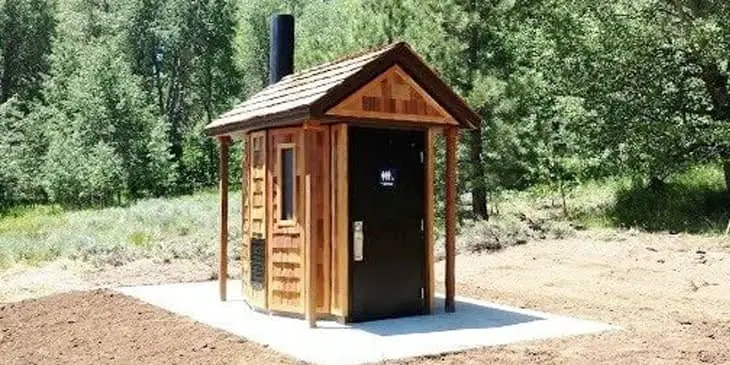
You have hiked three miles into a national forest, your pack is heavy, and nature calls. You find a small wooden structure with a vent pipe rising from the roof. There is no flush handle. There is no running water.
But if that toilet was built right and serviced on schedule, it will not smell — and it will not leak a single drop of waste into the watershed beneath your boots. That structure is one of the most underestimated engineering solutions in outdoor sanitation.
This guide explains exactly how the ventilation and containment system works, what separates a well-designed vault from a problem unit, and — most importantly — when this type of unit is the right call versus when a different solution is needed. The U.S. Forest Service has deployed these units across tens of thousands of remote sites for decades. Understanding how these units work will help you maintain one, specify one, or simply use one without grimacing.
📋 Scope of This Guide
Who this is for: Campground managers, land managers, off-grid property owners, park maintenance staff, and outdoor enthusiasts who want to understand vault toilet systems.
What it covers: How this system works, odor control mechanisms, maintenance schedules, material types, and when to choose this solution over alternatives.
What it does NOT cover: Municipal sewer installations, septic tank design for residential homes with running water, or porta-potty rental logistics for private events.
When to bring in a professional: Vault excavation, concrete vault placement, and pumping operations always require licensed contractors and specialized equipment. This guide is for understanding and decision-making — not DIY installation of large-capacity public vaults.
⚠️ The Most Common Mistake With Vault Toilets
Most people assume these units smell because they are primitive. They do not smell because they are primitive — they smell because the vent pipe is blocked, positioned wrong, or too short.
A unit built to U.S. Forest Service specifications, with a 12-inch vent pipe rising at least 3 feet above the roofline and painted black to harness solar heat, routinely performs as an essentially odor-free facility. The smell you remember from bad experiences came from a poorly designed or neglected unit — not from the technology itself.
What Is a Vault Toilet?
This type of unit is a waterless, non-flush sanitation system in which human waste drops directly into a large, sealed underground tank — the “vault” — where it accumulates until a vacuum pump truck removes it. There are no water supply lines, no drain connections, and no sewer hookups. The system operates entirely on containment and ventilation.
The term “vault” comes directly from the buried container itself. That container is watertight, meaning waste cannot leach into the surrounding soil or contaminate groundwater — the defining technical advantage over a simple pit latrine. These systems are the standard solution across U.S. national parks, national forests, state parks, trailheads, wilderness campgrounds, and remote recreation areas managed by the Bureau of Land Management.
The U.S. Forest Service — which operates more of these units than virtually any other agency in the country — formally classifies a well-designed unit as a “Sweet-Smelling Toilet” or SST. That name is not ironic. When the ventilation system functions correctly, the structure genuinely does not produce significant odor at the seat level. The SST designation reflects a specific set of engineering standards that separate a professional installation from a backyard outhouse.
Key Vault Toilet Facts at a Glance
- Vault capacity: typically 500–1,500 gallons for Forest Service units; up to 13,000 gallons for high-traffic installations
- Material: reinforced concrete (permanent) or cross-linked polyethylene (portable/semi-permanent)
- Pumping interval: every 1,500 uses or once per season for moderate-traffic sites; weekly to bi-weekly at high-use campgrounds
- ADA compliance: public vault toilet structures are built to ADA specifications in most jurisdictions
- Water use: zero gallons per use — the only water involved is a 10-inch pre-load after pumping to prevent waste buildup
How Does a Vault Toilet Work?
Understanding how this system works requires looking at two separate systems operating simultaneously: the waste containment system and the ventilation system. Both must function correctly for the toilet to perform as designed.
The Waste Containment System: The vault itself sits 3 to 4 feet below the shelter floor. A concrete slab covers the top of the vault, and a fiberglass riser mounts through the slab directly above the vault opening. The toilet seat and lid attach to the top of that riser.
When the toilet is used, waste falls straight down through the riser into the vault below. No water is involved at any stage. The vault is sealed on all sides and bottom to prevent leaching. A separate sealed manhole — located outside the shelter, not inside — provides access for the vacuum pump truck when the vault needs emptying.
The Ventilation System — the SST Mechanism: This is where engineering gets genuinely interesting. The shelter is designed to create a specific airflow pattern. Fresh air enters through gaps around the shelter door and through vents near the floor level.
That air moves through the shelter and gets pulled down into the vault through the toilet riser opening. A large-diameter vent pipe — 12 inches is the Forest Service standard — runs from the vault, up through or alongside the shelter wall, and exits at least 3 feet above the roofline. The vent pipe is typically painted black or enclosed in a metal shroud.
Here is why painting the vent pipe black matters: solar radiation heats the dark pipe, which warms the air inside it. Hot air rises. As the heated air in the vent pipe rises and exits at the top, it creates a convection current that continuously pulls odor-laden air out of the vault and away from the shelter.
Wind hitting the top of the vent pipe above the roofline accelerates this effect. The result is that air at seat level inside the shelter is moving toward the vault — not away from it — which is why a properly designed and maintained unit does not smell at the seat.
When the SST System Fails — and Why
The convection-driven ventilation only functions when two conditions are met: sufficient sunlight to heat the vent pipe, and air movement at the pipe exit. In heavily forested sites with dense canopy blocking direct sun, the thermal convection is weak.
On calm, windless days with cloud cover, the system is essentially passive — odors can build up. This is why some shaded forest sites require an electric fan assist inside the vent pipe. The vent needs both solar heat and wind exposure to work correctly.
Vault Toilet Types: Concrete vs. Plastic
These systems are manufactured in two primary material categories. The right choice depends on the permanence of the installation, the access road infrastructure, and the budget for both upfront cost and long-term maintenance.
Reinforced Concrete Vaults are the standard for permanent public land installations. Cast in place or delivered as precast units, concrete vaults are exceptionally durable — a properly installed unit will last 30 to 50 years without structural failure. Concrete resists cracking under freeze-thaw cycles and carries the weight of the shelter structure without concern.
The tradeoff is cost: installing a concrete vault requires an excavator and a crane. Before the shelter is factored in, total project costs for a full Forest Service-specification installation — including shelter, slab, riser, and vent system — routinely reach $30,000 to $50,000.
Cross-Linked Polyethylene (XLPE) Plastic Vaults dominate semi-permanent and portable applications. XLPE will not crack, corrode, or leak under normal operating conditions, even across wide temperature swings. Plastic vaults are lighter than concrete, making transport and placement less equipment-intensive.
They are the vault material of choice when a site needs sanitation without the infrastructure commitment of a permanent concrete installation. Plastic units can be relocated when land use patterns change. The tradeoff: plastic vaults are not appropriate for high-traffic permanent installations where the structure above exerts continuous structural load.
| Factor | Concrete Vault | XLPE Plastic Vault |
|---|---|---|
| Lifespan | 30–50 years | 15–25 years |
| Installation | Crane + excavator required | Lighter equipment, faster install |
| Portability | Permanent — not relocatable | Can be moved to new sites |
| Upfront cost | Higher ($30,000–$50,000+ full install) | Lower per unit |
| Best for | National parks, permanent trailheads | Seasonal sites, events, remote camps |
Vault Toilet Pros and Cons
These units are not the right solution for every situation, and they are not the primitive option many people assume them to be. Here is an honest assessment of where they excel and where they fall short.
- Zero water use — critical in drought-prone and arid regions
- No groundwater contamination — sealed vault prevents leaching unlike pit toilets
- Permanent placement — never needs relocation once installed
- Scales to any traffic level — vault sizes from 500 to 13,000 gallons
- ADA-compliant configurations available
- Functional in extreme cold where composting toilets fail
- No electricity required in standard configurations
- Low per-use operational cost compared to flush systems
- Requires vehicle access for pumping — not viable at truly foot-traffic-only sites
- High installation cost compared to pit toilets
- Waste does not decompose — must be hauled to a treatment facility
- Odor issues when vent system underperforms (shade, calm weather)
- Risk of freezing in subzero climates without cold-weather precautions
- Cannot serve residential daily use without very frequent pumping
- No hand-washing water unless separately provided
How to Reduce Vault Toilet Smell — Odor Control Tips
Odor comes from two primary sources: ammonia released from decomposing urea, and hydrogen sulfide gas produced by anaerobic bacterial activity in the waste mass. Controlling the smell is not about masking — it is about engineering the conditions that prevent those gases from reaching the shelter air. Here are the methods that actually work, in order of effectiveness.
1. Optimize the Vent Stack
The vent pipe must be a minimum of 12 inches in diameter and extend at least 3 feet above the highest point of the roofline. Paint it black or wrap it in a metal shroud. Position the exit on the prevailing windward side of the structure. If the site has dense canopy blocking direct sun, install a low-power exhaust fan inside the vent pipe.
2. Preload With Water After Pumping
After every pumping service, add 10 inches of fresh water to the vault before returning it to service. This creates a liquid layer that prevents solid waste from piling up against the vault walls and releasing concentrated gases directly toward the riser opening. The water layer acts as a physical and chemical buffer.
3. Use Bacterial Additives
The same biology-based products used in septic tank treatment — enzyme and bacterial additive formulas — suppress the odor-producing anaerobic bacteria in vault waste. Products like PORT (Portable Outdoor Restroom Treatment) are specifically formulated for this application. They encapsulate hydrogen sulfide and ammonia at the molecular level while introducing aerobic bacteria that out-compete the odor-producers.
4. Apply Activated Carbon
Sprinkling activated carbon directly onto the waste surface absorbs and neutralizes sulfur and ammonia gases before they reach the riser. This is a lower-cost supplemental treatment that works well between pumping cycles when odor begins to build.
5. Keep the Lid Down
This sounds basic, but it is among the most effective single actions a user can take. When the toilet lid is up and the vault is uncovered, the convection airflow reverses — instead of air being pulled down into the vault, odors can rise freely through the riser into the shelter. Posting a clearly visible sign instructing users to close the lid after each use costs nothing and measurably improves air quality inside the structure.
Vault Toilet Maintenance and Pumping Schedule
A vault toilet that is not pumped on schedule is a liability, not a functioning sanitation system. The single most important maintenance variable is setting a pumping frequency matched to actual site usage, not to a calendar assumption. Here is how professional land managers approach maintenance scheduling.
Usage-Based Pumping: The Forest Service standard is to pump at approximately every 1,500 uses for moderate-traffic sites, or when the vault reaches 75% capacity — whichever comes first. Waiting until the vault is 100% full creates odor surges and risks overflow. Maintain a 25% buffer at all times. For high-traffic campgrounds near a major trailhead, 1,500 uses may occur in a single weekend during peak season.
Calendar-Based Ranges by Site Type:
| Site Type | Typical Pumping Frequency | Notes |
|---|---|---|
| Low-traffic wilderness site | Once per season | Annual inspection minimum |
| Moderate-traffic campground | Every 2–4 weeks (peak season) | Check level monthly in off-season |
| High-traffic trailhead or park | Weekly to twice weekly | Monitor level every 2–3 days |
| Event or festival site | Daily during event | Pre-pump before event begins |
Who Does the Pumping: Most units on public lands are serviced by local septic tank companies contracted by the land management agency. These companies have vacuum pump trucks — sometimes called “honey wagons” — equipped with powerful suction pumps and sealed storage tanks that haul the waste directly to a municipal wastewater treatment facility. In truly remote areas inaccessible to standard vacuum trucks, the Forest Service uses smaller trailer-mounted vacuum pump systems with 500-gallon waste tanks that can navigate narrower access roads.
Post-Pump Protocol: After pumping, the interior walls of the vault should be rinsed with the clean water tank carried on most service vehicles. Then add 10 inches of fresh water before returning the unit to service. This step is often skipped under tight service schedules — it should never be.
Vault Toilet vs. Pit Toilet vs. Composting Toilet vs. Porta Potty
There is no universally correct sanitation solution for waterless applications — the right answer depends on site access, traffic volume, budget, climate, and how long the installation needs to stay in place. Here is a direct comparison across the four most common options.
| Factor | Vault Toilet | Pit Toilet | Composting Toilet | Porta Potty |
|---|---|---|---|---|
| Waste handling | Stored sealed, pumped out | Decomposes in unsealed pit | Biologically processed on-site | Chemical tank, pumped out |
| Groundwater risk | None — sealed vault | High — waste leaches into soil | Low with proper design | None — sealed tank |
| Permanence | Permanent (never relocate) | 5-yr lifespan, then move | Permanent or portable | Temporary/portable |
| Vehicle access needed? | Yes — for pumping | No | No (for most models) | Yes — for servicing |
| Cold climate use | Yes (with precautions) | Yes | Limited — bacteria need heat | Yes (with antifreeze) |
| High traffic capacity | Excellent | Poor | Poor to moderate | Good (if serviced frequently) |
| Installation cost | $30,000–$50,000+ (full install) | $500–$3,000 | $1,500–$15,000+ | Rental: $75–$150/week |
Vault Toilet vs. Pit Toilet: The defining difference is containment. A pit toilet has an unsealed hole — waste decomposes directly into the surrounding soil. This makes pit toilets cheap and simple, but they are fundamentally inappropriate near water sources, at high-traffic sites, or anywhere groundwater contamination is a concern. Pit toilets also have a finite lifespan — typically 5 years before the pit fills and the structure must be relocated. A vault toilet never needs relocation.
Vault Toilet vs. Composting Toilet: Composting toilets process waste biologically on-site, converting it into compost that can be managed or disposed of locally. In theory, a composting toilet never needs pumping. In practice, composting toilets require regular maintenance of the composting chamber, are highly sensitive to temperature (biological decomposition slows dramatically below 55°F), and cannot handle the volume that a large vault toilet can at a busy trailhead.
If you need a moderate-traffic single-family or small-group solution and can maintain the composting chamber, a composting toilet is excellent. If you need to handle 750 visitors on a weekend, a vault toilet is the only practical answer.
Vault Toilet vs. Porta Potty: Both use sealed tanks. The key differences are scale, permanence, and aesthetics. A porta potty uses a chemical deodorizer solution in a relatively small holding tank — typically 50 to 60 gallons — which must be pumped very frequently at any busy site.
A vault toilet holds 500 to 13,000 gallons and integrates with a permanent structure. Porta potties are the right choice for temporary events and construction sites. Vault toilets are for permanent or long-term installations where a porta potty’s frequent service requirements and impermanent structure are not appropriate.
When to Choose a Vault Toilet — and When Not To
If your site has road access, sees 50+ users per week, needs permanent placement, and has no water source → a sealed vault is almost certainly the correct solution.
- If your site is a national park trailhead with seasonal traffic → vault toilet
- If your site is a campground serving 100+ campers on peak weekends → vault toilet
- If your remote property needs a single-family off-grid sanitation solution and you can service it → vault toilet (smaller plastic unit)
- If your site is a construction zone needing temporary sanitation → porta potty, not vault toilet
- If your location is accessible only by foot and has no road access → pit toilet, not vault toilet (cannot be pumped)
- If your site needs zero maintenance and handles fewer than 20 users per day → composting toilet
- If your site is an off-grid homestead in a moderate climate where you want the compost output → composting toilet
↩️ When the Answer Flips — When to Skip a Vault Toilet
A vault toilet is the wrong answer when any of these conditions apply:
- No vehicle road access: If a vacuum pump truck cannot physically reach the vault, the toilet will fill and become permanently unusable. There is no workaround. At foot-access-only backcountry sites, use a pit latrine or pack-it-out waste system.
- Budget under $10,000 for a permanent single-family installation: A full concrete vault installation with shelter is a $30,000–$50,000 project. If your budget requires something simpler, a composting toilet or well-designed pit latrine is more realistic.
- Daily residential use by 4+ people with no pumping contract: A small plastic vault serviced only by the homeowner fills in 3–6 months under full-time family use. Without a reliable pumping contract, this becomes a crisis rather than a solution.
- Composting is your goal: Vault toilets do not produce compost. Waste goes to a wastewater treatment facility. If you specifically want on-site waste cycling for garden use, a composting toilet is the appropriate technology.
How to Properly Use a Vault Toilet
Odor surges, blockages, and accelerated fill rates — common problemscelerated fill rates — are disproportionately caused by misuse, not by the technology. Here is what every user should know before entering the structure.
Toilet Paper Only — No Exceptions
Put only toilet paper into the unit — nothing else. No wet wipes (even labeled “flushable”), no feminine hygiene products, no diapers, no food waste, no trash of any kind. Non-paper materials do not break down in the vault. They clog the riser, damage the pumping equipment at service time, and can make the vault unserviceable. If there is no trash service at the site, pack your trash out.
Close the Lid and the Door
Every time. When the lid is left open, the ventilation system reverses and odors rise into the shelter. When the door is left open, the airflow path is disrupted. Both are small habits that have a measurable impact on air quality inside the structure, especially at high-traffic sites where dozens of users cycle through in a single day.
Bring Your Own Supplies
Forest Service and park service units stock single-ply toilet paper and a basic hand sanitizer dispenser. If you want higher-quality toilet paper or additional hand hygiene, bring your own. Many well-maintained units also have grab bars — check before you rely on the wall for support.
Watch for Insects, Especially in Warm Months
These structures in warm weather attract flies, and occasionally wasps or bees may nest in the vent structure. Before sitting, do a quick visual check. Most Forest Service units have screens on the vent openings to prevent this, but screens can fail. If you spot an active wasp nest, report it to site staff — do not attempt to remove it yourself.
Red Flags — Vault Toilet Problems and When the System Fails
🚨 Vault at or Near Capacity
If waste is visible within 12 inches of the riser opening, the vault is dangerously close to overflow. Do not use it. Close the toilet immediately and contact the land manager or service provider. Continuing to use an overfull vault can cause waste to back up through the riser — a public health emergency that requires emergency pumping and disinfection of the entire shelter interior.
🚨 Riser or Seat Damaged
A cracked fiberglass riser or a broken toilet seat is not just a user inconvenience — it is a structural failure that can expose users to waste or allow liquids to seep under the slab. If the riser is visibly cracked, fractured at the base, or showing signs of liquid seepage around its base, the toilet must be taken out of service until the riser is replaced. This is a professional repair, not a field fix.
🚨 Frozen Waste — The Cold Climate Emergency
In subzero conditions, waste entering a cold vault can freeze on contact, building up a cone of frozen material — what field technicians literally call a “frozen poo pyramid” — that eventually reaches the riser and makes the toilet unusable. If you notice the drop distance from seat to waste surface shrinking significantly during winter operation, this is happening.
Prevention: add antifreeze-compatible bacterial additives before winter season, ensure the vault has a 10-inch water layer going into cold weather, and monitor vault levels monthly even during off-season if freezing temperatures are expected.
🚨 Vent Pipe Blocked or Detached
A vent pipe blocked by a bird nest, debris, or seasonal collapse of the screen guard eliminates the airflow that keeps the shelter odor-free. You will know immediately — the odor inside the shelter will be dramatically worse than normal, and closing the lid will not help. Inspect the vent pipe exit monthly. Clear any blockage immediately. A detached vent pipe joint requires professional repair before the toilet returns to service.
Decision Matrix — Which Waterless Toilet Is Right for Your Situation?
| Your Condition | Winner | Why |
|---|---|---|
| Road access + 50+ weekly users + permanent site | Vault Toilet | Capacity, permanence, and groundwater protection |
| Foot-access-only backcountry site, no road | Pit Toilet | Cannot pump a vault without vehicle access |
| Off-grid cabin, moderate climate, 1–4 people, want compost | Composting Toilet | No pumping needed, produces usable end product |
| Temporary event, construction site, or festival | Porta Potty | Fast deployment, flexible placement, removable |
| Very remote, extreme cold, single family homestead | Vault Toilet (plastic) | Composting fails in cold; vault works year-round |
| Near water source, sensitive watershed, any traffic level | Vault Toilet | Only sealed option — pit toilet is not acceptable |
Frequently Asked Questions
What is a vault toilet and how is it different from a regular toilet?
A vault toilet is a waterless, non-flush sanitation unit where waste drops directly into a large sealed underground tank. Unlike a regular toilet, it has no water supply, no drain line, and no connection to a sewer or septic system. Waste accumulates in the vault until a vacuum pump truck removes it and hauls it to a wastewater treatment facility.
How does a vault toilet work without smelling bad?
A well-designed unit uses a passive convection ventilation system — the “Sweet-Smelling Toilet” or SST design developed by the U.S. Forest Service. A large-diameter vent pipe (typically 12 inches), painted black to absorb solar heat, creates a thermal updraft that continuously pulls odors out of the vault and away from the shelter. When this system is functioning correctly and the user keeps the lid down, odor at seat level is minimal.
How often does a vault toilet need to be pumped?
Pumping frequency depends entirely on usage volume. Low-traffic wilderness sites may need one pump per season. High-traffic trailheads may require weekly servicing. The professional standard is to pump when the vault reaches 75% capacity — roughly every 1,500 uses at moderate-traffic sites. Never wait until the vault is full.
What is the difference between a vault toilet and a pit toilet?
The defining difference is containment. The sealed, watertight underground tank of a vault toilet cannot leach into the surrounding soil. A pit toilet uses an unsealed hole — waste decomposes into the earth over time. Vault toilets never need relocation and protect groundwater. Pit toilets are cheaper but have an approximately 5-year lifespan before the pit fills, and they present a groundwater contamination risk near water sources.
Can I install a vault toilet on my property?
Yes, but understand the full commitment. A standard concrete vault installation requires excavation, crane placement, a shelter structure, a proper vent system, and a pumping contract with a septic service company. Total costs run $30,000–$50,000 for a professional-grade installation. Smaller plastic vault units are more affordable and appropriate for single-family or small-group off-grid use, but still require vehicle access for servicing.
Why do some vault toilets smell worse than others?
Odor problems in vault toilets almost always trace back to one of four causes: the vault is approaching or past capacity, the vent pipe is blocked or incorrectly positioned, the site lacks sufficient sun and wind to drive the convection ventilation, or the toilet lid is consistently left open. A vault toilet that meets Forest Service engineering specifications and is serviced on schedule should not produce significant odor at seat level.
How do vault toilets handle cold weather and winter conditions?
These systems function in cold climates, but require specific cold-weather protocols. The primary risk is the “frozen poo pyramid” — waste freezing and building up toward the riser in subzero conditions.
Prevention includes maintaining a 10-inch water preload in the vault going into winter, using bacterial additives that remain active at lower temperatures, and monitoring fill level monthly even during off-season. Some high-traffic installations add insulation to the shelter and vent pipe to maintain adequate thermal convection in winter months.
📋 Expert Verdict — What Is a Vault Toilet?
Vault toilets are not the primitive fallback option many people assume. They are engineered sanitation systems that — when specified correctly — outperform every alternative in high-traffic, remote, road-accessible locations where groundwater protection is non-negotiable.
- If your site has road access and handles 50+ weekly users → a vault toilet is the professional standard. The Forest Service uses them at this scale precisely because no other waterless technology matches the capacity, permanence, and environmental protection.
- If your site has no road access → a vault toilet will not work. It cannot be pumped, and a full vault is a public health emergency. Use a pit latrine or pack-out system at foot-access-only sites.
- If you are evaluating off-grid options for a remote property → start with the pumping question. If you can reliably schedule pump service, a plastic vault unit is a durable, climate-hardy choice that composting toilets cannot match in cold environments.
The odor problem you remember from a bad vault toilet experience was a maintenance failure — not a technology failure. A properly designed and serviced vault toilet is, as the Forest Service says, a sweet-smelling toilet.
Vault Toilet for National Parks and Camping
National parks and federally managed campgrounds across the United States rely on these structures as the primary sanitation infrastructure at trailheads, campground loops, and day-use areas without water service. The National Park Service and U.S. Forest Service collectively manage tens of thousands of vault toilet installations, and the engineering standards they have developed over decades represent the most field-tested specifications available anywhere.
For campers, the practical reality of using vault toilets in national parks comes down to a few consistent patterns. Units at trailheads near major park entrances receive daily or near-daily servicing during peak season and are generally clean.
Installations deeper in the backcountry — accessible only by service vehicle at the end of a dirt road — are serviced less frequently and may show more wear. Check vault level before assuming a unit is out of service; a strong odor alone does not mean the vault is full.
Camping with these facilities also means adjusting your supply pack. Bring your own high-quality toilet paper if single-ply bothers you. Pack hand sanitizer regardless of whether the dispenser is stocked. Leave no trash behind — the “pack it in, pack it out” rule applies here.
Never assume wet wipes are safe to deposit in the vault, even if the packaging says “flushable.” For more on choosing the right toilet paper for minimal-maintenance systems, that guide covers the fiber and degradation factors that matter for both vault and composting toilets. If you are building or upgrading a campground facility that does include a flush restroom block, our guide to the best toilet seats covers durability ratings and ADA-compliant options.
Off-Grid Vault Toilet Installation
Off-grid installation for private property differs from public land deployment primarily in scale and permitting. Private installations typically use smaller plastic vault units — 500 to 1,500 gallons — rather than the multi-thousand-gallon concrete vaults at busy trailheads. But the core engineering requirements remain identical: vehicle access for pumping, correct vent stack placement and sizing, and a sloped shelter floor to prevent water intrusion under the slab.
Before breaking ground on any private installation, consult your county health department. Many jurisdictions have specific regulations governing placement — minimum distances from wells, property lines, water bodies, and structures. Some counties require a permit for any below-grade waste containment system that is not a standard septic system. Operating outside those regulations creates real liability, particularly if the tank ever leaks and contaminates a neighbor’s well.
The pumping contract is not optional. Before installing a vault toilet on private property, confirm that a licensed septic service company in your area will service these units — not all of them do — and get a written service agreement before installation.
Costs vary by region. In New Jersey, for example, pumping runs approximately $45 per week including toilet paper restocking. Rural areas with longer drive times will see higher per-pump costs. Build that operational cost into your decision before you commit. If you are also evaluating indoor options for a cabin or outbuilding with plumbing, our guides on best small toilets and comfort height toilets cover compact and ADA-friendly indoor options that pair well with a small-scale water supply system.
Flushable Vault Toilet Alternatives and Vault Toilet vs. Septic System
When running water is available — even at a remote property — a septic system becomes a viable alternative to a sealed vault, and in most cases a septic system is the superior long-term solution. A septic tank is buried underground just like a vault, but it connects to the building’s plumbing and uses water to transport waste. Effluent separates in the tank; liquid flows to a drain field; solids settle and are decomposed by anaerobic bacteria.
The key difference: a properly functioning septic system does not need pumping on any regular basis. Septic tanks are typically pumped every 3 to 5 years, compared to the seasonal or weekly pumping schedule of a vault toilet under equivalent use.
However, septic systems require running water, a functioning drain field with appropriate soil permeability, and significantly more installation complexity. At a remote site with no water source, a septic system is simply not on the table. The vault toilet exists precisely for that situation.
For sites where flush toilet performance matters — whether indoor residential or in a cabin context where water is brought in — there are excellent flushing toilet options for every application, including macerating systems that can function without conventional gravity drain lines. The Saniflo macerating toilet line, covered in our best Saniflo toilet guide, enables flush performance where standard drain installation is not feasible.
For remote sites comparing a sealed vault against a standard two-piece toilet in a structure with brought-in water, our best two-piece toilet guide covers the most durable and low-maintenance flush options. For sites with no water at all, the sealed vault system remains the most engineered, most field-proven, and most environmentally protective choice available — assuming vehicle access for servicing exists.
